The public handshake between India’s foreign minister Subrahmanyam Jaishankar and Pakistan’s parliamentary speaker Ayaz Sadiq in Dhaka on December 31, 2025, was a brief but notable moment after months of intense India–Pakistan tension. It followed a deadly Pahalgam attack, a four-day aerial clash in May, and India’s suspension of the Indus Waters Treaty. Analysts are divided: some see the gesture as a modest step toward restoring basic diplomatic civility, while others warn deep mistrust and strategic disputes make a sustained thaw uncertain in 2026.
Handshake in Dhaka: Could Jaishankar’s Gesture Open a 2026 Thaw Between India and Pakistan?
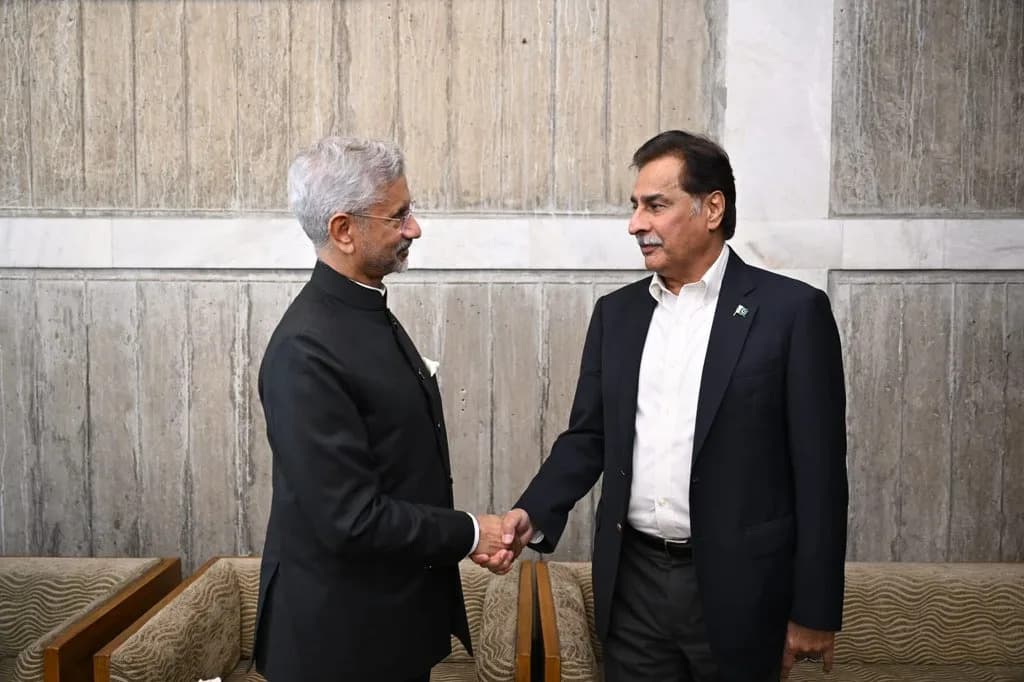
Sardar Ayaz Sadiq, right, speaker of the National Assembly of Pakistan, exchanged greetings with Indian External Affairs Minister S Jaishankar in Dhaka on December 31, 2025, ahead of the funeral of former Bangladesh Prime Minister Khaleda Zia [Handout/Chief Adviser of the Government of Bangladesh Press Wing]
On December 31, 2025, India’s foreign minister, Subrahmanyam Jaishankar, publicly shook hands with Ayaz Sadiq, the speaker of Pakistan’s National Assembly, during events in Dhaka surrounding the funeral of former Bangladesh prime minister Khaleda Zia. The brief exchange — photographed and shared by Pakistani and Bangladeshi officials — stood out against months of high tensions between the two nuclear-armed neighbours.
The Moment
Witnesses say Jaishankar entered a waiting room at Bangladesh’s parliament, greeted delegations from Nepal, Bhutan and the Maldives, and then approached Sadiq. "He walked up to me and said hello, at which I stood up, and he introduced himself and shook hands with a smile," Sadiq recounted. Photographs of the handshake were released by Sadiq’s office and reposted on X by Muhammad Yunus, chief adviser to Bangladesh’s interim government.
Context: Why It Matters
The handshake came after a turbulent 2025 that included a deadly attack in Pahalgam, Indian-administered Kashmir, which killed 26 civilians and led New Delhi to accuse Pakistan of complicity. In early May the two countries engaged in a fierce four-day aerial clash — the most serious direct military confrontation in decades — that ended after a US-mediated de-escalation effort. India subsequently placed the six-decade-old Indus Waters Treaty (IWT) in abeyance, a move Islamabad says threatens Pakistan’s water security.
Mixed Reactions
Reactions were divided. Some Pakistani commentators and analysts welcomed the gesture as a modest sign of restoring diplomatic normalcy. Mustafa Hyder Sayed, an Islamabad-based analyst, described the contact as "the bare minimum" of respectful interaction between officials. Sardar Masood Khan, a former Pakistani ambassador, called it a pleasant diplomatic gesture and suggested it was unlikely to be entirely spontaneous.
In India, commentators were more cautious. Rezaul Hasan Laskar, foreign affairs editor at the Hindustan Times, downplayed the encounter as routine behaviour between senior officials who happened to be in the same room and noted that official Indian releases did not publicise the meeting. He also warned the trust deficit between the two countries remains deep, with little sustained official dialogue since the 2008 Mumbai attacks.
Barriers To A True Thaw
Analysts point to several obstacles to sustained rapprochement: mutual accusations of sponsoring cross-border attacks, the suspension of the IWT, recent missile tests and military exercises, and entrenched political mistrust. Islamabad’s closer ties with the US, China and Middle Eastern states — plus a Pakistan-Saudi defence agreement and Pakistan’s reported role in proposed international stabilisation efforts — further complicate regional dynamics.
What Might Come Next
Experts say practical, limited measures could build confidence: reopening back-channel communications (for example between national security advisers and intelligence officials), agreeing pre-determined incident-management mechanisms to prevent rapid escalation, and exploring confidence-building steps on non-sensitive issues such as humanitarian or technical cooperation.
While the Dhaka handshake is unlikely on its own to resolve deep strategic disputes, it may signal a willingness — however tentative — by officials to show civility in public interactions. Whether that evolves into durable engagement in 2026 will depend on political will, concrete steps to reduce the risk of future clashes, and whether either side is prepared to return to longstanding channels of dialogue.
Key quotes: "Basic normalcy of relations in which respect is accorded to officials and hands are shaken — it is the bare minimum which, unfortunately, was absent after the war between India and Pakistan," said Mustafa Hyder Sayed. Sardar Masood Khan warned: "There are many ifs and buts down the road."
Help us improve.