
Asim Munir, Pakistan’s army chief, rose to international prominence in 2025 after a four-day clash with India and repeated public praise from US President Donald Trump. The May confrontation and subsequent diplomacy helped reopen ties with Washington and expand Pakistan’s regional outreach. Constitutional changes elevated Munir to field marshal and created a powerful Chief of Defence Forces post — moves critics say have concentrated power amid rising domestic violence and political crackdowns.
How Asim Munir Became Donald Trump’s 'Favourite Field Marshal' — Pakistan’s Diplomatic Rise and Domestic Risks

Debris of an Indian aircraft lie in the compound of a mosque at Pampore in the Pulwama district of Indian-administered Kashmir, on Wednesday, May 7, 2025 [Dar Yasin/AP Photo]
Mar-a-Lago provided an unlikely backdrop for a discussion about the fate of Russia’s war in Ukraine. At a December 22 news conference, US President Donald Trump invoked Pakistan’s role in averting a possible nuclear confrontation between Islamabad and New Delhi and repeatedly praised Pakistan’s army chief, General Asim Munir.
Trump’s public praise — he has called Munir “my favourite field marshal,” “a great fighter” and an “exceptional human being” on multiple occasions in 2025 — coincided with a marked shift in Pakistan’s international profile. Analysts and Pakistani officials argue that Munir’s growing stature at home and abroad is the result of a confluence of events and deliberate diplomatic outreach.
May 2025 Clash With India: A Turning Point
The four-day confrontation between India and Pakistan in May 2025 is widely viewed as a decisive moment. Following an April attack in Indian-administered Kashmir that killed 26 civilians, both sides launched air and missile strikes in early May. Intense backchannel diplomacy — with the United States playing a prominent role — helped produce a ceasefire that ended the immediate fighting.
Pakistan used the crisis to advance its strategic interests and to showcase its conventional defenses. The episode boosted Munir’s international profile and created an opening for Islamabad to re-engage with Washington and other global actors.
Institutional Changes and Regional Diplomacy
In the months after the clashes, Munir was elevated to the rank of field marshal — only the second officer in Pakistan’s history to receive that title — and a constitutional amendment established the post of Chief of Defence Forces (CDF), to be held concurrently by the Chief of Army Staff. The change placed the Pakistan Air Force and Navy under his authority.
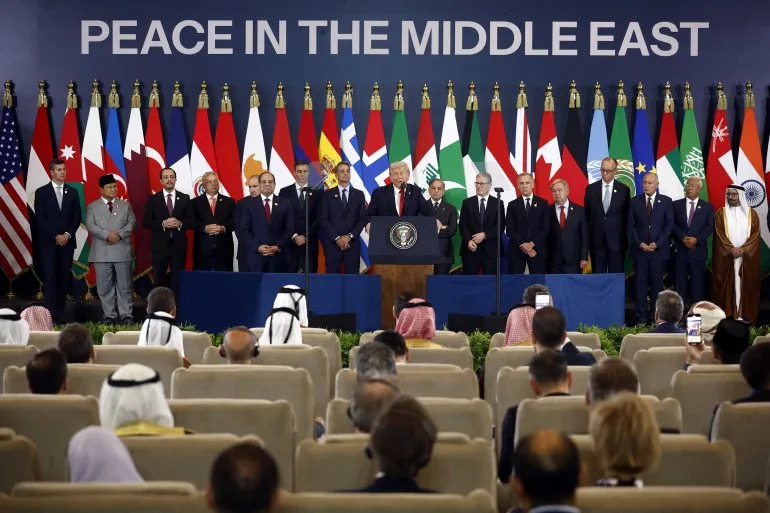
US President Donald Trump speaks during a world leaders’ summit on ending Israel’s war on Gaza, amid a US-brokered prisoner-captive swap and ceasefire deal between Israel and Hamas, in Sharm el-Sheikh, Egypt, October 13, 2025 [Yoan Valat/Pool via Reuters]
At the same time, Pakistan intensified diplomatic outreach across regions: renewing ties with Bangladesh, engaging Central Asian states such as Azerbaijan, Uzbekistan and Turkmenistan, balancing relations across the Middle East, and signing a mutual defence agreement with Saudi Arabia in September. Islamabad also signalled willingness to participate in a US-proposed international stabilisation force for Gaza.
Revived US-Pakistan Ties
Relations with Washington broadened beyond security cooperation to include economic discussions, including talks about crypto mining and critical minerals. US attention to Pakistan increased after Islamabad assisted in the arrest of a suspect linked to the 2021 Abbey Gate bombing in Kabul — a development Washington publicly acknowledged.
Trump repeatedly claimed credit for mediating the May ceasefire and publicly lauded Munir on more than one occasion. Pakistan even nominated Trump for the Nobel Peace Prize following the truce, while India maintained that the ceasefire resulted from bilateral talks.
Domestic Concerns and Criticism
While Pakistan’s diplomatic visibility has risen, critics warn the domestic costs are significant. The 27th constitutional amendment, which created the CDF post and granted expanded powers to the position, drew accusations that it concentrated authority, offered lifetime immunity, and weakened judicial oversight. Opposition parties, human rights groups and international observers also reported an escalation of political crackdowns, restrictions on the media, and rising violence in western provinces bordering Afghanistan.
“Foreign policy success has helped push uncomfortable domestic issues into the background,” said analysts who note that high-profile diplomacy can obscure internal tensions.
Outlook
Supporters argue Munir’s combination of military credentials and active diplomacy has restored Pakistan’s strategic currency, enabling it to engage major powers including the US, China, Iran, Saudi Arabia and Russia simultaneously. Critics counter that these gains risk being undermined by centralised power and weakening democratic institutions. The coming months will test whether Pakistan’s renewed diplomatic relevance can be sustained without further eroding domestic checks and democratic norms.


