
President Trump pursued a "peace through strength" foreign policy in 2025, producing several high‑profile diplomatic outcomes while leaving major issues unresolved. The administration helped broker an Israel‑Hamas ceasefire that released nearly all Oct. 7 hostages, hosted a Nagorno‑Karabakh declaration, advanced a U.S.‑backed 20‑point Ukraine framework, and oversaw the Washington Accords between the DRC and Rwanda. Despite these steps, core disputes — Gaza’s future, implementation in eastern Congo and Nagorno‑Karabakh, and Russia’s demands in Ukraine — remained unsettled, and tensions with Venezuela and Iran continued to pose escalation risks.
Trump’s 2025 'Peace Through Strength': Ceasefires, Summits and Fragile Agreements

U.S. President Donald Trump holds the signed agreement of the first phase of the Gaza ceasefire between Israel and Hamas, in Sharm El-Sheikh, Egypt, Oct. 13, 2025.
Donald Trump began 2025 pledging to end wars and to reshape U.S. foreign policy around a doctrine he called "peace through strength." Throughout the year, the administration framed its diplomacy as focused on achieving stability and reducing large-scale fighting, while emphasizing leverage and pressure as tools to secure agreements.
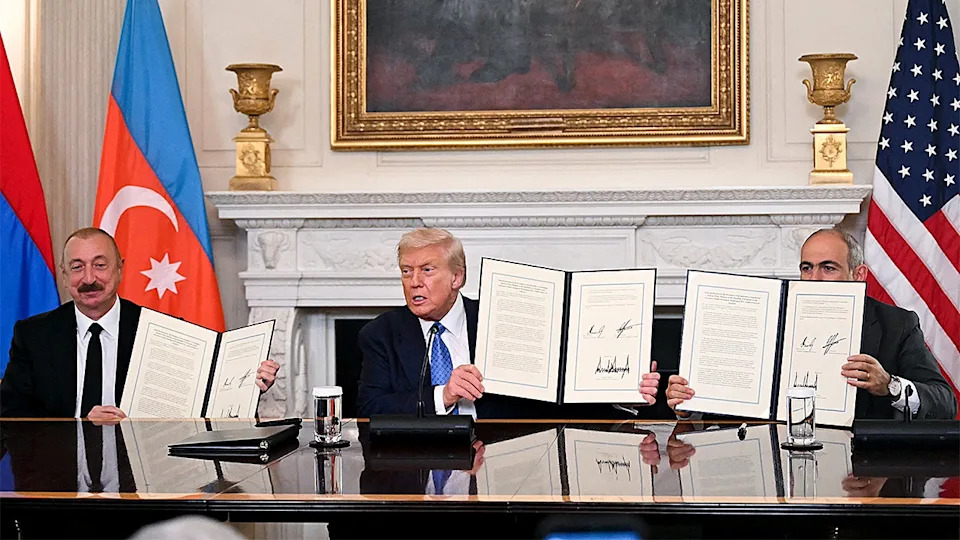
US President Donald Trump (C), Azerbaijani President Ilham Aliyev (L) and Armenian Prime Minister Nikol Pashinyan display the agreement they signed in the State Dining Room of the White House in Washington, DC on Aug. 8, 2025. US President Donald Trump said Friday that Armenia and Azerbaijan were committed to a permanent peace as he hosted a White House summit with the leaders of the two South Caucasus nations, which have fought for decades.
Major Breakthroughs
Israel‑Hamas Ceasefire: In early October the U.S. helped broker a ceasefire framework between Israel and Hamas that halted large-scale combat after months of intense fighting. The truce enabled the release of nearly all hostages taken in Hamas’ Oct. 7 attack on Israel; one remaining case—the body of Ron Gvili—remained held by Hamas operatives. While the ceasefire largely held through the end of the year, core issues such as Gaza’s long‑term governance, demilitarization, enforcement mechanisms and reconstruction were still unresolved.
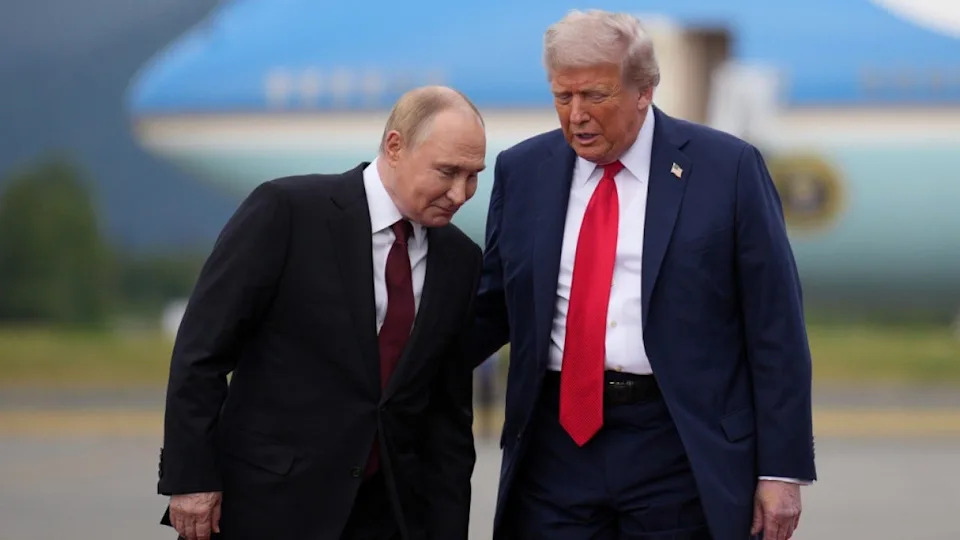
President Donald Trump (R) greets Russian President Vladimir Putin (L) as he arrives at Joint Base Elmendorf-Richardson on Aug. 15, 2025 in Anchorage, Alaska.
Nagorno‑Karabakh Declaration: In August the White House hosted Armenia and Azerbaijan for a U.S.‑brokered peace declaration addressing long‑standing tensions linked to Nagorno‑Karabakh. The pact emphasized reopening transit routes, economic cooperation and regional connectivity. Implementation and deeper reconciliation continued to be a work in progress.

President Donald Trump arrives for a signing ceremony with Rwanda's President Paul Kagame and Democratic Republic of Congo President Felix-Antoine Tshisekedi at the Donald J. Trump Institute of Peace, Thursday, Dec. 4, 2025, in Washington.
The Ukraine Effort
Ukraine remained the most ambitious and elusive target of the administration’s diplomacy. A high‑profile Trump‑Putin meeting in Alaska in August was presented as a test of personal diplomacy. In December, U.S.‑led negotiations advanced: Ukrainian and U.S. officials produced a reported 20‑point framework of security guarantees and related documents. Kyiv described the framework as imperfect but a tangible step; Moscow signaled it viewed the plan as only a starting point and intended to press for significant changes, particularly additional constraints on Ukraine’s military.
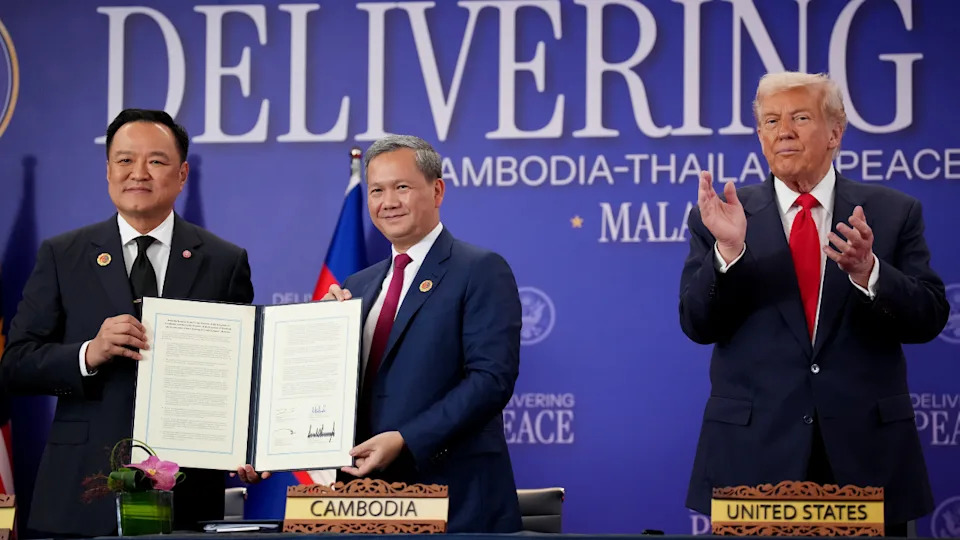
Thai Prime Minister Anutin Charnvirakul and Cambodian Prime Minister Hun Manet shake hands following the signing of a Cambodia-Thailand peace deal as U.S. President Donald Trump reacts at Kuala Lumpur Convention Centre on October 26, 2025 in Kuala Lumpur, Malaysia.
Africa and Regional Deals
Washington Accords (DRC–Rwanda): In early December the U.S. hosted the signing of the Washington Accords for Peace and Prosperity between the Democratic Republic of Congo and Rwanda, which recommitted both governments to ending decades of conflict and expanding economic cooperation. By year’s end, armed groups remained active in eastern Congo, highlighting the accord’s fragility despite political commitments.
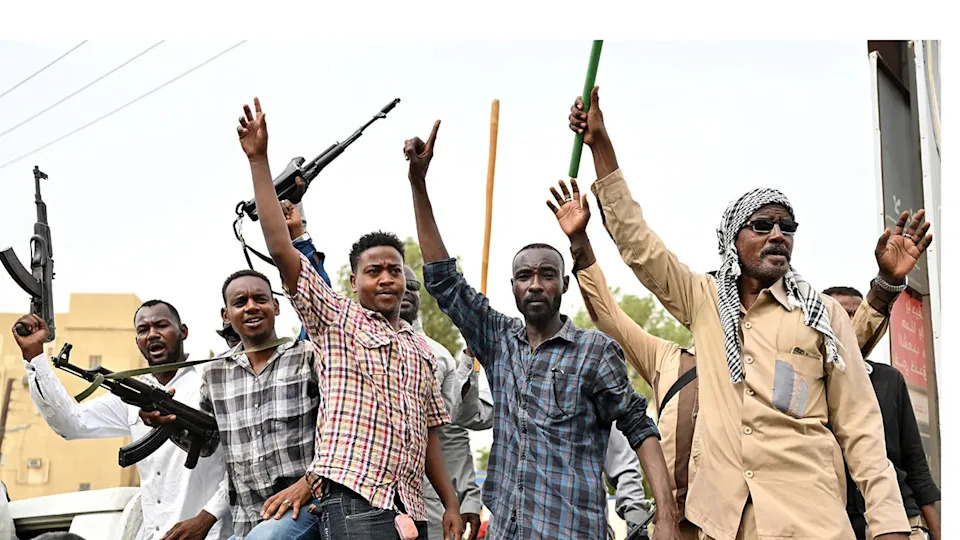
Armed men salute the governor of Sudan's Red Sea State Mustafa Mahmud in Port Sudan in the war-torn country on July 24, 2024. Sudan has been gripped by war since April 2023, when fighting erupted between forces loyal to army chief Abdel Fattah al-Burhan and the RSF led by his former deputy Mohamed Hamdan Daglo. The conflict in the country of 48 million has killed tens of thousands, displaced millions and triggered one of the world's worst humanitarian crises.
Asia, Iran and Other Flashpoints
After a terrorist attack in Kashmir and reciprocal strikes, U.S. officials engaged in emergency diplomacy that helped secure a ceasefire between the two nuclear‑armed rivals and averted immediate escalation. On the margins of an ASEAN summit, U.S. mediation supported a ceasefire between Cambodia and Thailand following months of border clashes, though sporadic fighting and displacement continued to complicate prospects for lasting peace.
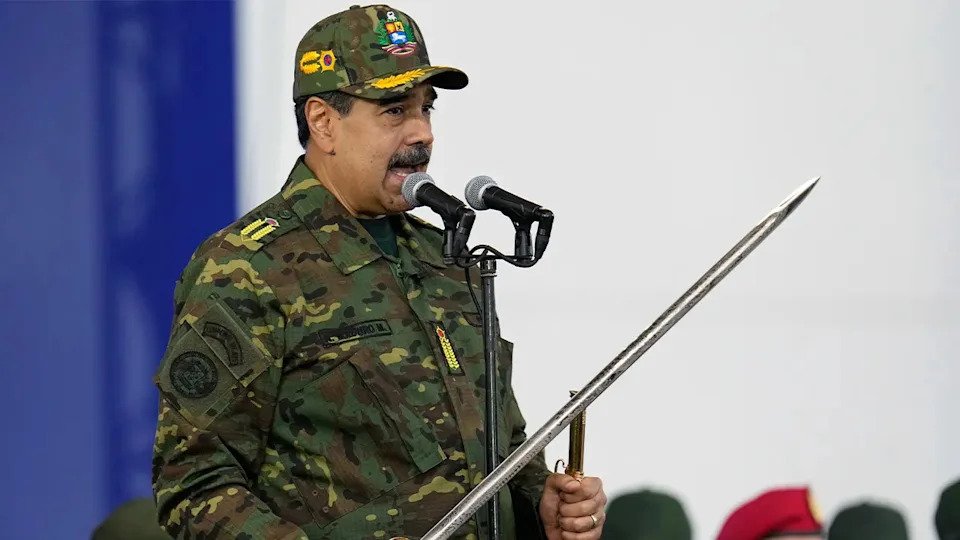
Venezuelan President Nicolas Maduro holds a ceremonial sword said to have belonged to independence hero Simon Bolivar during a government-organized civic-military march in Caracas, Venezuela, Tuesday, Nov. 25, 2025.
Following U.S. and Israeli strikes on Iranian nuclear facilities during the year, the administration prioritized containment and deterrence. No formal diplomatic settlement with Iran emerged, but the confrontation did not expand into a broader regional war by year’s end. Israeli officials warned that Iranian missile drills could mask other provocations, keeping tensions high.
Sudan And Venezuela
Sudan remained one of the world’s deadliest conflict zones. U.S. diplomacy concentrated on halting fighting and expanding humanitarian access rather than brokering a comprehensive peace. In December, Saudi Arabia and the United States presented Sudanese army chief Abdel Fattah al‑Burhan with a three‑point proposal intended to end hostilities, improve aid delivery and transfer power to civilians.
Venezuela emerged as the clearest point of direct confrontation between Washington and Caracas. The administration framed its posture toward President Nicolás Maduro as consistent with "peace through strength," relying primarily on sanctions, stepped‑up pressure on alleged cartel networks linked to the regime and public condemnation rather than direct negotiations. With no formal diplomatic channel open, the U.S. maintained economic and law‑enforcement pressure in hopes of producing political change in 2026.
Outlook
By year’s end the Trump administration could point to several notable diplomatic outcomes—most prominently the Israel‑Hamas ceasefire and a number of regional accords—but many agreements remained fragile and incomplete. Key disputes over governance, security guarantees, enforcement mechanisms and reconstruction persisted, leaving significant work for U.S. diplomats and regional partners in 2026.


