
Reindeer eyes undergo a reversible seasonal color change, shifting from a gold-turquoise reflection in summer to a deep blue in winter. Researchers first reported the phenomenon in 2013 and follow-up studies in 2022 suggest that changes in eye fluid balance and tapetum structure, driven by prolonged pupil dilation in low light, increase reflected blue light. The shift boosts perceived brightness by as much as 1,000 times while reducing image sharpness, and the precise biochemical trigger remains unknown.
Why Reindeer Eyes Turn Deep Blue in Winter — The Science Behind the Seasonal Glow

Reindeer Eyes Do Something Incredible When Winter Comes
Reindeer may not have noses that light up like holiday decorations, but they do possess a striking seasonal adaptation: their eyes change color when the Arctic moves from long summer days to the deep twilight of winter.
Seasonal Color Shift
Scientists first reported in 2013 that the eyes of Arctic reindeer (Rangifer tarandus) shift hue with the seasons, reflecting the changing light of the sky. In summer the tapetum lucidum, a light-reflecting layer behind the retina, produces a gold-to-turquoise shine similar to the greenish reflections seen in cats. In winter the same structure appears deep blue, creating a dramatic change in the animal's eye color.
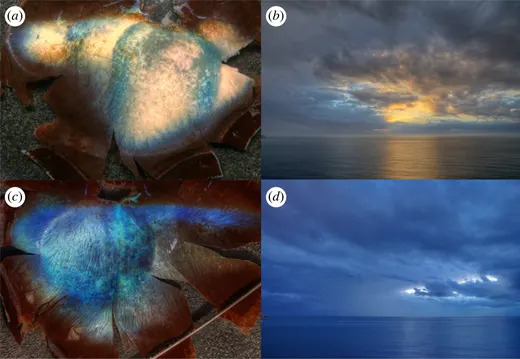
The summer and winter tapetum color compared with environmental light, with the Arctic Sun above and below the horizon. (Fossbury and Jeffery,Proc Biol Sci, 2022)
How The Change Helps Vision
Arctic winters feature prolonged periods of low-angle sunlight and extended twilight, often called the blue hour, which can last for more than a third of each day. To forage and avoid predators in this dim, blue-tinged light, reindeer appear to shift the reflective properties of the tapetum lucidum so that more blue wavelengths are reflected back through the retina. That second pass of light increases the signal reaching photoreceptors, making the scene much brighter at the cost of image sharpness — researchers estimate the effective brightness may increase by up to a thousandfold while resolution declines, similar to looking through misted glass.
What Researchers Have Found
Ophthalmologist Robert Fosbury and colleagues reported in 2022 studies comparing eyes from reindeer that died in summer with those from winter. Their work supports a hypothesis that prolonged pupil dilation in low light alters fluid balance inside the eye and may change the microscopic structure of the tapetum. Fosbury used a practical analogy: during icy conditions you sometimes reduce tire pressure for better traction; reindeer may alter fluid volume in the tapetum to improve vision in winter.
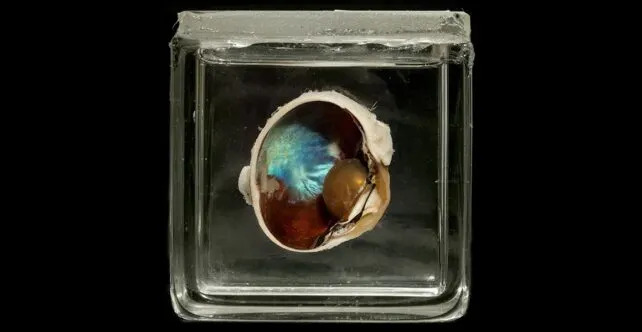
This reindeer eyeball has been sliced in half, revealing an iridescent blue layer. (UK's Natural History Museum)
The precise biochemical trigger is unknown, and the seasonal change must be reversible since eyes return to their summer hue as light conditions change.
Outstanding Questions
Scientists have not yet examined the exact same individual eyes across seasons, so the detailed mechanism remains uncertain. Future work that samples reindeer through autumn and spring could reveal how quickly and by what molecular pathways the tapetum transforms. It is also possible that other low-light mammals have evolved comparable seasonal adjustments, but so far the Arctic reindeer remains the clearest example.
Why This Matters
This seasonal eye adaptation illustrates how animals can tune sensory systems to extreme environments. Understanding the mechanism could shed light on basic principles of ocular physiology and adaptive responses to prolonged changes in natural light.


