
Summary: In 2025 US–Venezuela tensions surged after a US military buildup in the Caribbean, repeated strikes on vessels accused of drug smuggling and a $50 million US reward for President Nicolás Maduro. Venezuela — holder of the world’s largest extra‑heavy oil reserves and significant gas resources — has pivoted trade toward China, Russia and other partners amid sanctions and shrinking oil output compared with pre‑1999 levels. Domestic political continuity under Maduro, large migration flows and uncertain military readiness leave the region exposed to potential escalation and humanitarian strain.
US–Venezuela Rift Deepens in 2025: Oil, Migration and Military Pressure Shape a Volatile Standoff

Venezuela's President Nicolás Maduro participates in his inauguration ceremony in Caracas, Venezuela, on January 10. - Juan Barreto/AFP/Getty Images
In 2025, long‑standing tensions between Washington and Caracas accelerated into one of the most dangerous confrontations in recent Latin American history. A US military buildup in the Caribbean, repeated strikes on vessels suspected of drug trafficking, and a $50 million US reward for information leading to the arrest of President Nicolás Maduro have intensified a dispute rooted in politics, oil and shifting global alliances.
Snapshot: Geography, Population and Migration
Official name: Bolivarian Republic of Venezuela.
Geography: Venezuela covers about 912,050 km² (352,144 sq mi), bordered by the Caribbean Sea and Atlantic to the north, Colombia to the west, Brazil to the south and Guyana to the east.
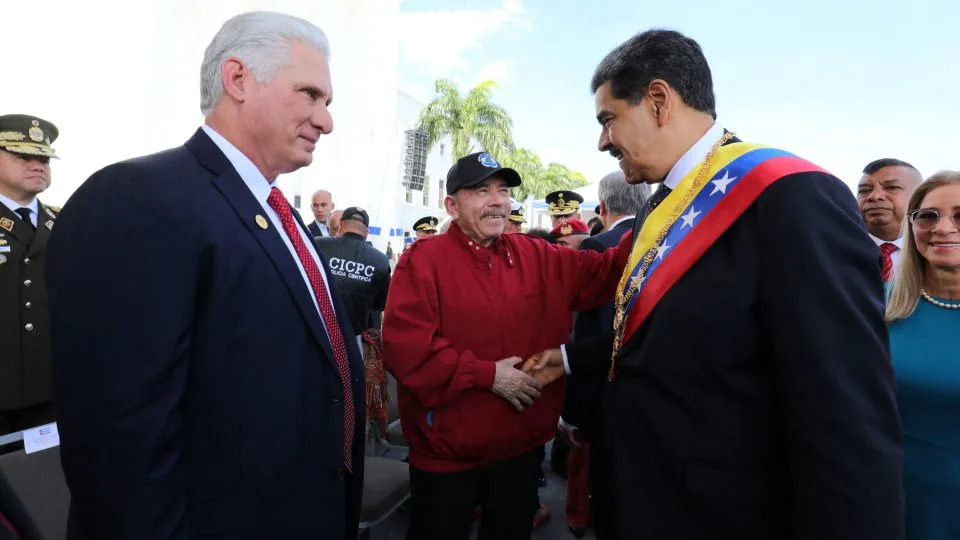
Venezuelan President Nicolás Maduro shakes hands with Nicaraguan President Daniel Ortega as Cuban President Miguel Díaz-Canel looks on on the day of Maduro's inauguration for a third six-year term in Caracas, Venezuela, on January 10. - Zurimar Campos/Miraflores Palace/Reuters
Population: The National Institute of Statistics estimated 33,800,393 people at the end of 2023, projecting roughly 34.4 million by the end of 2025.
Migration: The United Nations estimates at least 7.9 million Venezuelans have left the country seeking safety or better living conditions, concentrating primarily in Colombia, Peru and Chile.
Economy And Natural Resources
Oil remains Venezuela’s dominant economic sector. The country holds the world’s largest reserves of extra‑heavy crude, which require more complex refining but are compatible with some US refineries. According to OPEC, crude exports rose in 2025 to an average of more than 900,000 barrels per day — up from recent lows but still far below pre‑1999 levels (roughly 3.5 million b/d).
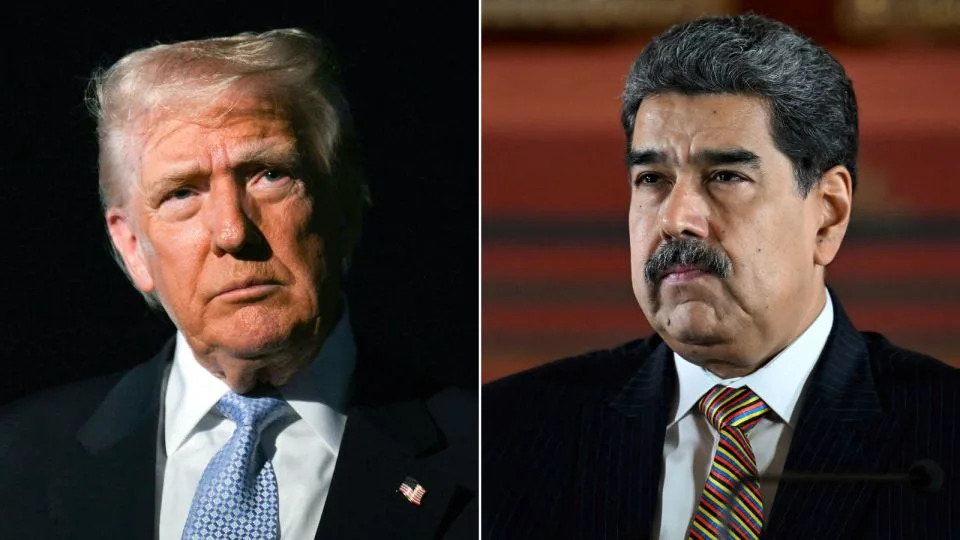
US President Donald Trump and Venezuelan President Nicolás Maduro. - Getty Images
The US Energy Information Administration (EIA) estimates Venezuela’s natural gas reserves at about 5.5 trillion cubic meters, roughly 73% of South America’s total. Facing sustained shortfalls in oil revenue, Caracas has also promoted mining in the Orinoco Mining Arc — a zone rich in gold, coltan, iron and bauxite — but the sector remains largely artisanal and linked to criminal networks and smuggling.
Trade patterns shifted after mid‑2024 US sanctions tightened: Washington was the largest buyer until 2023, but Caracas has since leaned more on China, Russia, India and Turkey. Russian and Chinese officials have reported substantial year‑on‑year growth in bilateral trade with Venezuela in 2024.
Alliances And Diplomacy
Since the turn of the century Venezuela has cultivated alliances with states that challenge US influence. Regionally, its closest partners include Cuba and Nicaragua. Outside the hemisphere, Caracas has deepened ties with China, Russia and Iran, while maintaining smaller Caribbean relationships established during past oil booms. Analysts caution that while these partners provide diplomatic and economic support, direct military intervention by them in a US–Venezuela clash remains unlikely.
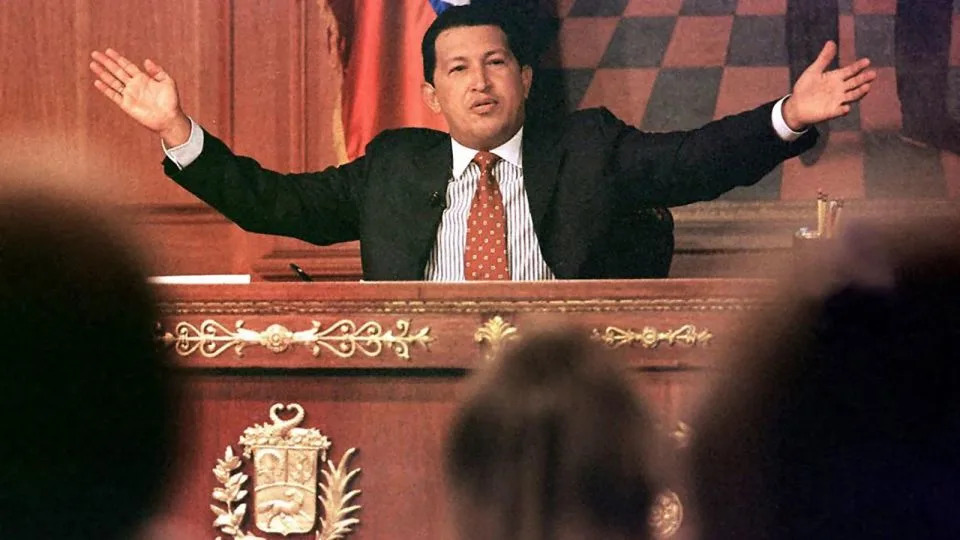
Venezuelan President Hugo Chavez speaks of the necessity of a world balance of power during a press conference in Caracas on August 17, 2000. - Juan Barreto/AFP/Getty Images
Domestic Politics And Power Structure
The political forces that shaped the Chavista project remain influential. Nicolás Maduro — in power since Hugo Chávez’s death in 2013 — was sworn in on January 10, 2025, after a contested July 2024 election that the opposition and several regional governments disputed. Prominent figures from the Chávez era, such as Diosdado Cabello and Jorge Rodríguez, continue to hold key roles in the ruling party and state institutions.
2025: Escalating Confrontation With The United States
Tensions escalated throughout 2025 under US President Donald Trump’s “maximum pressure” approach. Measures included expanded sanctions, large bounties for narcotics‑related charges, aggressive maritime interdictions, and a visible US naval and air presence in the Caribbean officially aimed at disrupting drug trafficking.
US forces struck dozens of vessels in the Caribbean and eastern Pacific; by mid‑December reports indicated at least 30 boats had been destroyed and more than 100 people killed. The US also Ordered a “total blockade” on sanctioned oil tankers and stepped up Coast Guard interceptions of ships linked to Venezuelan trade. Sources reported a December CIA drone strike on a Venezuelan coastal facility allegedly used by the Tren de Aragua criminal gang; Caracas has not publicly confirmed the strike.
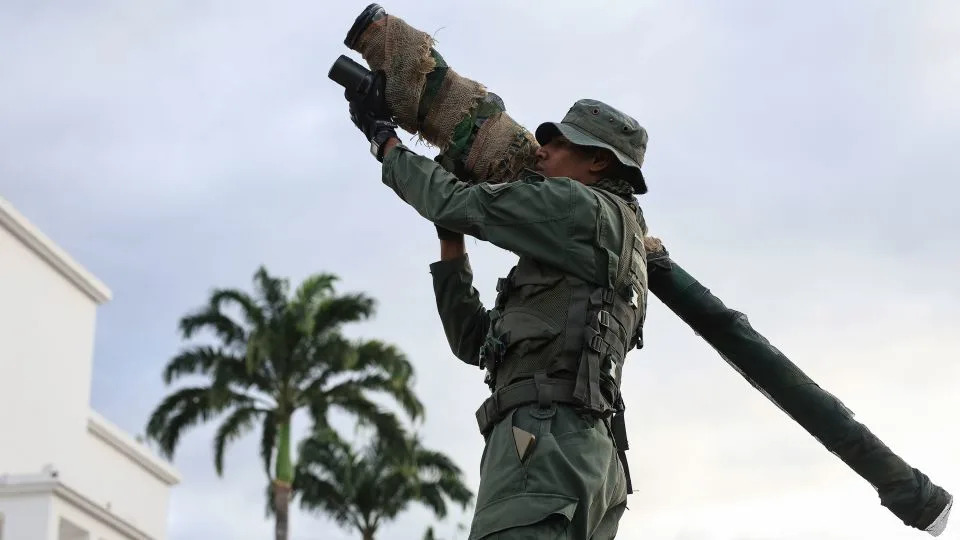
A member of the Bolivarian National Armed Forces (FANB) holds an "Igla-S" rocket launcher during a military ceremony commemorating the 200th anniversary of the presentation of the 'Sword of Peru' to Venezuelan independence hero Simón Bolívar on November 25 in Caracas. - Jesus Vargas/Getty Images
Diplomatic flashpoints included the March deportation of over 200 Venezuelan migrants to a detention center in El Salvador — an action Caracas called a “kidnapping” — and a July agreement that led to their return and the release of 10 Americans held in Venezuela. In July and August the US Treasury accused Maduro of directing the so‑called Cartel de los Soles and raised a $50 million reward for information leading to his arrest or conviction on US narcotics charges; Maduro has denied the accusations.
Military Capabilities And Readiness
Under Chávez, the Bolivarian National Armed Forces (FANB) acquired significant Russian equipment. Public estimates put active personnel at roughly 123,000 with about 8,000 reservists, though readiness, logistics and maintenance remain concerns after years of economic difficulty.
Major acquisitions include T‑72 tanks, BMP‑3 infantry fighting vehicles, Russian artillery (Msta‑S and Smerch), and a fleet of Sukhoi Su‑30 fighters. Venezuela fields multiple Russian air‑defence systems — S‑300 batteries, Buk and Pechora systems — and man‑portable Igla‑S missiles. The navy operates a limited blue‑water force, including a Mariscal Sucre–class frigate and a Type 209 submarine, but overall naval modernization lags behind other branches.
Analysts highlight uncertainty around actual operational status: some aircraft and systems may be limited by spare‑parts shortages, maintenance gaps and training shortfalls. Irregular militias and paramilitary groups also complicate Venezuela’s security landscape; Maduro has claimed militia rolls could rise substantially in response to perceived external threats.
Risks And Outlook
The standoff poses multiple regional risks: further militarization of the Caribbean, unintended civilian casualties from interdiction campaigns, refugee flows, and diplomatic ruptures between Washington and neighboring capitals concerned about sovereignty and escalation. While economic ties with China and Russia provide Caracas with alternatives to US markets, Venezuela’s recovery depends on investment, institutional reforms and progress on governance — all of which remain uncertain in the near term.
Bottom line: The 2025 escalation between the US and Venezuela centers on narcotics interdiction, sanctions and oil geopolitics, but the conflict’s broader implications touch migration, regional stability and the balance of external influence in Latin America.


