
NIST's U.S. time standard, UTC(NIST), slowed by about 4.8 microseconds after a Colorado windstorm and related utility actions led to a backup generator failing to preserve measurement and distribution connections. The physical atomic clocks continued running on battery power, but data links that establish official time were disrupted. Although imperceptible to the public, the brief error could affect highly time-sensitive systems such as GPS and telecommunications; power has been restored and technicians corrected the timing deviation.
Colorado Windstorm Briefly Slowed U.S. Official Time by 4.8 Microseconds

blue blurred clock
Last Wednesday a severe windstorm in Colorado indirectly disrupted the National Institute of Standards and Technology's (NIST) time-distribution systems in Boulder, producing a brief slowdown of the United States' official time standard, UTC(NIST).
What Happened
Hurricane-force winds toppled trees and damaged electrical infrastructure, prompting the region’s largest energy provider to carry out precautionary power shutdowns. At the NIST Boulder facility this cascade of events coincided with a backup generator failure that interrupted the lab’s measurement and distribution connections. As a result, UTC(NIST) slowed by about 4.8 microseconds.
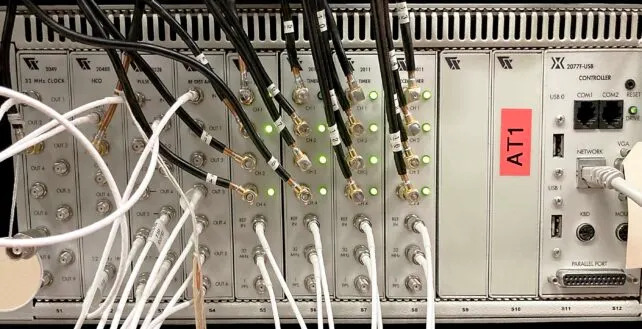
Photograph of an MCMS chassis with 16 clock measurement channels. The chassis contains an embedded industrial computer, four measurement modules that each implement four-channel dual-mixer time difference (DMTD) measurement systems, and various distribution amplifiers. (NIST)
Why The Delay Mattered
That interval is vanishingly small on human timescales — a blink of an eye takes roughly 572,000 microseconds — so the change had no practical effect on everyday schedules. However, NIST warned the blip could matter for ultra-sensitive systems such as telecommunications networks, GPS timing, certain financial systems, and other pieces of critical infrastructure that rely on precise timing.
“All of the atomic clocks continued ticking through the power outage last week thanks to their battery backup systems,” said NIST supervisory research physicist Jeff Sherman to NPR. “What failed was the connection between some of the clocks and NIST's measurement and distribution systems.”
How NIST Keeps Time
NIST maintains more than 20 atomic clocks at the Boulder laboratory — primarily hydrogen masers together with several cesium beam clocks — and typically uses about 10–15 of them to establish UTC(NIST) at any one time. These clocks are continuously monitored by primary and backup multi-channel measurement systems (MCMS) that detect minute frequency changes.

Subscribe to ScienceAlert's free fact-checked newsletter
Measurements from the MCMS are fed into algorithms and supporting systems that combine the inputs to produce the official U.S. time. It was the interruption of those measurement and distribution links, not the clocks themselves, that produced the short timing error.
Current Status
Power has been restored at the NIST facility, and technicians have corrected the timing deviation. NIST continues to monitor clock health and distribution links to prevent similar disruptions from affecting time dissemination in the future.
Why It’s Important: Even microsecond-scale timing errors can cascade into problems for systems that require extreme synchronization, so the incident highlights how localized weather and power events can ripple into national and international technical infrastructure.


