
The Biden administration? No — the Trump administration has proposed breaking up NCAR in Boulder, a premier atmospheric research center. Scientists and state officials call the move political retaliation tied to Gov. Jared Polis and warn it would weaken U.S. weather and climate forecasting, including wildfire and military forecasts. NCAR provides supercomputing, aircraft, and models used by universities, utilities and federal agencies; its loss could imperil public safety and national scientific capacity.
White House Plan To Break Up NCAR Seen As Political Retaliation — Scientists Warn U.S. Weather Forecasting Could Suffer

The Trump administration has repeatedly sidelined federal scientists and dismantled long-standing research institutions, turning political grievances into attacks on scientific norms.
The White House announced plans to dismantle the National Center for Atmospheric Research (NCAR) in Boulder, Colorado — a move scientists and state officials say looks like political retaliation tied to President Donald Trump’s dispute with Gov. Jared Polis. The announcement came shortly after the administration canceled $109 million in federal environmental and safety grants to Colorado and followed an Oval Office remark in which Trump called Polis a “weak and pathetic man.”
Why Scientists Are Alarmed
NCAR, founded in 1960 and administered by the National Science Foundation (NSF), is a cornerstone of U.S. and global atmospheric research. It provides supercomputing, heavily instrumented research aircraft, Earth‑system models, and specialized instruments — including the dropsonde used by hurricane hunter aircraft — to 129 North American university partners. Researchers say NCAR’s work underpins wildfire, flood and storm forecasting, supports military operations such as modeling for Fort Greely’s anti‑ballistic systems, and enables real‑time forecasts that utilities and emergency managers rely on.
“Shutting NCAR would be a major setback for the entire community and would have impacts for decades to come,” said Kevin Trenberth, a NCAR‑affiliated distinguished scholar.
Climate scientist Katharine Hayhoe described NCAR as “quite literally our global mothership,” and Antonio Busalacchi, president of the University Corporation for Atmospheric Research (UCAR), called it “truly an international treasure.” UCAR employs roughly 1,450 people, about 830 of whom work at NCAR.
Politics Or Policy?
Russell Vought, director of the White House Office of Management and Budget, announced via X that NCAR would be eliminated, linking the move rhetorically to a desire to shrink government and remove what he labeled sources of “climate alarmism.” The language echoes elements of Project 2025, a conservative policy blueprint that Vought helped write. His post did not provide operational details about how or where NCAR functions would be relocated.
The announcement arrived amid other campus‑ and state‑level impacts: Colorado officials reported cancellations of multiple grants — including $66 million for a northern Colorado rail‑safety project and two $11.7 million awards for vehicle electrification and rail fuel research. Gov. Polis said Colorado had not received formal notice from the administration and warned that the reported cuts would put public safety at risk and harm scientific work that saves lives and property.
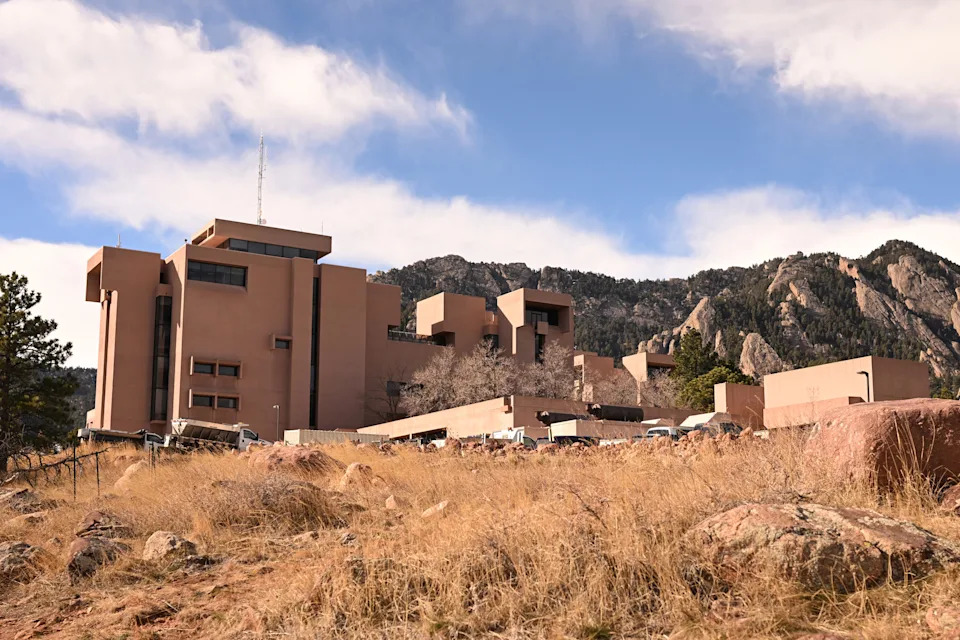
The National Center for Atmospheric Research in Boulder, Colorado, on December 17, 2025.
Science, Infrastructure And Public Safety
Researchers stress that weather and climate science are interlinked and that NCAR’s centralized computing and modeling infrastructure makes expensive, complex work possible for hundreds or thousands of scientists nationwide. Daniel Swain, an extreme‑weather researcher who partners with NCAR, noted that many of his university projects depend on NCAR’s computing resources and that decentralizing those capabilities would be costly and inefficient.
Critics pointed to an immediate example of NCAR’s value: Boulder was under extreme wildfire risk when the dismantling news circulated, and local utility Xcel Energy had cut power preemptively — a decision informed in part by forecasting and modeling that institutions like NCAR support. Swain said such forecasts likely helped utilities take preventive action that reduced the risk of fires starting from fallen branches or damaged power lines.
Funding, Economic Impact And Next Steps
NCAR received about $123 million from the NSF in the last fiscal year — roughly half of its budget — and also draws funding from the Department of Defense, other federal agencies, states, and private partners. NCAR and the UCAR‑managed complex are part of more than 30 federally funded labs and institutions in Colorado that together have an estimated $2.6 billion annual economic impact for the state, according to the University of Colorado’s Leeds School of Business.
Members of Colorado’s congressional delegation vowed to fight the plan. Rep. Joe Neguse called the proposal “deeply dangerous & blatantly retaliatory” and said he would use “every legal tool we have” to oppose it. UCAR leadership said they had received no formal communication from Washington aside from Vought’s social media post; reporting has cited varying sources including officials and internal documents.
As details remain unclear — including where NCAR’s critical functions would be moved and how continuity would be ensured — scientists and state leaders warn that dismantling the center risks degrading U.S. forecasting capabilities at a time when extreme weather is increasing in frequency and severity.


