
The spread of Christianity in the Nile River Valley led to a noticeable shift in Nubian tattoo practices by the 7th century A.D. Researchers examined 1,048 remains (350 B.C.–1400 A.D.) and found tattoos on 27 individuals — mostly children — concentrated at Kulubnarti. Tattoos there were often facial, featuring geometric dot-and-dash motifs likely applied with quick techniques, and may be early precursors to Christian forehead markings still seen today. Some markings may also have served medicinal purposes, for conditions such as headaches or fevers.
How Christianity Reshaped Nubian Tattoo Traditions — New Evidence from Kulubnarti

Tattooing on individual M-046, a 17 to 21-y-old female from the Meroitic period. Credit: From Austin, A., et al. Proceedings of the National Academy of Sciences (2025).
For at least 5,000 years, tattoos have served as markers of identity, life experience and even therapeutic practice. Archaeologists have documented tattooed human remains at more than 50 sites worldwide — from ancient Peru to China — and in the Nile River Valley of northeastern Africa, the long-time homeland of Nubian peoples.
A recent international study led by researchers in the United States and the United Kingdom used advanced imaging techniques that reveal markings invisible to the naked eye to trace how the spread of Christianity in the Nile Valley altered local tattooing traditions by the seventh century A.D.
Large Survey Spanning More Than a Millennium
The team examined 1,048 human remains dated between 350 B.C. and 1400 A.D., recovered from three archaeological sites in northern present-day Sudan. One site in particular, Kulubnarti, produced unusually well-preserved skin in Christian-era burials — mostly dated to 650–1000 A.D. — which allowed the researchers to study tattoo practices in greater detail. Kulubnarti, near today’s Egyptian border, functioned as a genetic and cultural crossroads.
Who Was Tattooed and Where
Researchers identified tattoos on 27 individuals, the majority of whom were children under 11 and were buried at Kulubnarti. More than one in five people from that site showed tattoos. The marks were predominantly located on the forehead, cheeks or temples and consisted of dot-and-short-dash arrangements that frequently formed diamonds or squares.
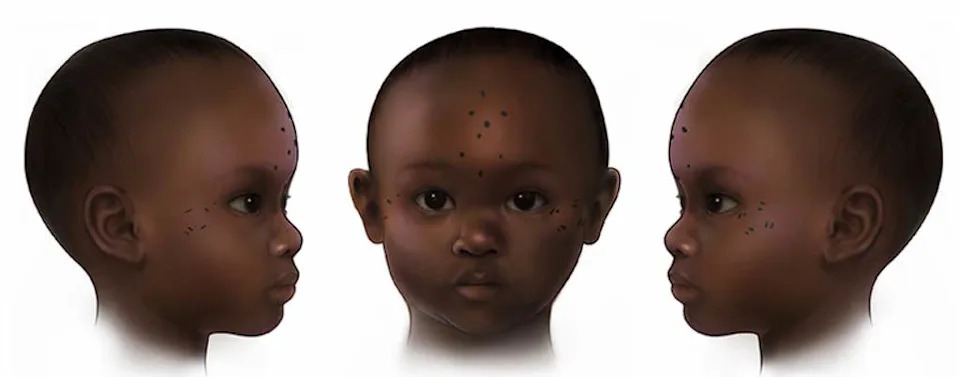
ANCIENT INK:A reconstruction of markings found on the forehead of a 3-year-old female from the Kulubnarti site that date back to around 657 to 855 A.D.From Austin, A.,et al. Proceedings of the National Academy of Sciences(2025).
Technique and Style Shifts Linked to Christianity
The study suggests these facial motifs may have been made with single punctures from a knife rather than many needle punctures used in earlier pre-Christian practices. In the pre-Christian period, dotted diamond motifs on the body and crisscrossed patterns on the hands seem to have been common. With the arrival of Christianity, tattooing shifted toward highly visible facial locations and to tools and techniques that could be executed quickly — a practical adaptation when many recipients were very young children who were difficult to keep still.
"The remarkable skin preservation at Kulubnarti allows a more detailed determination of the significance and ubiquity of tattoo practices," the authors write in Proceedings of the National Academy of Sciences.
Religious and Medicinal Meanings
The Kulubnarti facial decorations may represent some of the earliest antecedents of Christian tattoo traditions still practiced today in parts of Ethiopia, Sudan and Egypt, where cross tattoos on the forehead often mark believers permanently as Christians. The researchers also consider therapeutic uses for some marks: given their placement on the head and prevalence among young children, some tattoos may have been intended to treat headaches or high fevers — symptoms consistent with malaria, a disease long present in the region.
Twentieth-century ethnographic records from North Africa further document medicinal applications of tattooing, supporting the possibility that tattoos served multiple social, religious and therapeutic roles.
Why This Matters
The authors urge archaeologists and museum curators to apply appropriate imaging methods more widely because ancient tattoos can be easy to miss. This team was the first to identify these specific markings at Kulubnarti, and the study suggests additional millennia-old evidence may remain unseen in excavation sites and collections.
Lead image: From Austin, A., et al., Proceedings of the National Academy of Sciences (2025).


