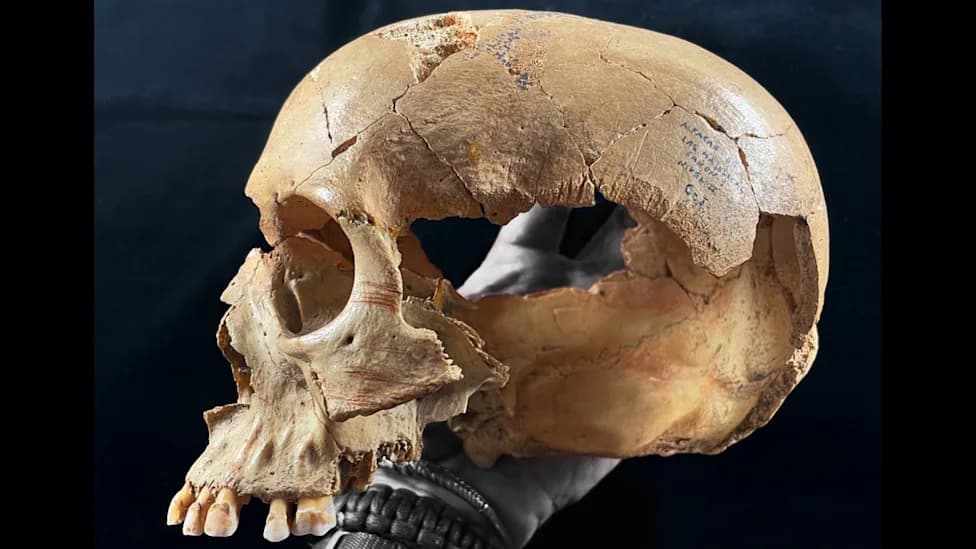
Archaeologists at Balcón de Montezuma in Tamaulipas, Mexico, uncovered a rare cube‑shaped skull produced by artificial cranial deformation. Isotope analyses of bone and tooth samples indicate the individual was local — born, raised, and died in the region — ruling out direct migration from southern groups like El Zapotal. This is the first recorded instance of intentional cranial shaping at the site and represents a previously undocumented regional variant. Motivations for cranial shaping varied historically and health effects remain debated.
Archaeologists Uncover Rare Cube‑Shaped Skull at Balcón de Montezuma

Archaeologists Discovered a Cube-Shaped SkullPaul Campbell - Getty Images
Archaeologists working at the Balcón de Montezuma archaeological complex in Tamaulipas, Mexico, have reported a highly unusual find: a skull altered by artificial cranial deformation into a parallelepiped — a cube‑like shape. The discovery, announced by the Instituto Nacional de Antropología e Historia (INAH), is the first recorded example of intentional skull shaping at this site and represents a variant not previously documented in the region.
What Was Found
The site of Balcón de Montezuma was occupied by different communities between about 650 B.C.E. and 1200 C.E.; one occupation phase around 400 C.E. included roughly 90 houses. During excavation and laboratory analysis of human remains and artifacts, researchers identified a skull whose shape appears to result from deliberate infant head binding that produced a parallelepiped, or cube‑like, vault.
Local Origin Confirmed by Isotope Analysis
To test whether the individual might have come from groups farther south — where similar deformations have been reported, such as at El Zapotal in Veracruz — researchers conducted stable isotope analyses on bone and tooth samples. "Stable oxygen isotope studies in collagen and bioapatite samples from bone and teeth indicate that he was born, lived, and died in this part of the mountains," biological anthropologist Jesús Ernesto Velasco González said in a translated press statement. These results argue against direct migration from southern groups as the explanation for the cranial style.
“Not only was intentional cranial deformation identified for the first time for this type of site, but also a variant with respect to the models recognized in Mesoamerica, not reported, until now, in the area.”
— Jesús Ernesto Velasco González, Biological Anthropologist (translated)
Context and Significance
Artificial cranial deformation is a culturally widespread, historically documented practice found across many parts of the world. Well‑known examples include the Huns in Central Asia, the Hirota people of ancient Japan, the Maya in Mesoamerica, and even late‑19th‑century peasants in Toulouse, France. Some contemporary practices persist in places such as the Democratic Republic of the Congo and Vanuatu.
Most forms of cranial shaping create elongated or conical skull shapes by applying head binding during infancy while the cranial bones are still fusing (typically up to about two years of age). Cube‑like or parallelepiped skulls are rare, and this example expands the known regional variability of the technique and its social expressions.
Why People Shaped Skulls
The motives behind cranial deformation were diverse: it could signal social status or group identity, mark rites of passage or religious beliefs, or reflect local aesthetic preferences. The health impacts remain debated. The prevailing view is that cranial deformation alters skull shape without significantly reducing cranial volume, and thus long‑term physical effects are often considered limited. However, some studies have suggested there may be possible effects on cognition or memory, and these questions require further multidisciplinary research.
What This Means: The Balcón de Montezuma find documents a previously unreported local variant of artificial cranial deformation and underscores the cultural complexity of prehistoric Mesoamerican communities. Ongoing analysis may reveal more about the social role and frequency of this practice at the site.
Help us improve.