
The Full Moon occurs when Earth lies nearly between the Sun and Moon, fully illuminating the Moon’s near side. This article presents the 2025 Full Moon calendar with dates, Eastern times and traditional names, highlights three Super Moons (Oct. 6, Nov. 5, Dec. 4), and provides mid-December daily sky details for 40° N, 90° W. It also explains common lunar terms (Super Moon, Blue Moon, Black Moon, Harvest Moon), the difference between Full and New Moons, and how lunar alignment affects tides. Verify times for your location with an almanac or astronomy app before observing.
2025 Full Moon Calendar: Dates, Times, Names and What to See in the Sky

Note: Moon phases in the calendar vary in size due to the distance from Earth and are shown at 0h Universal Time. Credit: Astronomy: Roen Kelly
The Full Moon occurs when Earth lies nearly directly between the Sun and the Moon, so the lunar hemisphere facing us is fully illuminated. As the Moon orbits Earth, the angle of sunlight striking and reflecting from its surface changes, producing the familiar sequence of lunar phases.
Note on timing: All times below are Eastern unless otherwise specified. The article originally included a few conflicting timestamps; the calendar below follows the Full Moon list provided in the main schedule. Verify times for your location with a reliable astronomical almanac or planetarium app before planning observations.
2025 Full Moon Dates (All Times Eastern)
Below is the complete list of Full Moons for 2025 with their traditional names. An asterisk (*) marks Full Moons identified as Super Moons in the original calendar.
- Monday, Jan. 13 — 5:27 p.m. — Wolf Moon
- Wednesday, Feb. 12 — 8:53 a.m. — Snow Moon
- Friday, March 14 — 2:55 a.m. — Worm Moon
- Saturday, April 12 — 8:22 p.m. — Pink Moon
- Monday, May 12 — 12:56 p.m. — Flower Moon
- Wednesday, June 11 — 3:44 a.m. — Strawberry Moon
- Thursday, July 10 — 4:37 p.m. — Buck Moon
- Saturday, Aug. 9 — 3:55 a.m. — Sturgeon Moon
- Sunday, Sept. 7 — 2:09 p.m. — Corn Moon
- Monday, Oct. 6 — 11:48 p.m. — Hunter’s Moon *
- Wednesday, Nov. 5 — 8:19 a.m. — Beaver Moon *
- Thursday, Dec. 4 — 6:14 p.m. — Cold Moon *
Mid-December Sky Notes (Location: 40° N, 90° W — local times)
The schedule below lists sunrise, sunset, moonrise, moonset and moon illumination for a central U.S. location (40° N, 90° W); illumination percentages are given for 10:00 P.M. local time unless otherwise noted.
Friday, December 12
Sunrise: 7:13 A.M. Sunset: 4:35 P.M.
Moonrise: 12:12 A.M. Moonset: 12:28 P.M.
Moon Phase: Waning crescent (37%)
Saturday, December 13
Sunrise: 7:14 A.M. Sunset: 4:35 P.M.
Moonrise: 1:14 A.M. Moonset: 12:48 P.M.
Moon Phase: Waning crescent (28%)
Sunday, December 14
Sunrise: 7:14 A.M. Sunset: 4:35 P.M.
Moonrise: 2:14 A.M. Moonset: 1:10 P.M.
Moon Phase: Waning crescent (20%)
Monday, December 15
Sunrise: 7:15 A.M. Sunset: 4:36 P.M.
Moonrise: 3:16 A.M. Moonset: 1:33 P.M.
Moon Phase: Waning crescent (13%)
Tuesday, December 16
Sunrise: 7:16 A.M. Sunset: 4:36 P.M.
Moonrise: 4:17 A.M. Moonset: 2:01 P.M.
Moon Phase: Waning crescent (8%)
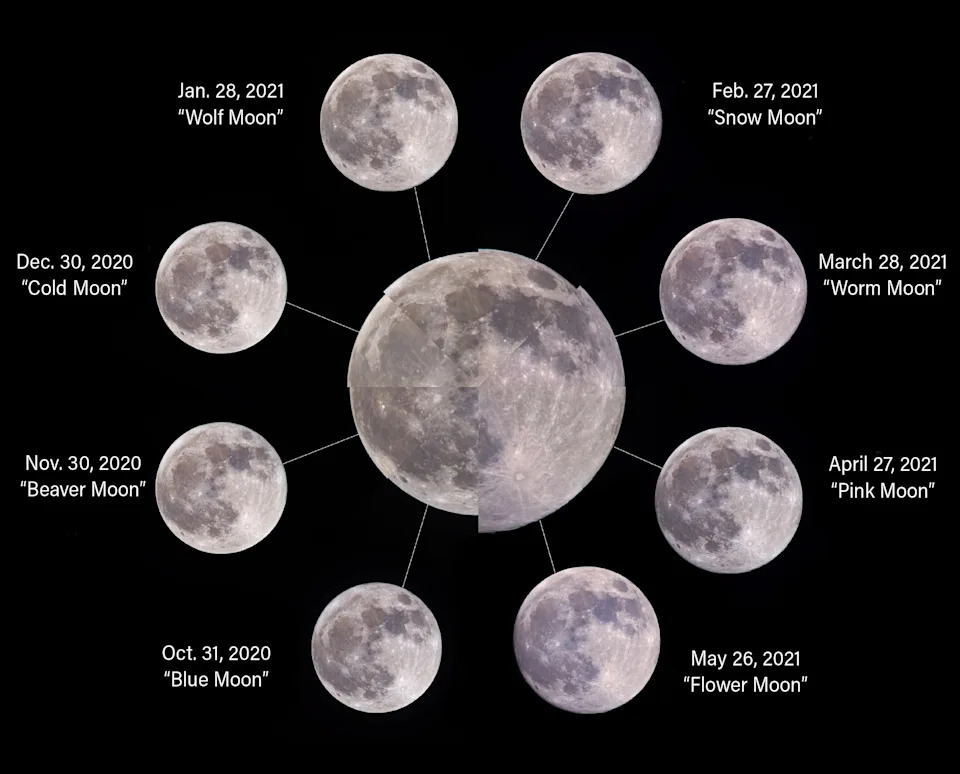
A composite of each month’s Full Moon in 2020 and 2021. Credit: Soumyadeep Mukherjee
Wednesday, December 17
At 1:09 A.M. EST the Moon reaches apogee, its farthest orbital point from Earth, at about 252,477 miles (406,322 km).
Predawn observers can catch a narrow waning crescent Moon near bright Mercury in the southeast. Around 6:45 A.M. local time the pair stands roughly 10° apart and about 9° above the horizon. The Moon will appear as a ~6% illuminated crescent in southeast Libra, and Mercury (magnitude ~–0.5) will be low in the southeast near the claws of Scorpius. Through a small telescope Mercury may appear ~6" across and ~82% illuminated. Antares rises near 6:30 A.M., a few degrees lower-right of Mercury.
Sunrise: 7:14 A.M. Sunset: 4:35 P.M.
Moonrise: 2:14 A.M. Moonset: 1:10 P.M.
Moon Phase: Waning crescent (3%)
Thursday, December 18
The Moon passes about 6° south of Mercury at ~7:00 A.M. EST and then roughly 0.4° south of Antares at ~8:00 A.M. EST. The crescent will be very thin (~1–2% illuminated) and is best seen with binoculars or a small telescope; earthshine may reveal the darkened lunar disk.
Sunrise: 7:17 A.M. Sunset: 4:37 P.M.
Moonrise: 6:21 A.M. Moonset: 3:14 P.M.
Moon Phase: Waning crescent (1%)
Friday, December 19
A New Moon occurs at 8:43 P.M. EST.
Sunrise: 7:18 A.M. Sunset: 4:37 P.M.
Moonrise: 7:19 A.M. Moonset: 4:01 P.M.
Moon Phase: New
Common Moon Terms and What They Mean
- Super Moon: A Full Moon that occurs near lunar perigee (the Moon’s closest approach to Earth), appearing slightly larger and brighter than average. The original calendar flagged Oct. 6, Nov. 5 and Dec. 4 as Super Moons.
- Blue Moon: The second Full Moon in a single calendar month. This happens roughly every 2.7 years; the Moon is not actually blue except under rare atmospheric conditions.
- Black Moon: An informal term that can mean either the second New Moon in a month or the third of four New Moons in an astronomical season. It denotes an additional New Moon, when the Moon is not visible from Earth.
- Harvest Moon: The Full Moon nearest the autumnal equinox, often providing extended moonlit hours that historically aided fall harvests.
Full Moon vs. New Moon and Tides
A Full Moon occurs when Earth is approximately between the Sun and Moon, lighting the Moon’s near side. A New Moon happens when the Moon lies between Earth and the Sun, leaving the near side in darkness. During New and Full Moons the Sun, Earth and Moon are roughly aligned, producing stronger-than-usual "spring tides" — higher high tides and lower low tides — due to the combined gravitational pull of the Sun and Moon.
All Lunar Phases in 2025
The original article included a complete set of phase dates for 2025 (New Moon, First Quarter, Full Moon, Last Quarter). Please verify these with an almanac or astronomy software for precise timing in your time zone before planning observations.
Final note: We will refresh this calendar with updated moonrise, moonset and Full Moon times and highlight notable sky events. For the most accurate local times, use a trusted astronomical resource or app and enter your exact location.


