
The Full Moon happens when Earth sits between the Sun and the Moon, lighting the Moon’s near side. This article lists every Full Moon in 2025 with Eastern times and traditional names; three are Super Moons (Oct. 6, Nov. 5, Dec. 4). The next Full Moon is the Wolf Moon at 5:03 a.m. EST on Jan. 3, 2026 — a Super Moon. December highlights include a Dec. 4 Full Moon and a Dec. 10 close pass/occultation of Regulus visible from parts of Greenland and northern Canada.
2025 Full Moon Calendar: Dates, Names, Super Moons and What To Watch This Year
12:39 AM, 12/11/2025

Note: Moon phases in the calendar vary in size due to the distance from Earth and are shown at 0h Universal Time. Credit: Astronomy: Roen Kelly
The Full Moon occurs when Earth lies nearly exactly between the Sun and the Moon, allowing the Sun to fully illuminate the lunar hemisphere facing us. Because the Moon orbits Earth, the angle of sunlight changes and produces the familiar sequence of lunar phases.
Next Full Moon: The Wolf Moon will occur at 5:03 a.m. EST on Saturday, Jan. 3, 2026. That appearance is also a Super Moon.
Full Moons of 2025 (All times Eastern)
- Monday, Jan. 13 — 5:27 p.m. — Wolf Moon
- Wednesday, Feb. 12 — 8:53 a.m. — Snow Moon
- Friday, March 14 — 2:55 a.m. — Worm Moon
- Saturday, April 12 — 8:22 p.m. — Pink Moon
- Monday, May 12 — 12:56 p.m. — Flower Moon
- Wednesday, June 11 — 3:44 a.m. — Strawberry Moon
- Thursday, July 10 — 4:37 p.m. — Buck Moon
- Saturday, Aug. 9 — 3:55 a.m. — Sturgeon Moon
- Sunday, Sept. 7 — 2:09 p.m. — Corn Moon
- Monday, Oct. 6 — 11:48 p.m. — Hunter’s Moon* (Super Moon)
- Wednesday, Nov. 5 — 8:19 a.m. — Beaver Moon* (Super Moon)
- Thursday, Dec. 4 — 6:14 p.m. — Cold Moon* (Super Moon)
December Highlights
Dec. 4, 2025: Full Moon (Cold Moon) — pictured in the accompanying December phase images.
Dec. 10, 2025: At 2:00 a.m. EST the Moon passes about 0.7° north of Regulus. Observers in Greenland and northern Canada may see the Moon occult (pass in front of) Regulus; elsewhere the two will appear very close together in Leo. On some U.S. West Coast locations the pair will be low on the horizon during the pass.
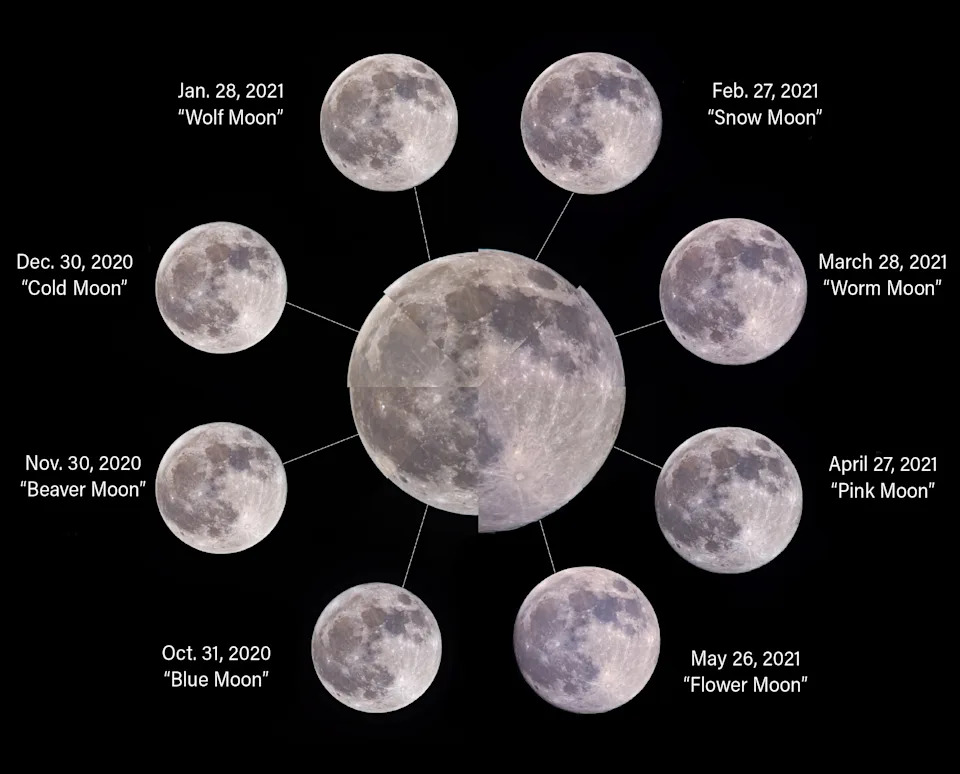
A composite of each month’s Full Moon in 2020 and 2021. Credit: Soumyadeep Mukherjee
Reference Times: Sunrise, sunset, moonrise and moonset times included in the original table use local time for 40° N, 90° W. Moon illumination percentages are given for 10:00 p.m. local time at that location. For accurate viewing, always check local moonrise/moonset times for your exact location.
Understanding Lunar Phases
The lunar cycle moves through: New Moon → Waxing Crescent → First Quarter → Waxing Gibbous → Full Moon → Waning Gibbous → Last Quarter → Waning Crescent. One synodic month (the time from one Full Moon to the next) is about 29.5 days. While the exact instant of a Full Moon is a single moment of alignment, the Moon appears essentially full for roughly three days to the casual observer.
Traditional Full Moon Names
- Wolf Moon (Jan.): Named for the howls of hungry wolves.
- Snow Moon (Feb.): For heavy winter snowfall in many regions.
- Worm Moon (March): Marks earthworms appearing as the ground thaws.
- Pink Moon (April): Honors pink wildflowers that bloom in spring.
- Flower Moon (May): Celebrates widespread blooming.
- Strawberry Moon (June): Signifies peak strawberry harvest.
- Buck Moon (July): Refers to bucks growing new antlers.
- Sturgeon Moon (Aug.): Named for abundant sturgeon fish season.
- Corn Moon (Sept.): Tied to corn-harvest time.
- Hunter’s Moon (Oct.): Linked to hunting season before winter.
- Beaver Moon (Nov.): When beavers prepare for winter.
- Cold Moon (Dec.): Evokes the chill of winter.
Special Moon Terms
- Super Moon: A Full Moon occurring near lunar perigee (the Moon's closest approach to Earth), making it appear slightly larger and brighter. A common threshold is within roughly 90% of its closest distance.
- Blue Moon: The second Full Moon in a calendar month that contains two Full Moons (about every 2.7 years). The term doesn't imply the Moon is actually blue.
- Black Moon: An informal term for either the third of four New Moons in a season or the second New Moon in a month. It refers to an unobservable New Moon.
- Harvest Moon: The Full Moon nearest the autumnal equinox, which often rises shortly after sunset and provides extended evening light useful historically for harvesting.
Full Moon vs. New Moon and Tides
At Full Moon, Earth lies between the Sun and Moon so the Moon’s face is fully lit. At New Moon, the Moon is between Earth and Sun and its near side is dark. When the Sun, Earth and Moon align at Full and New Moon, their combined gravity causes stronger "spring tides," which produce higher high tides and lower low tides.
2025 Lunar Phases (New / First Quarter / Full / Last Quarter)
Jan. 6 / Jan. 13 / Jan. 21 / Jan. 29
Feb. 5 / Feb. 12 / Feb. 20 / Feb. 27
March 6 / March 14 / March 22 / March 29
April 4 / April 12 / April 20 / April 27
May 4 / May 12 / May 20 / May 26
June 2 / June 11 / June 18 / June 25
July 2 / July 10 / July 17 / July 24
Aug. 1 / Aug. 9 / Aug. 16 / Aug. 23
Aug. 31 / Sept. 7 / Sept. 14 / Sept. 21
Sept. 29 / Oct. 6 / Oct. 13 / Oct. 21
Oct. 29 / Nov. 5 / Nov. 12 / Nov. 20
Nov. 28 / Dec. 4 / Dec. 11 / Dec. 19
Dec. 27
Use this calendar to plan your skywatching. For week-by-week observing tips and accurate local rise/set times, consult current sky-event guides and local astronomy resources.
Similar Articles

2025 Full Moon Calendar — Dates, Traditional Names and When to Watch (Super Moons Highlighted)
The Full Moon occurs when Earth is positioned between the Sun and the Moon, fully illuminating the Moon’s near side. This gui...

2025 Full Moon Calendar: Dates, Traditional Names, Phases and What To Watch
The Full Moon occurs when Earth nearly aligns between the Sun and Moon, fully illuminating the lunar near side. This article ...

Cold Moon Supermoon Rises Dec. 4, 2025 — When and How to See It
The Cold Moon — the December full moon — will rise on Dec. 4, 2025 at 6:14 p.m. It is part of a series of supermoons; a super...

Cold Moon Supermoon Rises Dec. 4, 2025 — When and How to See It
The December full moon, known as the Cold Moon , will rise on Dec. 4, 2025, at 6:14 p.m. and is classified as a supermoon. Su...

December 2025 'Cold Moon' Is a Supermoon — When and How to See It (Dec. 4, 2025)
The December full moon — the Cold Moon — rises on Dec. 4, 2025, at 6:14 p.m., and will be a supermoon, making it appear large...

December 'Cold Moon' Peaks Dec. 4 — See 2025's Final Supermoon
The December full moon — the Cold Moon — reaches peak illumination on Thursday, Dec. 4 at 6:14 p.m. ET and is the third and f...

When to See the Cold Moon — Final Supermoon of 2025 Peaks Dec. 4
Cold Moon (final supermoon of 2025) peaks on Dec. 4 at 6:14 p.m. local time and should appear slightly larger and brighter th...

Cold Moon Peaks Dec. 4 — Catch the Final Supermoon of 2025
The December full moon, called the cold moon , will peak on Thursday, Dec. 4 at 6:14 p.m. ET and is the third and final super...

Don't Miss the 'Cold Moon' Supermoon — Dec. 4 (Peaks ~6:15 p.m. local)
The final full moon of 2025 — the Cold Moon — falls on Dec. 4 and will peak near 6:15 p.m. local time in Binghamton. It is th...

Don't Miss the Cold Moon — December's Last Supermoon of 2025 (Dec. 4)
The Cold Moon — December's full moon — will be a supermoon on Dec. 4, reaching perigee at about 221,808 miles and peaking in ...

December 2025 Cold Supermoon and Geminids: When to Watch the Night Sky
The December 2025 full moon — known as the cold moon — is a supermoon peaking on Dec. 4 at 6:14 p.m. ET , appearing larger be...

2026 Skywatching Guide: Full Moons, Supermoons, Eclipses and Meteor Showers
2026 offers a packed celestial calendar: 13 full moons (including a blue moon on May 31), three supermoons, four eclipses (an...

December's 'Cold' Supermoon Rises Dec. 4 — Geminids Peak Dec. 13–14
December's full moon — the cold or long night moon — will be a supermoon on Dec. 4, 2025 , with peak illumination at 6:14 p.m...

Moon Tonight — Nov. 30: Waxing Gibbous (74% Illuminated) — What to Look For
The Moon is a Waxing Gibbous on Nov. 30, about 74% illuminated . Naked-eye observers can spot Mare Vaporum, Mare Crisium and ...

Tonight: December 2025 Cold Supermoon Rises as the Geminid Meteor Shower Begins
The December 2025 full moon — the "cold" or "long night" moon — will appear larger because it’s a supermoon, coming to about ...