Japanese astrophysicist Tomonori Totani reports an extended, halo‑like pattern of gamma rays near the Milky Way’s center that could match predictions for dark matter annihilation. The signal, detected with NASA’s Fermi Gamma‑ray Space Telescope, is faint — about one‑millionth the brightness of the galaxy — and appears diffuse rather than coming from a compact source. Independent scientists urge caution, noting the Galactic center is difficult to model and other sources (pulsars, black holes) can mimic the signal. Further analysis and independent confirmation are needed to determine whether this is direct evidence of dark matter.
Possible First Direct Signal of Dark Matter? Researcher Detects Gamma‑Ray Halo at Milky Way Center

Dark matter remains one of astronomy’s deepest mysteries: an invisible form of matter that does not emit, absorb or reflect light but appears to dominate the mass of galaxies through its gravitational effects. Nearly a century after the concept was first proposed, a Japanese astrophysicist reports a halo of gamma-ray emission near the center of the Milky Way that he suggests could be the first direct signal of dark matter.
What was reported
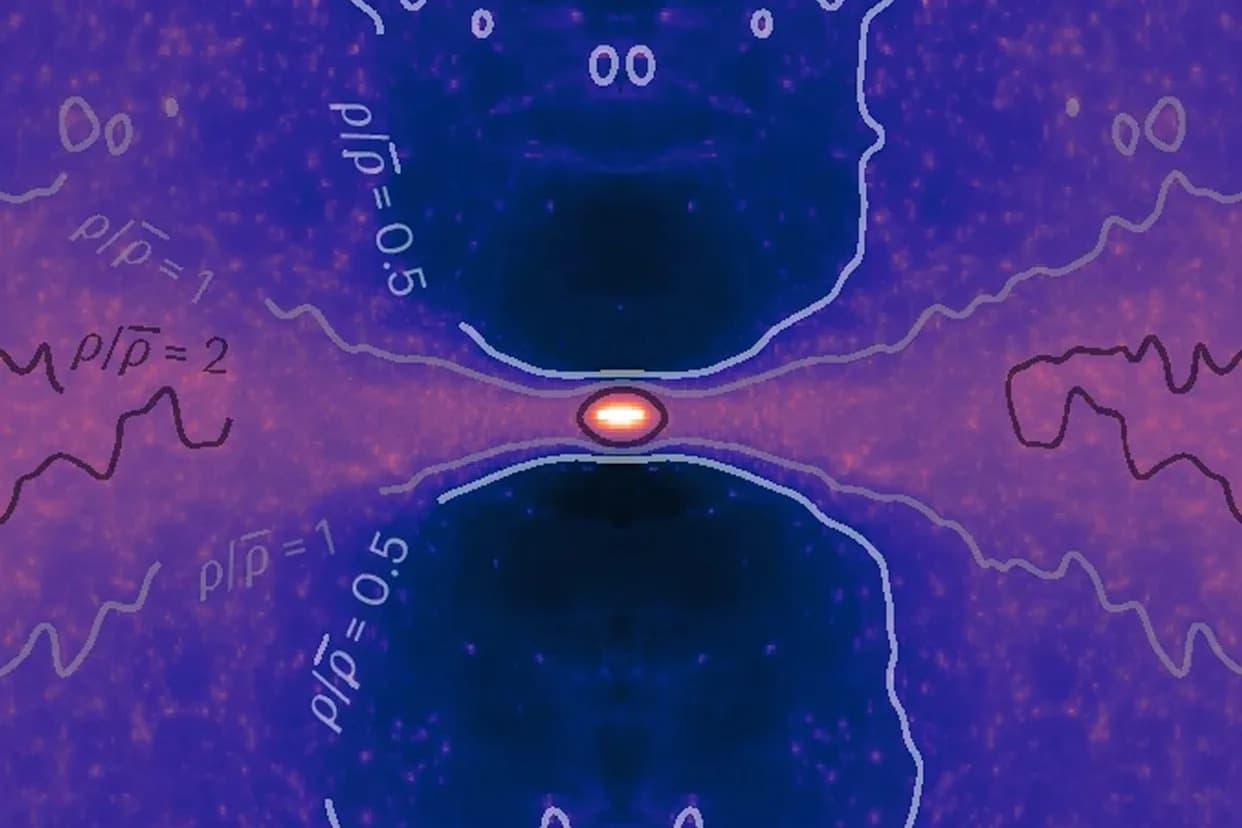
Tomonori Totani, a professor in the astronomy department at the University of Tokyo, analyzed observations from NASA's Fermi Gamma‑ray Space Telescope and found an extended, roughly spherical region of gamma-ray emission centered near the Galactic center. The emission is faint — roughly one‑millionth the brightness of the entire Milky Way — but appears spread in a halo‑like pattern rather than concentrated in a single compact source.
Why this could matter
One prominent dark matter model proposes the existence of weakly interacting massive particles (WIMPs). If two WIMPs annihilate, they could release energetic gamma rays. A diffuse, symmetric gamma‑ray halo could be consistent with such annihilation across a dark matter distribution, rather than radiation from a single astrophysical object like a black hole or a star.
"I'm so excited, of course! Although the research began with the aim of detecting dark matter, I thought the chances of success were like winning the lottery," Totani said.
Scientific caution and alternative explanations
Independent researchers have praised the analysis as interesting but urged caution. Gamma rays are produced by many astrophysical processes, and the Galactic center is a particularly complex region to model.
"We don’t even know all the things that can produce gamma rays in the universe," said David Kaplan, professor of physics and astronomy at Johns Hopkins University, noting that millisecond pulsars, accreting black holes and other energetic phenomena can mimic similar signals.
"There’s a lot of details we don’t understand," said Eric Charles of SLAC National Accelerator Laboratory. "Seeing a lot of gamma rays from a large part of the sky associated with the galaxy — it’s just really hard to interpret what’s going on there."
Dillon Brout of Boston University added that the region near the Galactic center is "genuinely the hardest to model," and that extraordinary claims require extraordinary evidence.
Context and next steps
The idea of unseen mass dates back to the 1930s, when Fritz Zwicky inferred missing mass from galaxy motions in the Coma Cluster. Since then, dark matter has been invoked to explain galaxy formation and large‑scale structure. Direct detection — confirming particle properties or observing annihilation signals beyond doubt — remains a major goal of astrophysics and particle physics.
Totani’s findings were published in the Journal of Cosmology and Astroparticle Physics. He and other researchers emphasize that further analysis and independent replication are essential. Additional observations, improved modeling of the Galactic center, and cross‑checks with different instruments or wavelengths will be required to determine whether the gamma‑ray halo truly originates from dark matter or from more mundane astrophysical sources.
Bottom line: The reported gamma‑ray halo is an intriguing candidate signal for dark matter annihilation, but the complexity of the Galactic center and the variety of gamma‑ray sources mean the claim must be tested carefully before it can be accepted.
Help us improve.