
The Election Commission of India’s Special Intensive Revision (SIR), launched on November 4, has coincided with at least 33 deaths among booth-level officers (BLOs), including several suicides and sudden medical collapses. BLOs — largely government teachers — report crushing targets, poor training, server failures and pressure from supervisors. The exercise removed millions of names in states such as Bihar and West Bengal, sparking political controversy and legal petitions. Families and watchdogs are demanding accountability, compensation and better protections for poll staff.
India’s New Crisis: Poll Workers’ Deaths Amid Rushed Voter-List Revision

A photo of Vijay Kumar Verma, a booth-level officer who died of a brain haemorrhage, at his home near Lucknow, Uttar Pradesh [Sumaiya Ali/Al Jazeera]
India’s nationwide voter-list update — the Election Commission’s Special Intensive Revision (SIR) — has coincided with a string of deaths among booth-level officers (BLOs), prompting alarm from families, opposition parties and election watchdogs. Reports identify long hours, high targets, limited training and technical obstacles as key pressures on predominantly teacher-turned-BLOs tasked with door-to-door enumeration and online data uploads.
What Happened
The SIR, launched on November 4 in 12 states and centrally administered territories, aims to add eligible voters and remove ineligible or duplicate entries through house-to-house verification. BLO duties include verifying households, identifying current and deceased voters, collecting photos and documents, and uploading records to a designated portal.
Human Toll
According to a report by the Spect Foundation, at least 33 BLOs have died nationwide since the SIR began, including at least nine who took their own lives. Several other BLOs suffered fatal medical collapses while working late at night. Individual cases cited in media reports include:
- Vijay Kumar Verma (50), a contractual teacher in Lucknow, who collapsed while completing SIR work and later died of a brain haemorrhage.
- Sarvesh Singh (46) of Moradabad, Uttar Pradesh, who died by suicide and left a note and a final video citing extreme pressure and lack of sleep.
- Anuj Garg (44) in Dholpur, Rajasthan, who collapsed at his laptop and died of cardiac arrest after weeks of exhausting work and warning notices from supervisors.
- Rinku Tarafdar and other BLOs in West Bengal who blamed SIR workload and administrative threats in suicide notes.
Working Conditions and Complaints
BLOs — many of them government schoolteachers or junior officials — describe relentless targets, late-night data uploads due to unreliable servers, public exposure of their contact numbers, and minimal training. Several told reporters they received only a two- to three-hour briefing and were expected to collect and upload thousands of records within tight deadlines. In some districts, supervisors sent repeated messages pressuring BLOs to meet numerical targets with warnings of administrative consequences.
Political Fallout
The SIR has also produced political controversy. In Bihar the roll revision removed about 4.7 million names; in West Bengal a draft list deleted roughly 5.8 million entries. Opposition parties and some community groups have alleged disproportionate removals in certain regions — for example, higher-than-average deletions in Muslim-majority Seemanchal — and accused the commission of rushing the exercise amid elections. The Election Commission and government ministers have denied politicisation and defended the SIR.
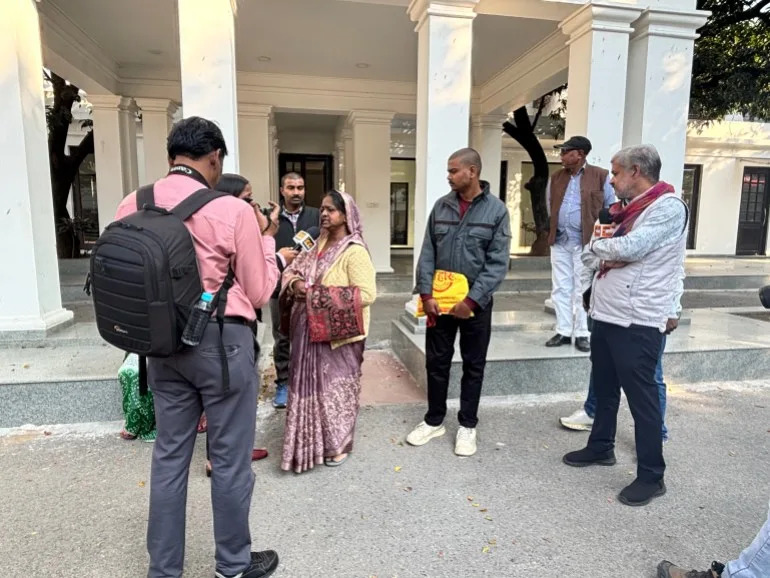
Sangeeta Rawat, the wife of Vijay Kumar Verma, talks to reporters in Lucknow after her husband’s death while he was working on the SIR [Sumaiya Ali/Al Jazeera]
ECI Response And Support Measures
The Election Commission has called the deaths unfortunate but rejected claims that SIR workloads caused the fatalities. It recently increased BLO pay to 1,000 rupees per assignment (roughly $11) and announced a 6,000-rupee incentive (roughly $66) upon completion of an election cycle. Critics say these steps and a short relief video posted by the ECI were inadequate and sometimes tone-deaf given the scale of distress.
Legal Challenges And Families’ Demands
Petitions have been filed in multiple courts by opposition politicians, families of victims and the Association for Democratic Reforms. Bereaved families are seeking compensation and jobs in some cases, and many report they have received little meaningful government support beyond condolences.
“We want the money we spent on our father’s untimely death, and a government job for me. Are we asking for a lot?” — Harshit Verma, son of a deceased BLO.
Deadlines And Rollout
After initial rollout in 12 states, the SIR is being extended and phased into remaining states. Deadlines in Uttar Pradesh were extended twice (most recently to December 26). The timeline has varied by state, with some exercises concluding in mid-December and others still underway.
Helplines
If you or someone you know is at risk of suicide, please seek help immediately. In India: Sumaitri (New Delhi) +91-11-23389090; Sneha Foundation (Chennai) +91-44-24640050.
The SIR has highlighted tensions between the operational demands of a vast democratic exercise and the welfare of the temporary workforce charged with executing it. Families, civil-society groups and courts will be central to how the crisis and accountability questions evolve in the coming weeks.


