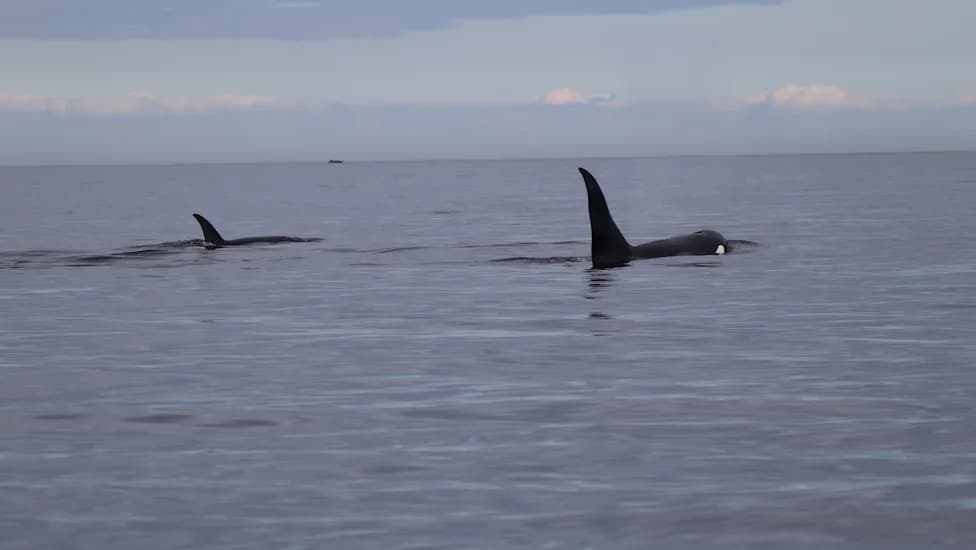
Researchers recorded Bigg's orcas (T36s, T137s and T99B) stalking and harassing common loons, surf scoters and a rhinoceros auklet in shallow Murden Cove near Bainbridge Island. Drone footage shows whales kicking up mud and one individual sneaking up on birds. Observers believe the interactions are play or hunting practice rather than feeding, and past research suggests juveniles use such behavior to develop skills for catching larger prey like harbor seals.
Orcas Harass Seabirds in Puget Sound — Playful Practice or Predation?

Researchers conducting fieldwork in November recorded Bigg's orcas stalking and harassing seabirds in shallow water off Bainbridge Island, Puget Sound. The animals were identified as members of pods T36s and T137s together with T99B, and the encounters occurred in Murden Cove.
Drone footage shows a trio of whales kicking up mud with their flukes in very shallow water while another whale broke away to approach an unsuspecting group of birds. Reported targets included common loons, surf scoters and at least one rhinoceros auklet.
Observers say the whales did not appear to be consuming the birds. Instead, the interactions look like play or hunting practice that could help juveniles refine techniques for capturing larger, more elusive prey. One witness described a pod chasing, tail-slapping and repeatedly pouncing on a rhinoceros auklet for roughly 30 minutes. Another observer reported an orca attempting to punt a bird while a companion spy-hopped to watch where the bird landed; spy-hopping is when an orca rises partly out of the water to view the surface.
Context and significance
Scientists have documented similar behavior before. In their 1999 book Transients, John Ford and Graeme Ellis noted that interactions with seabirds often serve as play or harassment rather than routine feeding, and that juveniles likely learn valuable prey-capture and handling skills from these encounters.
Seabirds are frequently used as objects of play or practice, helping young orcas learn handling techniques that may improve their success when hunting seals and other challenging prey.
These observations add to our understanding of Bigg's orca behavior and social learning. While dramatic, the bird-chasing episodes appear to be one of several ways young orcas develop the coordination and tactics they will need for larger prey.
Help us improve.