Rapid VLT follow‑up captured the first light from supernova SN 2024ggi, allowing astronomers to measure the explosion’s early geometry for the first time. Spectropolarimetry with the FORS2 instrument showed the breakout shock was elongated along a single axis — "olive‑shaped" rather than spherical. By day 10, the hydrogen envelope aligned with the same axis, implying a persistent directional mechanism. The study was published in Science Advances on Nov. 12, 2025.
First Map of a Supernova’s Early Shape Reveals an Olive‑Shaped, Asymmetric Blast

An international team of astronomers has, for the first time, measured the three‑dimensional imprint of a supernova during its earliest moments — and the blast was not a perfect sphere. Rapid follow‑up observations with the European Southern Observatory’s Very Large Telescope (VLT) captured the first light from SN 2024ggi, revealing an elongated, "olive‑shaped" shock that points to an intrinsically asymmetric explosion.
ATLAS (the Asteroid Terrestrial‑impact Last Alert System) detected the initial flash from the explosion on April 10, 2024. Because the window to observe the very first light is extremely brief, astronomers reacted quickly: just 26 hours later, on April 11, 2024, they trained the VLT on the event in the galaxy NGC 3621, about 22 million light‑years away in the constellation Hydra.
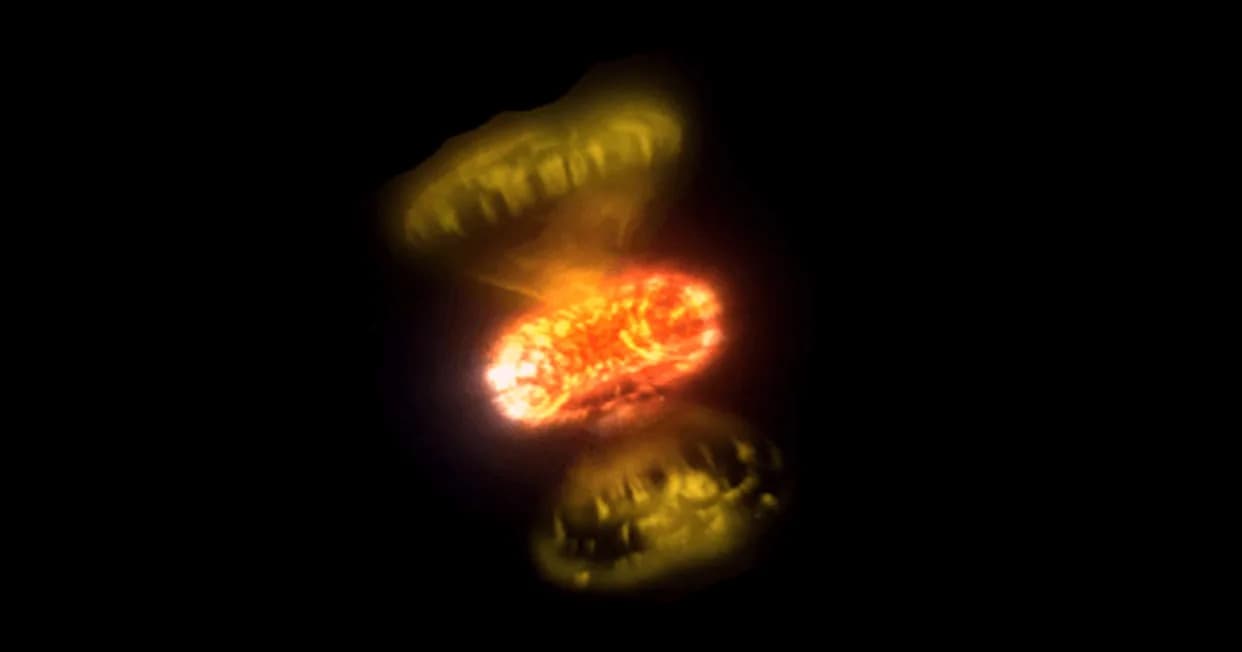
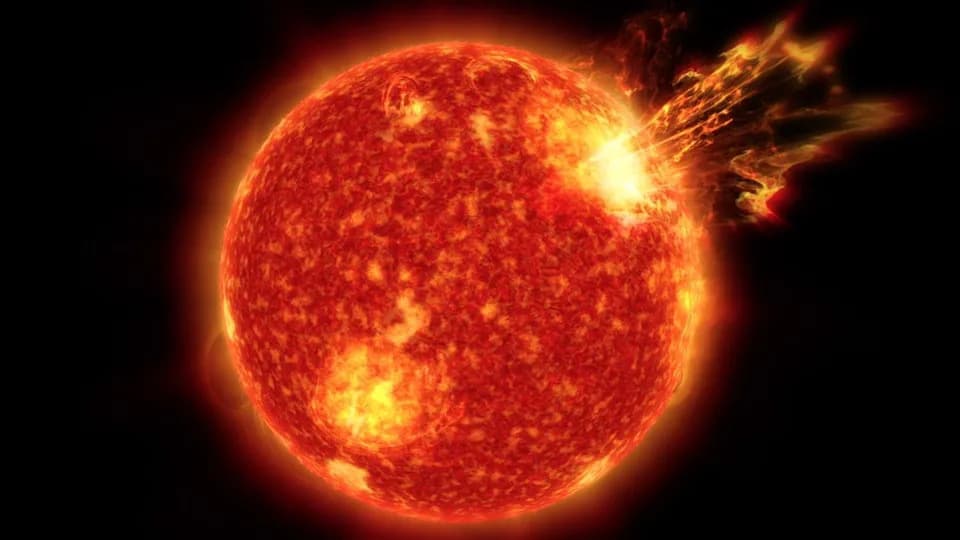
The widely circulated image is an artist’s impression based on the VLT data. The key measurement came from FORS2, the VLT’s spectropolarimeter — the only instrument in the Southern Hemisphere capable of this kind of early spectropolarimetry. This technique measures how light is polarized (the direction in which light waves vibrate) as a function of wavelength, giving a direct probe of the explosion’s geometry when the ejecta are still optically thin.
FORS2 data show the first light from SN 2024ggi was not emitted equally in all directions. Instead, the breakout shock was elongated along a single axis, described by the team as "olive‑shaped," a clear departure from spherical symmetry. As the blast expanded and began interacting with surrounding gas, later spectra showed that by about day 10 the hydrogen‑rich outer layers became visible and were aligned with the same axis as the early shock. That persistent orientation implies a stable, directional component in the core explosion.
Why this matters
Capturing the very earliest emission with spectropolarimetry provides an observational constraint that can directly test theoretical models of core‑collapse supernovae. According to the authors, the new geometry rules out some previously proposed explosion scenarios while supporting models that produce a preferred direction in the core. In short, these observations narrow the range of plausible mechanisms that drive the catastrophic deaths of massive stars.
Context and next steps
SN 2024ggi occurred in NGC 3621 and is catalogued under that designation. The study reporting these measurements was published on Nov. 12, 2025 in the journal Science Advances. Future rapid‑response spectropolarimetry of other very young supernovae will test whether asymmetric, axis‑aligned explosions are common or unusual, and will help refine models of how massive stars end their lives.
Quick facts: SN 2024ggi — detected Apr. 10, 2024 (ATLAS); VLT follow‑up Apr. 11, 2024; distance ~22 million light‑years; study published Nov. 12, 2025 (Science Advances).
Help us improve.