ZTF J2130 is a compact binary roughly 4,000 light-years away made up of a white dwarf and a subdwarf completing an orbit in under 40 minutes. High-cadence observations from Hamburg and Calar Alto show the orbital period is shrinking by about 2×10-12 seconds per second, consistent with general relativity. The system should be detectable by ESA’s LISA in the 2030s and could produce a supernova‑level thermonuclear explosion when the stars merge.
Two Stars in a Death Spiral Put Einstein’s Gravity to the Test

Astronomers have obtained the clearest view yet of a compact binary system that is spiralling toward a catastrophic merger, and the pair’s fatal dance is offering a precise new test of gravity.
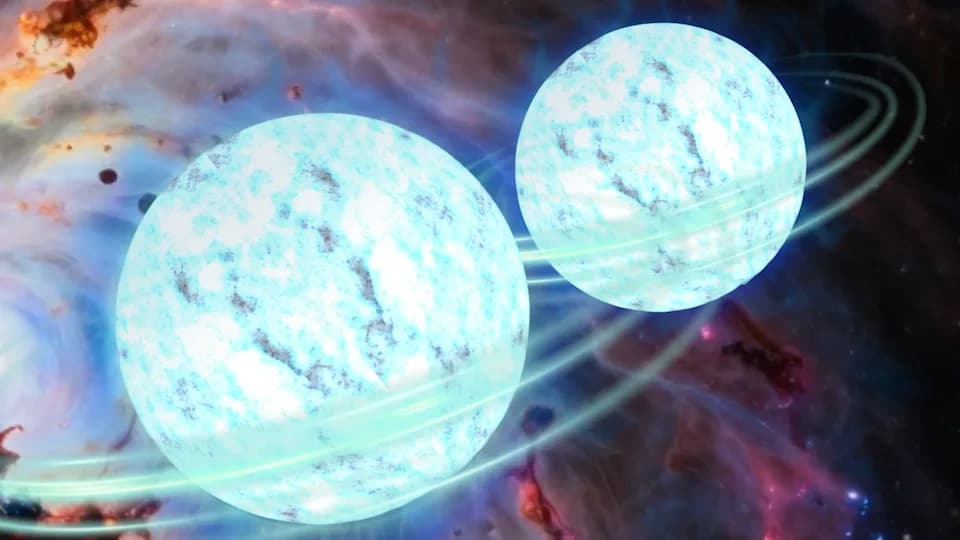
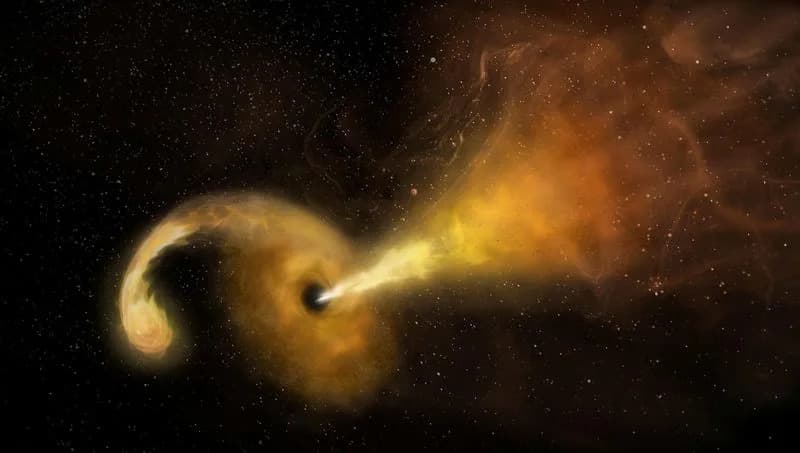
The system, designated ZTF J2130 and located about 4,000 light-years from Earth, contains a white dwarf — the dense, hot remnant of a sunlike star — and a subdwarf, a small, evolved star. The two objects orbit each other in under 40 minutes, close enough that tidal forces have distorted their shapes and the subdwarf is transferring material onto the white dwarf.
Timing a cosmic clock
Because the stars are massive and move rapidly, they emit gravitational waves: ripples in space-time first predicted by Albert Einstein and directly detected by LIGO in 2015. Emitting those waves robs the system of orbital energy, causing the orbit to shrink slowly over time. Using high-cadence observations from the Oskar Lühning telescope at the Hamburg Observatory and the Calar Alto (CAHA) Observatory in Spain, researchers measured that the orbital period is decreasing by roughly 2 × 10-12 seconds every second.
That tiny decay rate matches calculations based on general relativity. The results — reported in a study submitted in October to the journal Astronomy & Astrophysics — show that ZTF J2130 can serve as a sensitive laboratory for testing gravity. Progressively more precise timing measurements could reveal subtle deviations from Einstein’s theory if any exist.
Looking ahead: gravitational-wave detection and a dramatic finale
The team also notes that the European Space Agency’s Laser Interferometer Space Antenna (LISA), planned for the 2030s, should be able to directly detect the low-frequency gravitational waves from ZTF J2130. The system is expected to remain bright and detectable through the next decade, making it an excellent target for coordinated electromagnetic and gravitational-wave studies.
When the two stars eventually coalesce they are predicted to produce a violent thermonuclear event — potentially comparable in brightness to a supernova. Depending on the exact dynamics and the explosion’s brightness, that outburst might be visible to the unaided eye. Until then, astronomers can continue to “put gravity to the test” by watching this rare, rapidly evolving system.
Study and data sources: observations from the Hamburg Observatory and Calar Alto (CAHA); results submitted to Astronomy & Astrophysics. Researchers involved in the timing campaign provided the measurements and analysis.
Help us improve.