The Phaistos Disk, discovered in Crete in 1908 by Luigi Pernier, is a fired clay disk about 16 cm wide and 2 cm thick stamped with 242 symbols arranged in spirals. Found in a Middle Minoan context (around 1800 BCE) alongside a Linear A tablet and pottery, it appears to represent a writing system distinct from known Cretan scripts. Interpretations have ranged from religious text to hoax; parallels on the Arkalochori Axe, stamped pottery and a spiral signet ring support authenticity, while a 2008 forgery claim led to calls for thermoluminescence dating, which the Heraklion museum has refused. Most scholars now favor genuineness, but translation remains impossible without more examples or non‑destructive dating.
Fraud or Find? What We Know About Crete’s Phaistos Disk

In early July 1908 Luigi Pernier, leading an excavation on Crete, was interrupted one evening while writing to his superiors by Zacharias Eliakis, the day's trench supervisor, who arrived carrying a curious object. It was a clay disk roughly the size of a dinner plate, still flecked with soil. Pernier examined it and saw what appeared to be carved symbols in an unknown script; in a postscript to his letter he called the find "one of the most important monuments of early Cretan writing." More than a century later, the object known as the Phaistos Disk remains unique and undeciphered.
The disk was recovered from the acropolis of Phaistos, a major Minoan palace site on Crete’s southern shore. The palace-city had been occupied since about 3600 BCE, and excavations at Phaistos had been underway for nearly ten years when Eliakis uncovered the disk. He found it in a basement on the palace’s north side in a context dated to roughly 1800 BCE, the Middle Minoan period. The same deposit also contained a tablet inscribed in Linear A, an undeciphered Aegean script, and contemporary pottery.
Made of very fine clay, the disk is about 2 centimetres thick and 16 centimetres across; it is not a perfect circle because it was hand-formed rather than moulded. Its maker pressed 242 individual motifs into the soft clay using stamps, arranging those sigils in two spirals on either side separated by dividing lines; the disk was then fired at high temperature, preserving the impressions. Because the signs were applied with stamps rather than incised by hand, the disk is sometimes described as the earliest known example of movable type.
The signs on the disk differed from other known Cretan scripts. In Middle Minoan Crete two other systems were in use: Linear A and an earlier Cretan hieroglyphic script. The pictographic humans, plants, animals and objects stamped on the Phaistos Disk do not clearly match those systems, suggesting a third, apparently unrelated writing tradition active at the same time as the others — an unexpected proliferation of scripts for a single island.
Classicists and antiquarians rushed to be the first to interpret the find. Arthur Evans, famed for his excavations at Knossos and for identifying and naming Minoan culture, was among the first prominent figures to weigh in. Evans even argued the disk might not be Cretan in origin, possibly coming from Asia Minor. He catalogued and numbered the distinct signs, producing a list of 45 unique symbols.
Evans disagreed with Pernier on some readings — for example, he contested Pernier’s identification of symbol number seven as a hat, asserting instead that it represented a breast and thereby suggested a female deity. Evans was a proponent of the so-called "Great Goddess" interpretation of prehistoric religion and linked other symbols — for instance symbol 29, often depicted like a cat, and symbol 24, which he read as a temple — to that hypothesis. He reasoned that the non-Minoan appearance of some motifs supported an Anatolian provenance, though he did not produce a convincing decipherment.
The central problem is obvious: how do you read a text when you do not know the language, the direction of writing, or the value of the signs? That challenge attracted more analysts. George Hempl, a philologist at Stanford, studied the disk and argued—based on pressure marks on the impressions—that the stamps had been struck from the outer edge toward the centre and that the text ran right-to-left, contrary to Evans’s view. Hempl also inferred that the relatively large number of distinct signs made them more likely to be syllabic units than single sounds or whole words.
Hempl went further, applying frequency analysis to the corpus and proposing that the language was an early form of Greek; he read the text as religious in tone and produced a complex reconstruction involving Cretan privateers, an Ionian priestess and a cattle cult. His solution, like many that followed, has not been accepted by mainstream scholars.
Over the decades specialists, cryptographers and enthusiastic amateurs have proposed wildly different readings. The disk has been variously described as a receipt, calendar, board game, hymn, land deed, fictional tale and mathematical treatise. Its proposed language identifications have included Ionic and Attic Greek, Luwian, Hittite, Egyptian, Basque, Dravidian, Semitic, Sumerian and others.
As speculative translations accumulated, some researchers began to suspect the disk might be a forgery. The hesitation was amplified by the apparent uniqueness of its signs — why had identical symbols not appeared elsewhere on Crete?
Subsequent discoveries weakened that skepticism. In 1934 the Arkalochori Axe was found in a cave in central-eastern Crete by Greek archaeologist Spiridon Marinatos; the axe bears 15 pictographic signs, and several resemble signs from the disk, notably a head with a plume (catalogued as symbol 2) that appears on both objects. In 1965 Doro Levi’s excavation at Phaistos produced pottery fragments, including a bowl stamped with the comb sign (symbol 21) and a broken tablet bearing the same comb mark. These parallels indicated that some disk signs had contemporaries in local material culture.
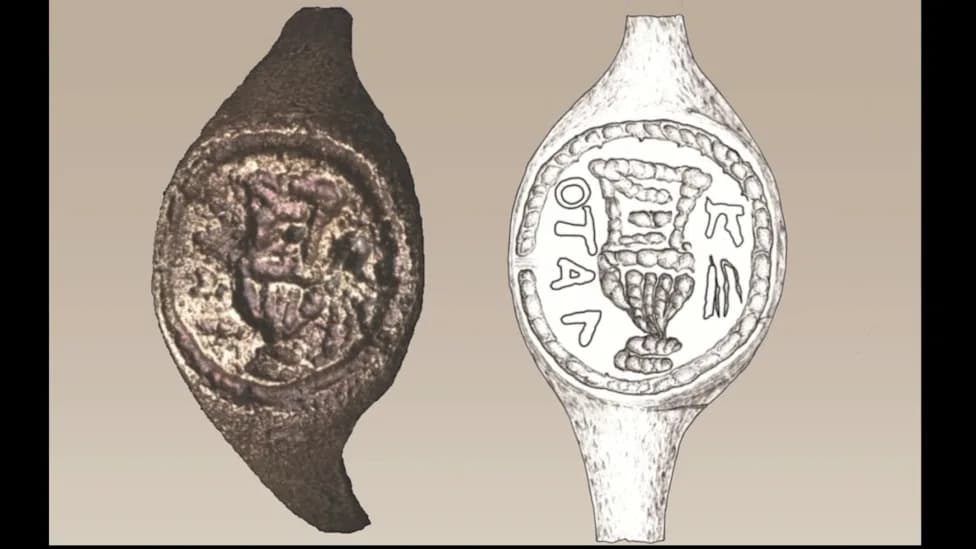
There are also echoes of the disk’s spiral layout. In the 1920s Arthur Evans recovered a gold signet ring from the Mavro Spelio necropolis near Knossos that featured an inscription arranged in a spiral, similar to the disk’s layout. Most of these related finds date to the Middle Minoan era.
The debate over authenticity flared again in 2008 when Jerome Eisenberg, an antiquities dealer known for exposing fakes, published a lengthy critique arguing the disk was a modern hoax staged by Pernier. Eisenberg suggested Pernier, frustrated by Evans’s success at Knossos and eager to secure his own reputation, had manufactured a deliberately inscrutable object. He proposed Pernier modelled the disk on the Magliano Disk — a lead spiral discovered in 1882 — and highlighted what he considered suspicious circumstances surrounding the late-night discovery, the disk’s unique format, and its unusually high number of distinct signs with too few repetitions for natural written language.
Defenders of the disk pointed to the local parallels and the stamped pottery tradition as evidence of authenticity. Eisenberg countered that these parallels could have been used as source material for a forgery. He and others argued for thermoluminescence dating — a technique that would determine the firing age of the clay — to settle the question scientifically.
The Archaeological Museum in Heraklion has declined to allow such a test, partly out of reluctance to damage the artifact even minimally and partly because a definitive result could harm the museum’s reputation depending on the outcome. In the absence of an absolute date, many scholars continue to defend the disk’s genuineness.
In 2009 Pavol Hnila of the University of Berlin published a rebuttal to Eisenberg after examining Pernier’s correspondence. Hnila argued Pernier’s behavior and letters were those of a conscientious archaeologist, not someone who had staged a fraudulent discovery, and noted that Pernier himself had acknowledged the disk’s similarity to the Magliano find. Hnila and others also pointed out that stylistic borrowings across neighbouring writing systems are common, and that the existence of stamped Middle Minoan ceramics with motifs matching disk signs supports the idea that the disk is an authentic, if unusual, local object.
Even if the disk is genuine, translating it remains effectively impossible without more examples of the same script. Scholars continue to attempt readings; John Chadwick, who famously helped decipher Linear B, was inundated with proposed solutions and once asked colleagues to stop sending him new claims. In recent decades computational studies have applied statistical and algorithmic methods to the disk, but no consensus decipherment has emerged.
Today most specialists lean toward authenticity while acknowledging that the Phaistos Disk’s message — and even its precise purpose — remains a mystery unless new inscriptions turn up or a non-destructive definitive test is permitted. The object endures as one of archaeology’s most alluring puzzles: a beautifully made stamped disk, preserved by ancient firing, that continues to defy translation and invites both rigorous study and imaginative speculation.
Help us improve.