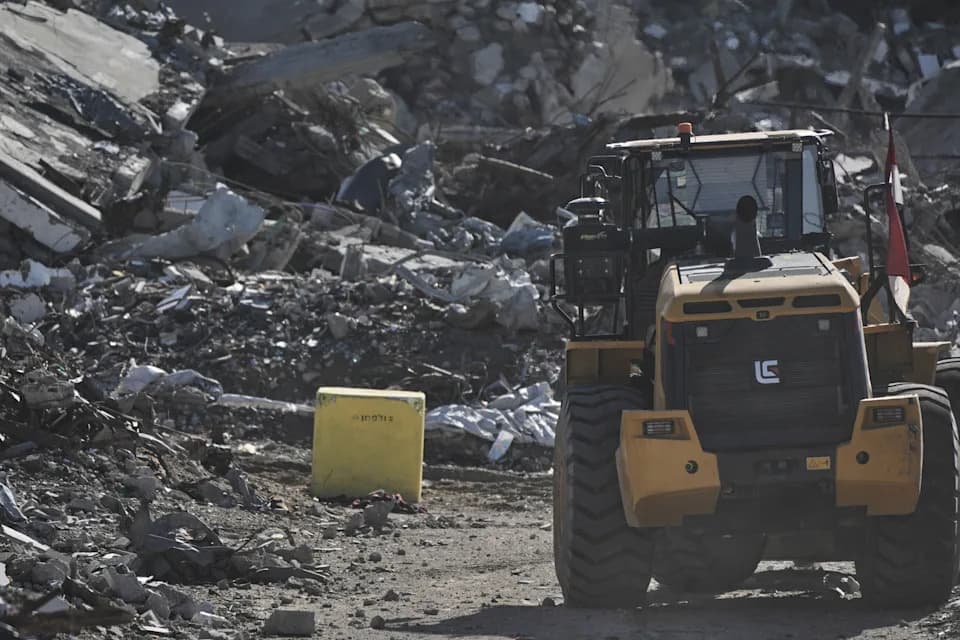
The IDF released footage showing what it describes as a seven-kilometre, ~25-metre-deep "root" tunnel under Rafah with roughly 80 chambers used for command, weapons storage and sheltering operatives. Analysts say destroying such a tunnel is a strategic blow because root tunnels feed many tactical passages and support logistics and manufacturing. Israeli officials linked the network to the area where Lt. Hadar Goldin was held; his remains were returned this month. The military says dismantling underground networks is central to degrading Hamas’s military capabilities.
IDF: Destruction of 7 km 'Root' Tunnel Under Rafah Delivers Strategic Blow to Hamas

The Israeli Defense Forces on Nov. 20 released video footage it says shows one of Hamas’s most elaborate underground complexes beneath the southern Gaza city of Rafah. The military describes the structure as a roughly seven-kilometre-long “root tunnel” running about 25 metres below the surface, with approximately 80 chambers and reinforced concrete passageways.
The footage, posted on social media, moves through wide corridors and large rooms, highlighting the scale and technical construction of the network. According to the IDF, the tunnel system was used for multiple military purposes, including command and control, weapons storage, sheltering operatives and logistical support.
“IDF troops uncovered one of Gaza’s largest and most complex underground routes, over 7 km long, ~25 meters deep, with ~80 hideouts, where abducted IDF officer Lt. Hadar Goldin was held.”
Israeli authorities say the tunnel reportedly began beneath a compound run by an international relief agency and extended beneath civilian areas. The military added that the network may be linked to the location where Lt. Hadar Goldin, an Israeli officer taken during the 2014 Gaza war, was held; Goldin’s remains were returned to Israel earlier this month after more than a decade.
Analysts: A Strategic Backbone
Senior analysts characterized the tunnel’s demolition as a meaningful setback for Hamas. Professor Kobi Michael of the Institute for National Security Studies and the Misgav Institute described the structure as a strategic spine that feeds many tactical tunnels and supports manufacturing, storage and command operations. He said such root tunnels are typically staffed by hundreds of militants and commanders.
"This is an example of a root tunnel, a strategic one that feeds many tactical tunnels and is used for strategic purposes such as command and control, weapon storage, manufacturing platforms of weapons and strategic logistics," Michael said. He estimated the cost of construction, materials and labor at millions of shekels and suggested that routing tunnels beneath sensitive civilian and humanitarian sites was intended to deter attacks.
Israel has long maintained that dismantling Hamas’s underground infrastructure is central to degrading the group’s military capacity and preventing future attacks. The military has previously reported finding hundreds — and by some counts more than a thousand — tunnels and shafts across the Gaza Strip; officials say the recent uncovering and destruction of this extensive root tunnel further undermines Hamas’s underground warfare capabilities.
This account reflects the claims and assessments presented by the Israeli military and analysts; independent verification of all details remains limited in the public record.
Help us improve.