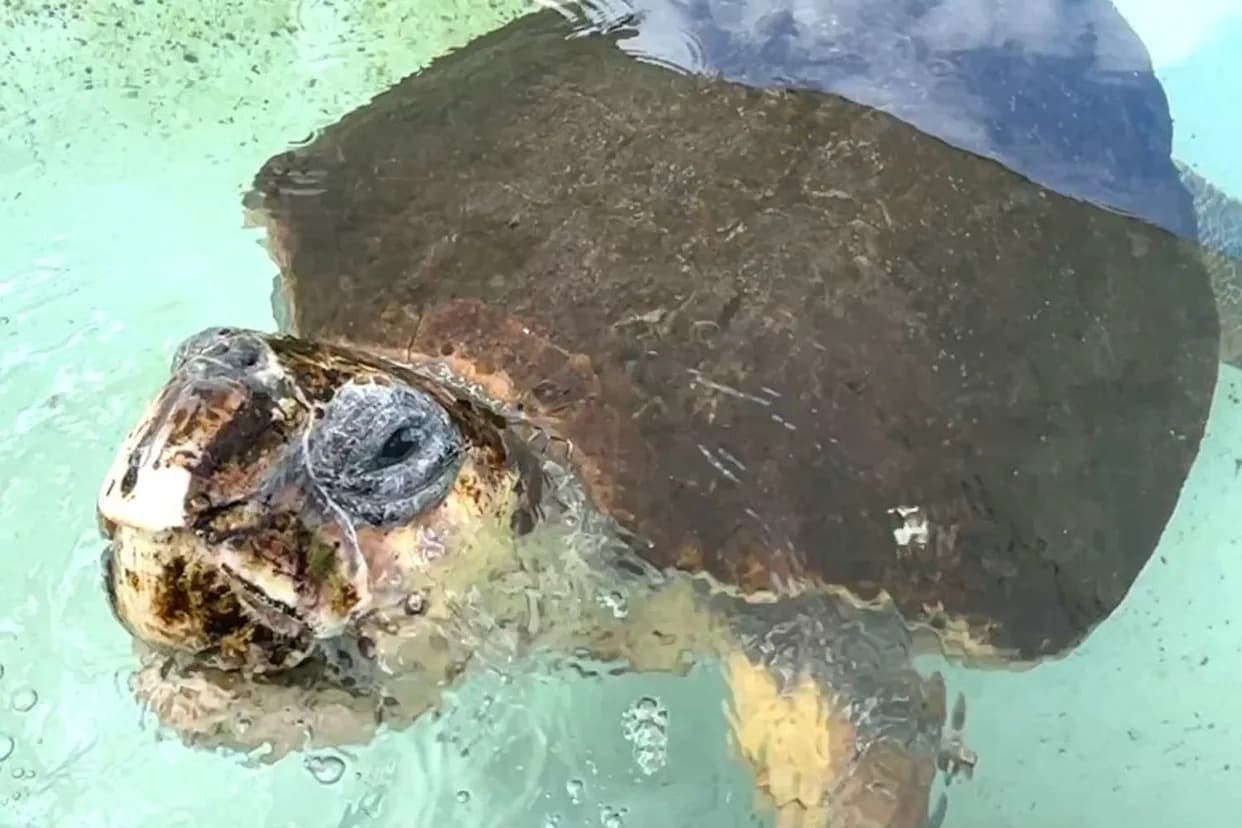
The University of North Carolina team trained eight hatchling loggerheads to associate two distinct magnetic signatures—modeled on locations near Turks and Caicos and off Haiti—with food over two months. When researchers disrupted the turtles' magnetic sense with a strong electromagnetic pulse, the conditioned 'dancing' response was reduced, indicating reliance on magnetoreception. The results support the involvement of magnetite-based receptors in turtles' map sense, while the incomplete loss of behavior suggests other cues may also help guide feeding-site navigation.
Tiny Turtles, Big Compasses: How Hatchling Loggerheads Use Earth's Magnetism to Find Food

Researchers at the University of North Carolina, Chapel Hill, show that hatchling loggerhead turtles (Caretta caretta) can learn to associate specific magnetic signatures with food-rich locations, and that disrupting their magnetic sense reduces that learned response. The study, published in the Journal of Experimental Biology, provides experimental evidence that magnetite-based receptors contribute to a map-like sense in young sea turtles.
Training the tiny navigators
Over two months, eight hatchlings were conditioned to expect food when placed in two distinct magnetic fields modeled on real locations within their natural range: one simulating waters near Turks and Caicos and the other simulating a site off Haiti. Each time a turtle encountered one of the target magnetic signatures, it received a food reward until the association was established.
Recognizing the 'dance'
The conditioned response the researchers called 'dancing' is an excited feeding behavior in hatchlings: pushing higher in the water, flapping their flippers and opening their mouths. Previous experiments from the group had already shown that hatchlings can link magnetic cues to feeding, and this study probed which sensory mechanism underlies that ability.
Disrupting magnetoreception
After the turtles reliably danced in the trained magnetic fields, the team briefly disrupted each hatchling's magnetic sense with a strong pulse delivered by an electromagnetic coil. When returned to a learned magnetic signature while their magnetic sense was impaired, the turtles' dancing diminished, indicating they primarily relied on sensing magnetic fields to identify the food-associated locations.
Conclusions and caveats
The authors conclude that magnetite-based magnetoreceptors likely underlie the turtles' map sense because a magnetic pulse can disrupt such receptors. However, because the conditioned dancing did not stop entirely after the pulse, the results also leave open the possibility that other sensory cues supplement magnetoreception when turtles map feeding areas.
Why it matters
These findings help explain how tiny-brained hatchlings navigate thousands of miles of open ocean to find and return to productive feeding grounds as they grow. The experiment strengthens evidence for a biologically based magnetic map in sea turtles and highlights how multiple senses may work together to guide migration and foraging.
Lead author: Alayna Mackiewicz, graduate student, University of North Carolina, Chapel Hill.
Help us improve.