New observations combining DESI optical spectra with LOFAR radio maps show that plasma jets from active supermassive black holes disrupt the circumgalactic medium and shut down star formation. Bright ionized emission marks where jets strike gas clumps, with the greatest energy deposition occurring at galaxy outskirts and the CGM edge. These localized jet–gas interactions provide a clear mechanism for how compact black holes can regulate galaxy growth across vast distances.
Supermassive Black Hole Jets 'Kill' Galaxies — How Plasma Outflows Shut Down Star Formation
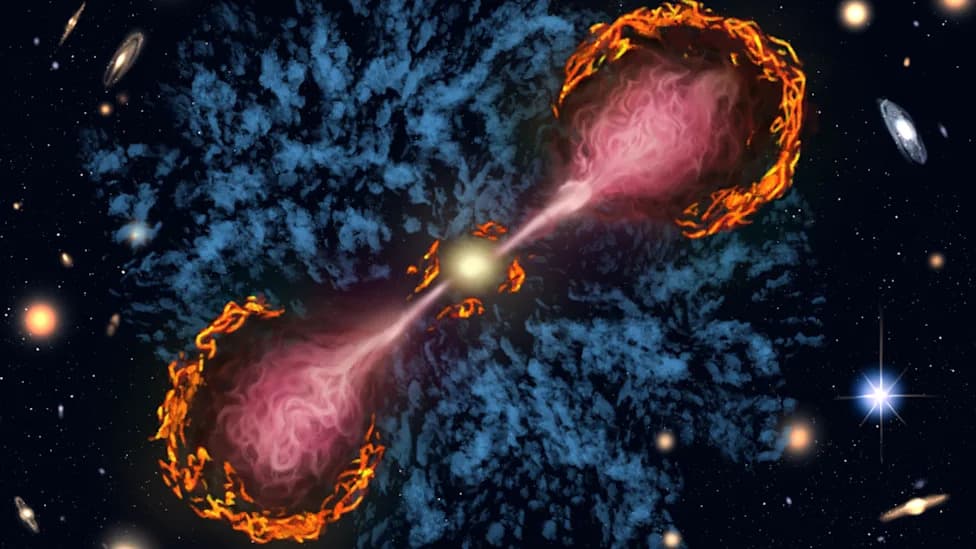
Iillustration of a supermassive black hole at the center of a radio galaxy launching powerful jets all the way into the galaxy’s circumgalactic medium.
Scientists report new observational evidence that narrow, fast jets launched by active supermassive black holes can disrupt the gas reservoirs that feed star formation, effectively 'killing' their host galaxies. By combining optical spectra and radio maps, researchers traced where jets interact with surrounding material and found that most of the jets' energy is deposited far from the galactic nucleus—at galaxy outskirts and the edge of the circumgalactic medium (CGM).
What the CGM Is: The circumgalactic medium is a vast envelope of diffuse gas and dust that surrounds galaxies and supplies the raw material for future stars. When that gas cools and flows inward it fuels star formation; if it is heated or dispersed, star formation stalls.
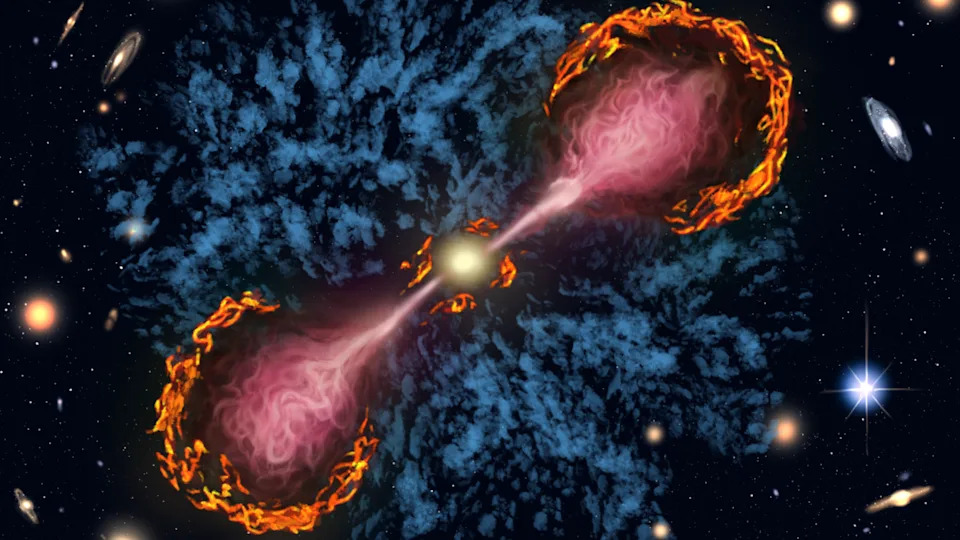
Illustration of a supermassive black hole at the center of a radio galaxy launching powerful jets all the way into the galaxy's circumgalactic medium. | Credit: Hailey Nelson/ Arizona State University
Observations and Method
The team examined hundreds of galaxies hosting active, or feeding, supermassive black holes. They combined optical spectroscopy from the Dark Energy Spectroscopic Instrument (DESI) survey with radio-jet imaging from the LOFAR Two-meter Sky Survey (LoTSS). In these datasets the researchers identified bright, ionized gas emission along jet paths—direct signatures of plasma striking and energizing clumps of circumgalactic material.
Key Findings
Rather than affecting the surrounding gas uniformly, jets hit preferred interaction points. The strongest impacts appear where jets first encounter the galaxy's outer regions and near the outer boundary of the CGM itself. The researchers report that the outermost CGM receives the largest fraction of the jets' energy, producing bright ionized emission and disturbing the gas so it can neither cool nor collapse into new stars.
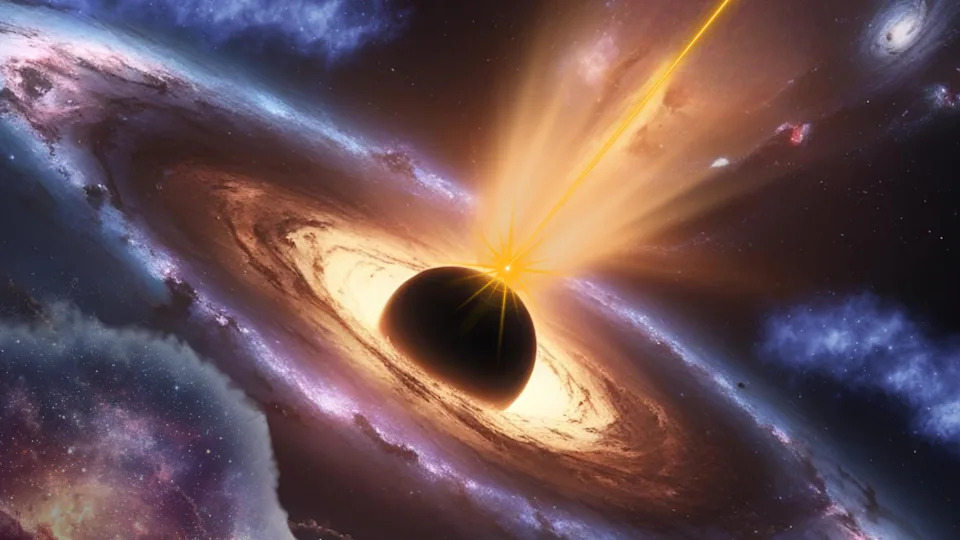
An illustration of a supermassive black hole blasting out a jet of plasma. | Credit: Robert Lea (created with Canva)
This is a pathbreaking result that solves the long-standing mystery of how black holes influence galaxies, their stars, and life as we know it, said Sanchayeeta Borthakur of Arizona State University, a co-leader of the team.
The surprising question is: How can something so small energetically impact something so enormous? said Namrata Roy of the Raman Research Institute, who co-led the research. The study shows the jet carries energy outward and lights up gas hundreds of thousands of light-years away.
Why This Matters
These spatially concentrated interactions provide a concrete mechanism for galaxy 'quenching'—the shutdown of star formation in massive galaxies. By heating and disturbing the CGM at large radii, black hole jets can prevent gas from cooling and accreting back into the galaxy, regulating galaxy growth and evolution over cosmic time.
The findings offer a new observational framework to test how black hole jets influence galaxy evolution and are published in the Astrophysical Journal Letters.
Illustration credits: Hailey Nelson/Arizona State University; Robert Lea (Canva).
Help us improve.