The Affordable Care Act requires many plans to cover at least one annual preventive visit without cost-sharing, but vague definitions and fee-for-service billing mean patients often face surprise charges for tests or problems discussed during that visit. Studies estimate tens to hundreds of millions of dollars in improper bills; people with chronic conditions are at higher risk. Experts recommend clearer rules, more no-cost primary-care visits, and better upfront communication between clinics and patients to reduce unexpected bills.
Why Your 'Free' Annual Doctor Visit Often Turns Into A Surprise Bill
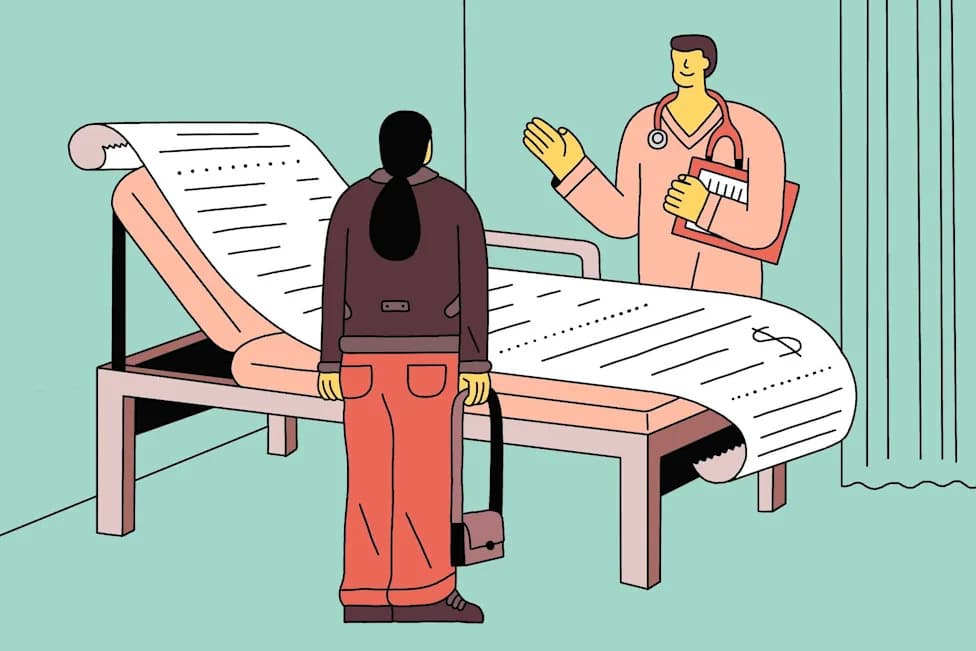
an illustration of a woman in a doctor's office. A doctor is waiving to her from the other side of an exam table covered in a giant bill.
After moving to West Virginia, Steve Kuo enrolled in a plan that promised one free preventive visit each year. He booked his annual exam, mentioned a past kidney issue, and later received two charges for the same appointment—one for a preventive visit and another coded as an "office sick visit." His story, posted on social media, is far from unusual.
How A Simple Promise Became Confusing
The Affordable Care Act requires many insurers to cover preventive services without cost-sharing, including an annual wellness or preventive visit. But the law did not specify a precise list of diagnosis and procedure codes or how insurers must apply them. That ambiguity left insurers and providers to interpret the rules, creating frequent disputes over billing.
Why Patients Get Billed
- Fee-for-service billing: Providers bill separately for each test, procedure, or problem discussed. Vaccination counseling might be covered, but addressing back pain or ordering blood tests can generate additional charges.
- Vague definitions: The ACA didn't define exactly what counts as "preventive," so insurers often adopt narrow definitions to limit costs.
- Incentive mismatch: Insurers want fewer covered services to avoid cost-sharing; clinicians want to be compensated for diagnostic or treatment work performed during the visit.
- Out-of-network services: Labs or imaging sent outside your plan’s network can trigger large bills, even when ordered during a preventive visit.
Common Scenarios
Examples include a preventive gynecology appointment later billed after an ultrasound was added; a preventive visit recoded as a chronic-disease visit because a patient mentioned an ongoing condition; and colonoscopies that become billable when a polyp is found and removed.
"Every single time I'm in the clinic, this issue comes up with a patient," said Dr. Yalda Jabbarpour, family physician and medical director at the Robert Graham Center for Policy Studies. "The blame is not on the patient or the physician—this points to a bigger system issue."
The Financial Toll
A 2021 study estimated that people with employer-sponsored coverage paid between $75 million and $219 million in 2018 for services that should have been free under the ACA. People with chronic conditions are especially likely to be charged, because their visits are more likely to be recoded as disease management or diagnostic visits.
Proposed Fixes And Practical Steps
Policy proposals include guaranteeing multiple no-cost primary-care visits each year—Georgetown researchers suggested three primary-care and two urgent-care visits with no cost-sharing—or eliminating copays for primary care entirely. Experts like Alex Hoagland have also called for clearer statutory definitions of preventive services.
While legislative change is slow, patients and practices can take immediate steps to reduce surprise bills:
- Ask before you go: When scheduling, ask whether the appointment is coded as preventive and what topics or services might trigger charges.
- Set expectations at check-in: Tell the receptionist and clinician at the start of the visit that you’ve come for the annual preventive visit and ask whether mentioning a symptom will change billing.
- Check your insurer’s preventive services list: Many plans publish which services are covered without cost-sharing; KFF maintains a database of ACA preventive services that can help.
- Confirm lab and imaging networks: Ask whether a blood draw or imaging will be handled in-network to avoid out-of-network surprises.
- Appeal questionable bills: If you believe a service should have been covered, contact your insurer to appeal and request a coding review—providers can sometimes re-bill using preventive codes when appropriate.
Taking It Forward
The ACA increased access to preventive care overall, but mismatched incentives and unclear rules leave patients vulnerable to unexpected costs. Better policy design—clearer definitions, broader no-cost primary care, and simpler billing rules—would reduce confusion and improve health outcomes. Meanwhile, improved transparency from practices and proactive questions from patients can limit the chance that a "free" visit becomes a costly surprise.
Help us improve.