At an en banc hearing, a DOJ attorney surprised D.C. Circuit judges by effectively proposing that former Homeland Security Secretary Kristi Noem be treated as a "sacrificial lamb" to end a contempt probe into alleged violations of a March 15, 2025 TRO barring certain AEA deportations. Judges from across the ideological spectrum pressed the government on whether advisers — not just top decisionmakers — could face contempt, and whether the record supports halting further fact-finding via mandamus. Central questions include testimony from fired DOJ attorney Erez Reuveni, Deputy Assistant Attorney General Drew Ensign, and an alleged remark by Emil Bove urging defiance of the courts.
DOJ Lawyer Suggests Naming Kristi Noem As 'Sacrificial Lamb' To End Contempt Probe — D.C. Circuit Pushes Back
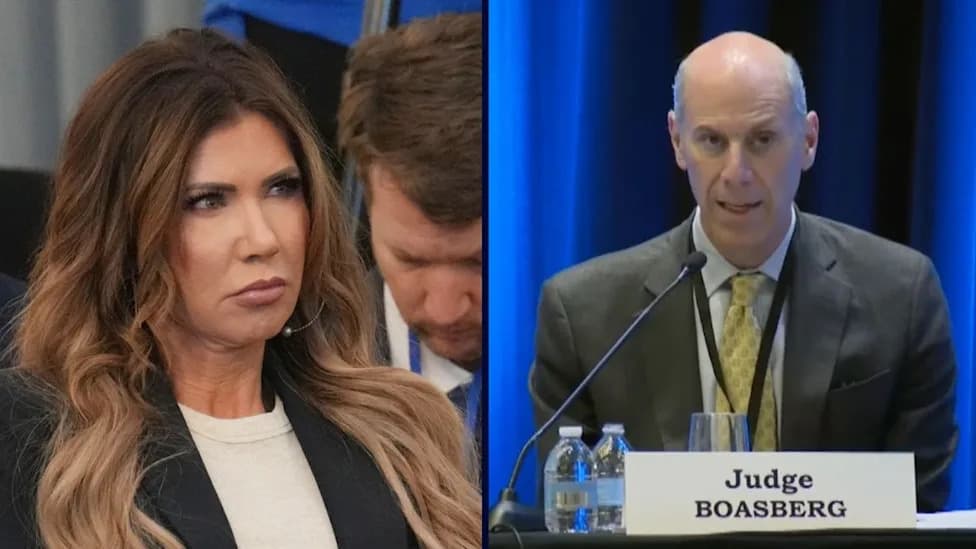
Left: Special Envoy for The Shield of the Americas Kristi Noem attends the Organization of American States where visiting Ecuador's President Daniel Noboa is to speak, Thursday, May 14, 2026, in Washington (AP Photo/Jacquelyn Martin). Right: Chief U.S. District Judge James Boasberg speaks on a panel in April 2025 at an American Bar Association meeting (PBS NewsHour/YouTube).
At an en banc hearing before the U.S. Court of Appeals for the D.C. Circuit, a Department of Justice attorney stunned several appellate judges by effectively offering former Homeland Security Secretary Kristi Noem as a "sacrificial lamb" to terminate a district judge's contempt investigation — even though judges said there was no clear basis to conclude she, personally, willfully defied a court order.
What Happened At The Hearing
DOJ lawyer Brett Shumate led the government's argument in the high-profile session, which centered on whether the court should grant an extraordinary writ of mandamus to stop Chief U.S. District Judge James Boasberg from continuing an inquiry into alleged violations of a March 15, 2025 temporary restraining order (TRO) that limited deportations under the Alien Enemies Act (AEA).
Several judges pressed the government on whether it had met the demanding standard for mandamus — i.e., a "clear and indisputable" right to relief — and whether the district court should be allowed to identify and investigate potential contemners beyond the ultimate decisionmaker.
Key Figures And Allegations
The dispute involves potential testimony from fired DOJ attorney Erez Reuveni and Deputy Assistant Attorney General Drew Ensign. Reuveni was placed on leave and then dismissed in April 2025 after nearly 15 years at DOJ; he says he refused directions to file a brief that misrepresented facts about Kilmar Abrego Garcia, a Maryland resident and Salvadoran national whose deportation and subsequent prosecution have drawn scrutiny.
Reuveni has alleged that Ensign was present the day before Boasberg issued the TRO, when former Principal Associate Deputy Attorney General Emil Bove — described in the record as once serving as President Trump’s personal attorney — allegedly suggested in a meeting that the government should tell the courts "f— you" if blocked from carrying out mass AEA deportations. At the time, Bove’s nomination to the 3rd U.S. Circuit was pending; he was later confirmed and submitted a brief declaration about his role advising Noem.
Judicial Reaction
Multiple judges signaled skepticism about the government's approach. Judge Patricia Millett pressed the DOJ on whether contempt could attach not only to the top decisionmaker but also to advisers who allegedly counseled defiance of the order. "I assume you would agree that the ultimate decisionmaker is not the only one who could have been in contempt of court," she said, asking whether an attorney who advised a secretary to disregard a court order could be liable.
"I think that’s an interesting question that a prosecutor may wish to probe…" — Brett Shumate (paraphrased)
Judge Florence Pan warned that the government appeared to be trying to limit the district court’s investigative discretion, citing record evidence that someone advised saying "f you" to the courts. Judge Cornelia Pillard called it a "remarkable position" to suggest a district court should refer a Cabinet secretary for criminal prosecution without specific evidence that she willfully violated the order.
Judge J. Michelle Childs cautioned against treating an alleged contemner as a "sacrificial lamb" on the government’s representations alone, noting that a contempt referral requires proof that the person knew of the order and willfully violated it.
Procedure And Next Steps
Shumate stressed that the district court could identify a specific person and then issue any necessary referral to prosecutors. The judges, however, repeatedly returned to whether the district court lacked sufficient information and whether further fact-finding — including testimony from Reuveni and Ensign — was appropriate before any referral for contempt or prosecution.
The panel’s questioning underscored judicial concern over the scope of mandamus and over holding advisers or high-ranking officials criminally accountable absent clearer evidence of willfulness and knowledge of the order. The government also noted that the U.S. Supreme Court later vacated Boasberg’s TRO — a development the DOJ emphasized in its argument.
Why This Matters
The case raises important questions about (1) how far a district court may probe the mental state of government officials who are alleged to have defied court orders, (2) the threshold for naming high-ranking officials in contempt referrals, and (3) the balance between prosecutorial discretion and judicial fact-finding in sensitive national-security and immigration matters.
Help us improve.