Philippe Karpe and Gunther Jikeli’s new study rigorously evaluates claims that Israel is guilty of apartheid, genocide, or settler colonialism. Applying established legal and historical criteria, the authors conclude that the evidence does not meet the legal thresholds for apartheid or genocide and that settler-colonialism is an inadequate overall framework for describing Zionism and Israel. They warn that combining these labels in public discourse can erode legal precision and function as a tool of delegitimization.
New Academic Study Finds Legal Criteria For Apartheid and Genocide Not Met; Calls Settler-Colonial Label Inadequate
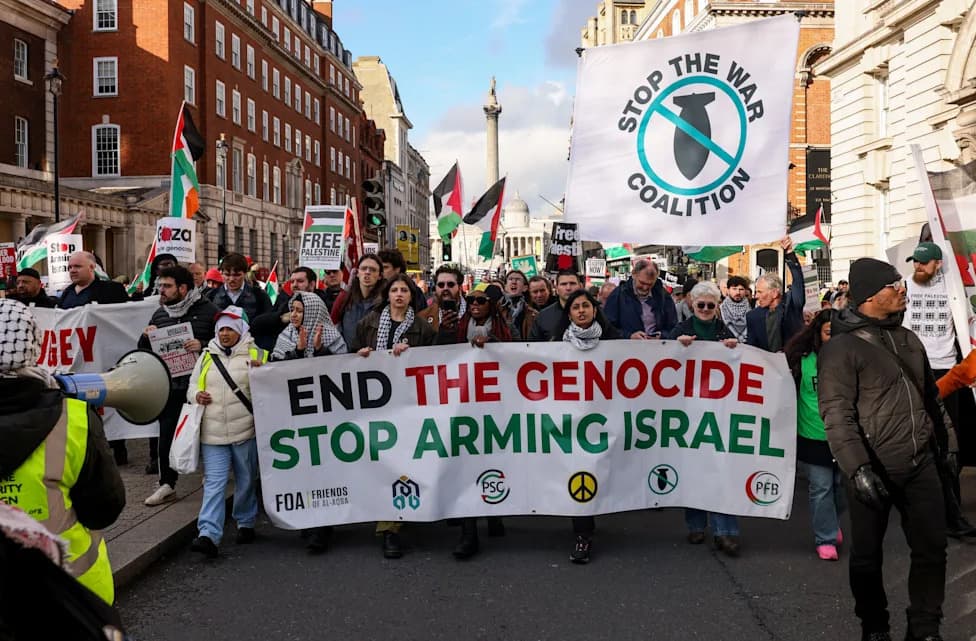
People take part in the National March for Palestine - hands off Gaza, a pro-Palestinian protest calling for the government to "end the genocide and stop arming Israel", in London, Britain, January 31, 2026. (photo credit: REUTERS/Jack Taylor)
A new academic study by Philippe Karpe (CIRAD) and Gunther Jikeli (Indiana University Bloomington), published on SSRN, examines claims that Israel should be classified as an apartheid state, a settler-colonial project, or guilty of genocide. Applying established legal definitions and historical-comparative frameworks, the authors conclude that the evidence does not establish the legal elements required to prove apartheid or genocide, and that settler-colonialism is an insufficient overall classification.
Scope and Method
The paper subjects each accusation to close legal and historical scrutiny rather than treating the three labels as interchangeable. It analyzes the 1973 Apartheid Convention and the Rome Statute for apartheid, Article II of the Genocide Convention for genocide, and comparative settler-colonial frameworks across several historical phases (pre-state settlement, 1947–1949 displacement, and post-1967 settlement activity).
Findings on Apartheid
The authors acknowledge that "racism and substantial disparities persist" within Israel’s citizenship regime inside the Green Line, but underline that Arab citizens participate in national elections, litigate in Israeli courts, and are represented in the Knesset. They argue that equating ethnonational inequality with a legally defined system of apartheid—which requires a demonstrable purpose to enforce systematic racial domination and political exclusion—misreads the legal standard in this context.
Regarding the West Bank, Karpe and Jikeli identify the occupation, settlements, and unequal administrative arrangements as presenting the "strongest case" for apartheid-like claims. However, they find the available evidence does not establish the specific intent or purpose required to demonstrate a system designed to sustain "systematic racial domination and oppression." The study emphasizes that several legal differentiations in the West Bank derive from the Oslo Accords and from Palestinian non-citizenship and Palestinian Authority jurisdiction.
The authors also distinguish Gaza’s separate internal governance and the character of military operations there from an institutionalized racial regime, arguing Gaza must be treated analytically as distinct from the West Bank and areas inside the Green Line.

Israeli soldiers clash with Palestinians as they hold Friday prayers during a protest against Israeli settlement expansion and land confiscation near Bethlehem in the West Bank, July 3, 2026. (credit: WISAM HASHLAMOUN/FLASH90)
Settler-Colonial Framework
Evaluating settler-colonialism across the three historical phases, the paper acknowledges that the framework helps illuminate aspects of land acquisition and settlement expansion. Still, it argues that settler-colonialism fails to account for Zionism’s national and refugee dimensions, Jewish historical attachment to the land, and the absence of a conventional metropole—a feature of many classic settler-colonial cases. Within the West Bank, divergent territorial strategies and negotiations over withdrawal also complicate any claim of an unbroken project of permanent incorporation.
The study notes that roughly 160,000 Arab residents who remained in Israel after 1948 were incorporated into the state, which the authors say complicates claims that Israeli state formation was conceived and executed as a comprehensive program of indigenous removal.
Genocide Analysis
Applying Article II of the Genocide Convention, the authors assess allegations concerning the deliberate infliction of life conditions calculated to bring about physical destruction and measures intended to prevent births. They analyze humanitarian access data from the Coordinator of Government Activities in the Territories (COGAT), reporting at least 1,341,904 tons of food delivered in 63,191 truckloads via land and maritime routes. The study argues this record weakens an inference that deprivation resulted from a policy intended to physically destroy the population.
Addressing the March–May 2025 suspension of aid, the authors emphasize that the pause alone does not establish genocidal intent and that the wider record can support competing inferences—such as military or operational rationales. In the case of the Al-Basma IVF clinic strike, they note the UN Commission of Inquiry’s technical findings but maintain that evidence of damage to reproductive infrastructure does not, by itself, prove an intent to prevent births as part of a genocidal plan.
Discursive Interaction of Labels
Beyond independent legal evaluations, Karpe and Jikeli analyze how the three accusations function together in public discourse. They argue that expansive definitions and selective evidence can allow apartheid, genocide, and settler-colonial claims to reinforce one another, shift burdens of proof, and blur the distinctions each category is designed to capture. Presented in totalizing forms, these labels risk operating less as precise descriptions of specific illegal acts and more as instruments for stigmatizing and delegitimizing a political actor.
"Our argument is fundamentally about legal and historical precision, but also about the way these accusations are increasingly combined in public discourse and what this combination does to the way Israel and the conflict are understood," the authors told The Jerusalem Post.
The full paper is available on SSRN: https://papers.ssrn.com/sol3/papers.cfm?abstract_id=7501120. The authors’ project website is at https://three-accusations-israel.netlify.app/en/.
Help us improve.