Adalah's new report documents what it calls a two‑track disciplinary regime in Israeli higher education that disproportionately targets Palestinian students since the October 2023 Gaza war. The study chronicles more than 130 inquiries from students at around 40 institutions — over 75% of them women — and highlights expanded disciplinary powers, reliance on automated translation to judge Arabic expression, and invocation of the 1965 Yardor ruling. Adalah says these practices amount to structural repression and have created a chilling effect on campuses; some universities dispute the findings.
Adalah Report: Israeli Universities Accused Of A Two‑Track Disciplinary System Targeting Palestinian Students
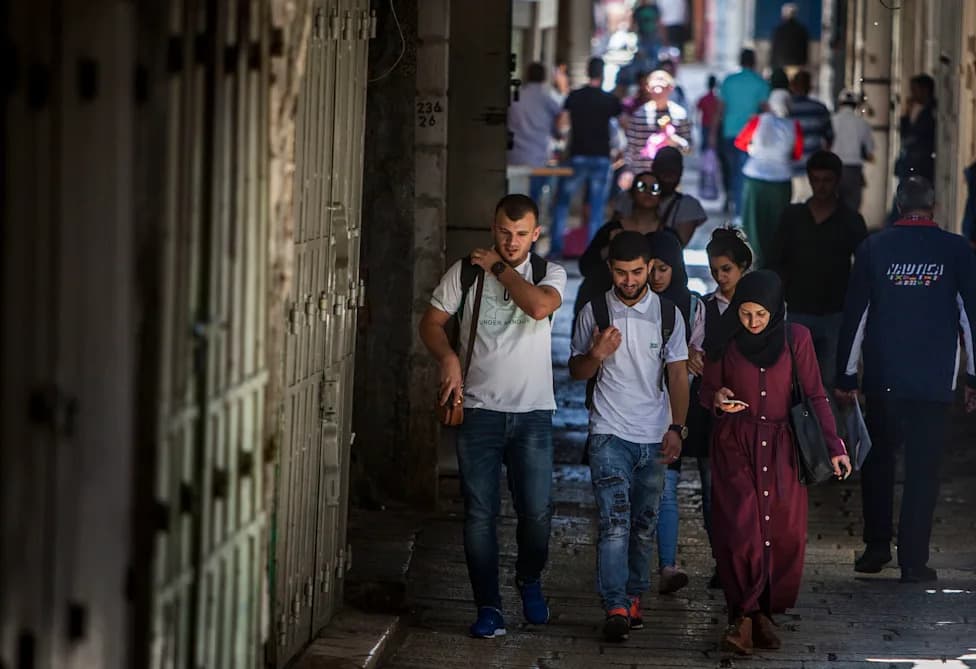
Palestinian students walk down a closed shopping street in occupied East Jerusalem's Old City [File: Eyal Warshavsky/AP]
A new report from Adalah, the Legal Center for Arab Minority Rights in Israel, documents what it describes as a systematic, two‑tier disciplinary regime in Israeli higher education that disproportionately targets Palestinian students since the Gaza war began in October 2023. The study compiles more than 130 inquiries from students across roughly 40 institutions and raises concerns about procedural fairness, language misinterpretation and widening disciplinary powers.
Key Findings
Adalah reports that more than three‑quarters of the students who sought help were women, and that institutions have applied a markedly different set of procedures to Palestinian and Jewish‑Israeli students. The report characterises this as an "administrative track" for Palestinians — where routine safeguards and the presumption of innocence are weakened — and a "constitutional track" for Jewish Israelis, whose rights are treated as rooted in rule‑of‑law protections.
Illustrative Cases
Examples highlighted in the report include a Palestinian student at Zefat Academic College who faced permanent expulsion and cancellation of credits after posting a video of a religious preacher praying for people in Gaza, and a student at the Technion who was suspended after sharing a verse from the Quran.
Procedural Concerns and Language Errors
The report raises multiple procedural problems: reliance on catch‑all provisions such as "unfitting conduct" or "harm to public peace," the use of vague standards like "public sensibilities" or a nebulous "reasonable person" test, and frequent dependence on automated tools (for example, Google Translate) to interpret Arabic prayers, texts and cultural expression. Adalah says these practices have led to misinterpretation and unfair disciplinary outcomes.
Adi Mansour, an Adalah‑affiliated lawyer and co‑author of the report, said: "We view it as institutional incompetence, compounded by an unwillingness to both understand the complexity of language and discourse, and to engage with anything that departs from a majority Zionist Israeli Jewish point of view."
Broadened Authority And Legal Justifications
Historically, Article 17 of Israel's Students' Rights Law limited disciplinary measures to conduct connected to academic activity. According to Adalah, many institutions expanded their jurisdiction after the October 2023 Gaza war began, invoking broad clauses and even the 1965 Yardor ruling — a doctrine associated with "militant democracy" used to justify curbs on legal protections against perceived internal enemies.
Adalah asserts that these legal and administrative manoeuvres have produced a conditional form of inclusion for Palestinian students: they remain enrolled so long as their expression aligns with the comfort of the majority and the dominant national discourse.
Responses and Calls For Oversight
Some universities have rejected the findings. The Technion, for example, told Times Higher Education that the report was "part of a broader attempt to discredit Israeli academia and institutions" and described the allegations as "baseless."
Adalah calls on international human‑rights bodies and academic partners to hold institutions to international standards on academic freedom, freedom of expression and non‑discrimination. The report's authors describe the documented measures as systemic rather than isolated incidents and urge immediate reforms.
Impact
Adalah says the practices have created a chilling effect across campuses. The organisation notes that consequences have sometimes extended beyond university discipline: students were reportedly arrested, in some cases held in harsh conditions, and some universities themselves referred students to the police.
Help us improve.