The five principal leaders of Israel's opposition 'change bloc' met at Yair Lapid's home and signed a joint agreement to cooperate ahead of the October elections. They pledged to boost turnout, avoid mutual attacks during the campaign, and draft shared guiding principles for a future government. Key disagreements remain — notably who will head the bloc into a challenge against Benjamin Netanyahu — and recent polls put the opposition bloc at 55 seats versus 49 for the pro-government coalition.
Opposition ‘Change Bloc’ Leaders Sign Truce and Coordination Pact Ahead of October Vote
Five
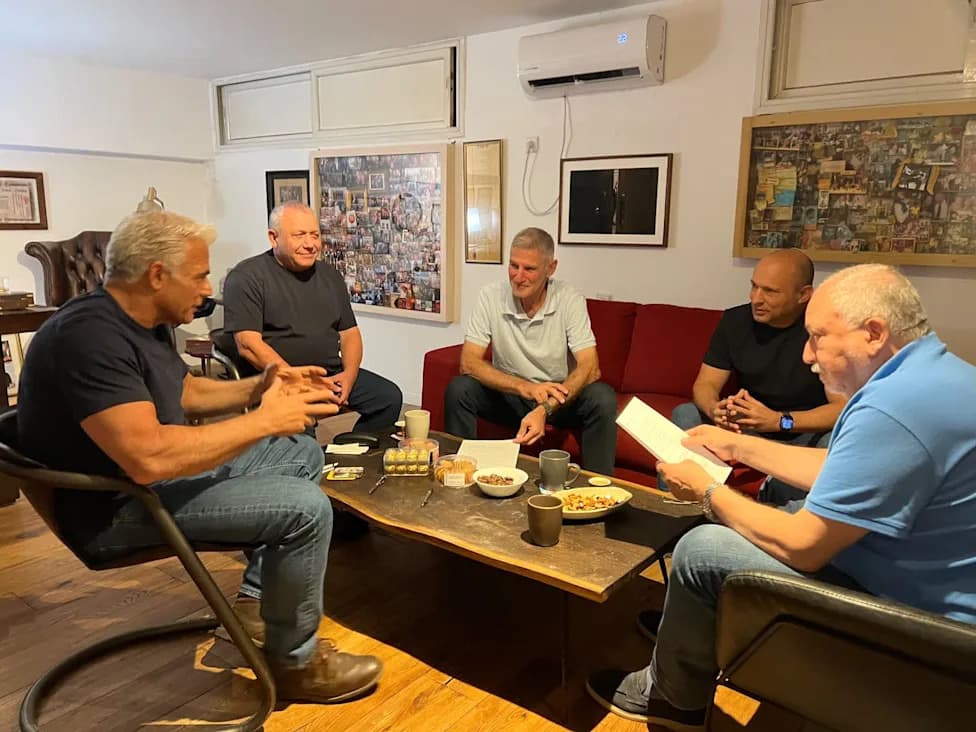
Opposition leader Yair Lapid hosted senior figures from the anti-Netanyahu 'change bloc' at his home on Saturday night, where five leaders signed a joint statement committing to coordinated campaign conduct ahead of the October elections.
Joint Pledge, Unresolved Leadership Question
The meeting produced a succinct agreement: the parties pledged to boost turnout, refrain from attacking one another during the campaign, and work together to draft shared principles for a future government. The signatories included Yair Lapid (host), Gadi Eisenkot (Yashar), Naftali Bennett (B'Yachad), Avigdor Liberman (Yisrael Beytenu) and Yair Golan (The Democrats).
Crucial issues remain unresolved. The statement did not settle how the bloc will choose its candidate to challenge Prime Minister Benjamin Netanyahu. Eisenkot has argued publicly that the leader of the largest party in the bloc should be its candidate.
Tensions and Messages
After the meeting, Naftali Bennett expressed optimism, saying he was confident the bloc could 'win 63 seats and, together, fix Israel,' and that the leaders had put personal differences aside to agree on 'full cooperation until the election, on Election Day and after the election, in order to establish a government of correction for Israel.'

Former Prime Minister and Together party leader Naftali Bennett is seen with Opposition Leader Yair Lapid as they arrive for a press conference as part of the B'Yachad party election campaign in Tel Aviv, central Israel, August 19, 2026. (credit: AVSHALOM SASSONI/FLASH90)
Gadi Eisenkot acknowledged ongoing disagreements but stressed the shared objective: 'There are weekly meetings to coordinate between the parties, and there are also substantive disagreements. We have a common goal, and I am certain it will be expressed by the elections.'
Public friction has surfaced in recent days: figures from Yisrael Beytenu criticized strategies advocated by Eisenkot, prompting sharp exchanges. MK Oded Forer accused Eisenkot of 'fueling Bibi's campaign,' arguing that victory requires attracting voters beyond the bloc’s base.
Poll Snapshot
A Maariv poll released Friday illustrated the volatile landscape. It put the pro-government coalition at 49 seats (down one), while the Zionist opposition bloc rose by one seat to 55. Within that opposition tally, Yashar polled at 22 seats, B'Yachad at 13, The Democrats at 11 and Yisrael Beytenu at nine.
The survey also noted several smaller lists remain below the electoral threshold: Blue and White (1.3%), Haredi Public (0.9%) and Noam for Israel (0.7%). Other results in the poll included Otzma Yehudit rising to nine seats and Likud at 18.
What Comes Next
The meeting at Lapid’s home was intended to tighten coordination and present a more unified front, but major strategic and leadership questions still loom. The bloc will need to translate its pledge into concrete campaign discipline and a clear plan for post-election coalition-building if it hopes to displace Netanyahu’s government.
Help us improve.