The AfD parliamentary group in Brandenburg has been using life-size cardboard cutouts of party leaders and contentious historical figures—including Paul von Hindenburg, Otto von Bismarck and Wilhelm II—at public events. Critics say the imagery is provocative given the figures' links to repression and the collapse of democracy, while AfD officials insist the displays are humorous and not intended as veneration. Brandenburg's domestic intelligence office currently classifies the AfD in the state as a far-right extremist organisation; the party is appealing that decision.
AfD Displays Life-Size Cardboard Cutouts of Hindenburg, Bismarck and Party Leaders at Brandenburg Events
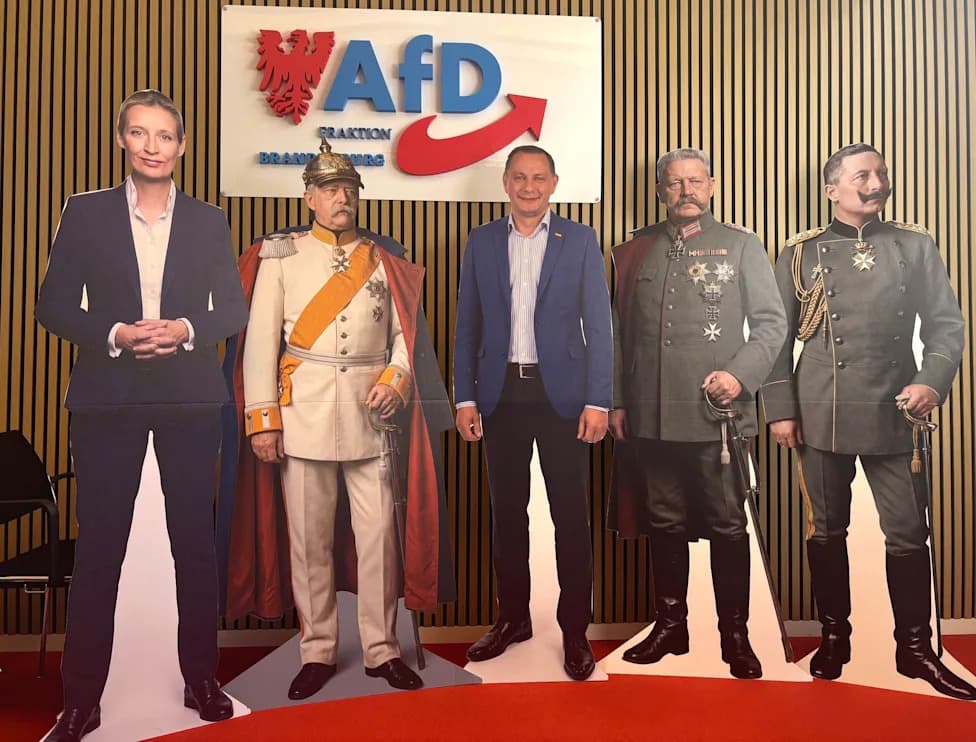
The Alternative for Germany (AfD) caucus in the Brandenburg state parliament has display stands ready for events—featuring AfD chairpersons Alice Weidel (R) and Tino Chrupalla (center), as well as Reich Chancellor Otto von Bismarck, Reich President Paul von Hindenburg, and Emperor Wilhelm II. (is associated with: «AfD campaigns using cardboard figures from Hindenburg to Weidel») Marc-Oliver von Riegen/dpa
The AfD parliamentary group in the Brandenburg state parliament has been using life-size cardboard cutouts of contemporary party figures and controversial historical leaders at public events, drawing attention — and criticism — for its choice of imagery.
The standees include AfD federal co-chairs Alice Weidel and Tino Chrupalla, alongside figures from the German Empire and the early 20th century: Chancellor Otto von Bismarck, President Paul von Hindenburg and Emperor Wilhelm II.
Historical Context
Paul von Hindenburg (1847–1934) served as president of the German Reich during the Weimar Republic. He is widely criticised for appointing Adolf Hitler as chancellor in 1933, a decision that many historians say cleared the way for the Nazi dictatorship.
Otto von Bismarck (1815–1898) engineered the unification of Germany in 1871 and introduced early social insurance programs. At the same time, Bismarck pursued policies that suppressed political and religious opponents, including measures against the Catholic Church and restrictions on the Social Democratic movement.
Wilhelm II (1859–1941), the last German Emperor, is associated by historians with policies and diplomatic decisions that contributed to the outbreak of World War I.
Party Response And Official Concerns
Hans-Christoph Berndt, leader of the AfD parliamentary group in Brandenburg, defended the displays and urged caution against what he called the "demonizing" of historical figures. When asked about Hindenburg he said, "Hindenburg was, after all, the only freely elected president of the German Reich," adding that he believed Hindenburg had helped stabilize Germany in the 1920s. Berndt also said the cardboard figures were intended "with a light touch of humour" so visitors could pose for photos and that "this isn't meant to be hero worship."
Critics argue that invoking imperial-era personalities and figures linked to the collapse of German democracy is provocative, especially given the AfD's contested political positioning.
Officially, the Brandenburg Office for the Protection of the Constitution classifies the AfD in the state as a far-right extremist organisation; the party is appealing that classification in court.
Help us improve.