The Transportation Safety Board of Canada recommends Transport Canada and railways adopt trend-based analytics of Wheel Impact Load Detector (WILD) data to better detect wheels at risk of failure. An April 5, 2023 derailment near Uncas, Alberta, was caused by a shattered rim that produced progressive rail fractures and derailed 18 cars of a 104-car CN grain train; there were no injuries. The TSB's analysis of this incident and three similar events found that tracking impact trends over time can flag deteriorating wheels earlier. The report also warns that wheels manufactured before 2003 may be more prone to sudden failure and lack a proactive replacement strategy.
TSB Calls for Trend-Based Wheel Monitoring After Alberta Grain-Train Derailment
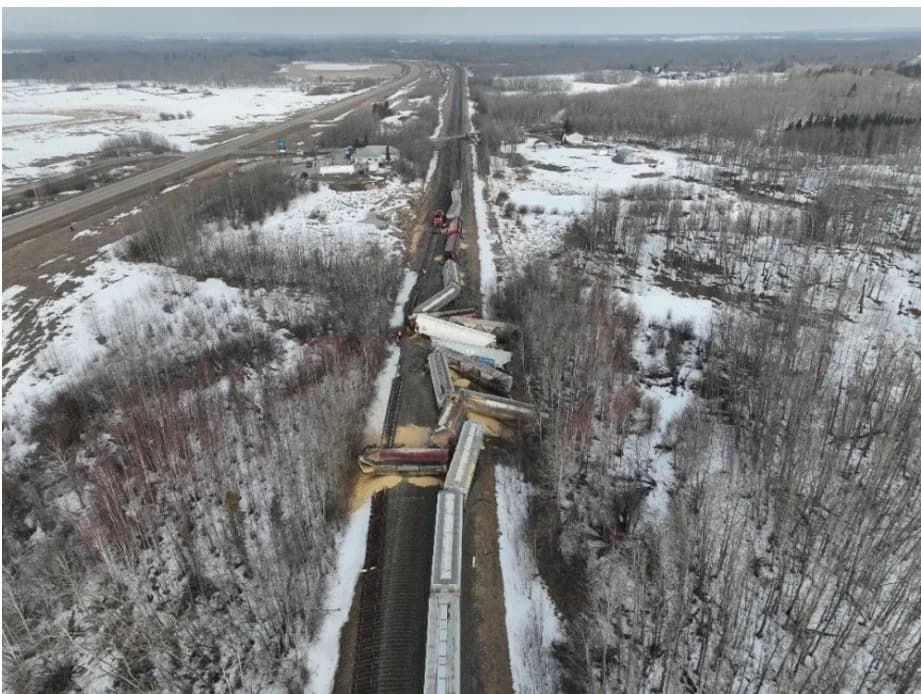
A wheel failure caused track damage that led to a derailment of a CN grain train in Alberta in 2023. TSB
EDMONTON, Alberta — The Transportation Safety Board of Canada (TSB) today recommended that Transport Canada work with railways to adopt trend-based analytics for Wheel Impact Load Detector (WILD) data to better identify railcar wheels at risk of imminent failure.
The recommendation follows the TSB's investigation into the derailment of a Canadian National unit grain train near Uncas, Alberta, on April 5, 2023. Eighteen cars of the 104-car train (G86742-04), which originated in Humboldt, Saskatchewan, and was bound for the Port of Prince Rupert, British Columbia, derailed. There were no injuries.
What the Investigation Found
The TSB determined that a wheel experienced a shattered-rim failure. Repeated impacts from the damaged wheel caused progressive wheel deterioration and a series of rail fractures that ultimately led to the derailment. Despite compliance with existing inspection requirements — including multiple visual inspections in the days before the accident — no wheel condition issues were detected.
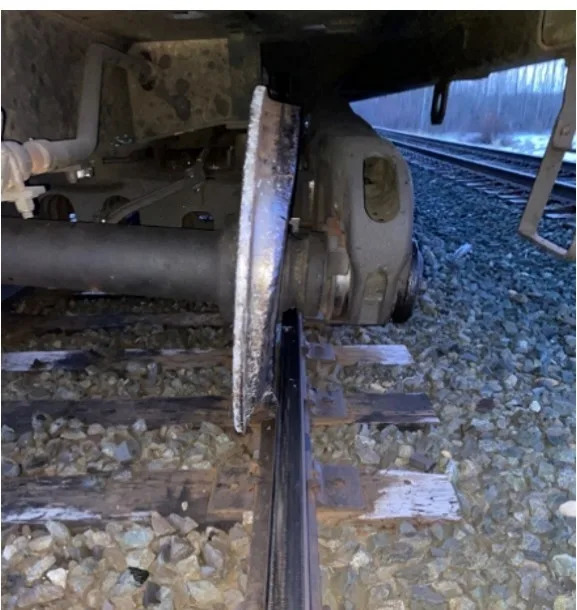
A wheel on a grain hopper suffered a rim failure, which damaged track and led to a derailment on CN. TSB
"Wheel irregularities and other conditions can be invisible to the naked eye and may be missed during visual inspections. They can also generate elevated impact forces against rails, potentially leading to derailments," the TSB said in a Sept. 24 news release.
Why WILD Data Matters
Railways use WILD systems to monitor wheel tread condition and measure impact forces. The TSB found that WILD measurements are typically assessed as independent, isolated events rather than evaluated as trends over time. As a result, rapidly deteriorating wheels can be missed until they fail.
In this occurrence the failed wheel had already produced an impact reading that met industry and Canadian National thresholds for removal and was scheduled to be removed in Edmonton. However, the wheel failed before reaching that location. A review of its WILD history showed peak impact forces increasing progressively at successive monitoring sites along the route.
As part of the investigation, the TSB performed an exploratory analysis of WILD data from this event and three other recent derailments involving broken-rim wheel failures. The analysis showed that enhanced, trend-based analytics applied to the WILD data railways already collect can improve early identification of wheels at elevated risk of failure and reduce the likelihood of similar derailments.
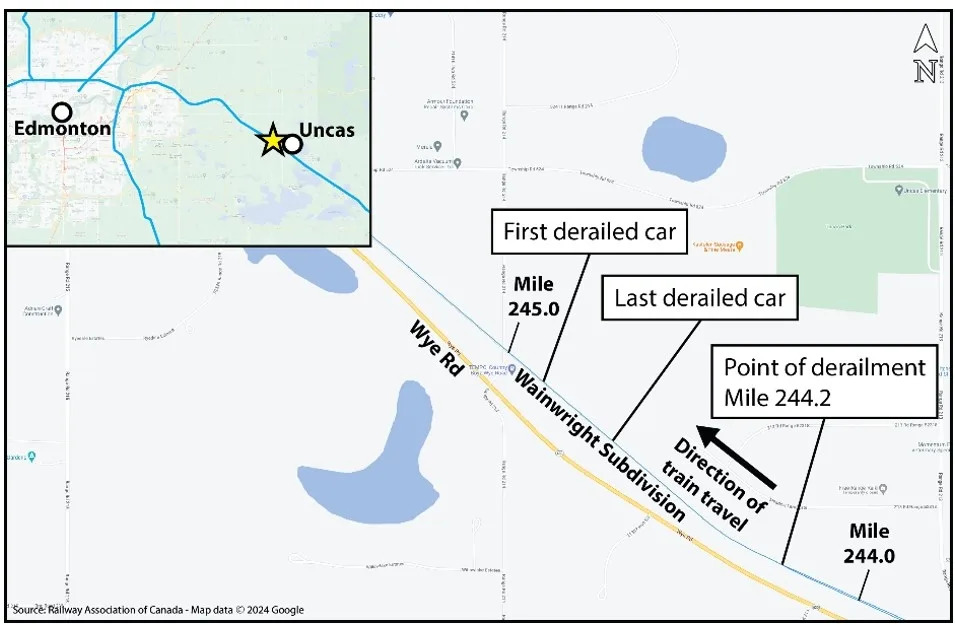
The April 2023 derailment occurred on CN's Wainwright Subdivision east of Edmonton, Alberta. TSB
Age and Manufacturing Standards
The failed wheel was manufactured in 1991, before the Association of American Railroads (AAR) introduced steel cleanliness standards in 2003. The TSB noted older wheels may contain larger or more numerous subsurface imperfections that increase susceptibility to sudden failure. There is currently no proactive replacement strategy for wheels manufactured before 2003, and the board expressed concern that reprofiling and returning these wheels to service may leave an unacceptable risk of in-service rim failures.
"The TSB has been investigating broken wheels and wheel failures for decades," said TSB Chair Yoan Marier. "Advanced analysis of data that is already collected can help identify wheel condition issues early. By better leveraging this data, Transport Canada and the rail industry have an opportunity to help prevent future derailments."
The derailment occurred on Canadian National's Wainwright Subdivision east of Edmonton, Alberta. The TSB's recommendation asks Transport Canada to work collaboratively with railways to establish an enhanced system that uses trend analysis and rate-of-deterioration metrics to more reliably identify wheels approaching failure.
To report news or errors: [email protected]
Help us improve.