Ground-penetrating radar has revealed the buried foundations of St. Clare's Convent beneath a soccer field in Roskilde, Denmark, mapping walls, cloisters and a church about six feet below the surface. Founded in 1256 and dismantled after the 16th-century Reformation, the convent's remains appear unusually well preserved. A limited excavation tied to nearby parking construction will focus on the eastern half of the complex and is expected to take six to 12 months. Archaeologists hope to recover artifacts, organic material and burials that illuminate medieval convent life.
Soccer Field Hides 13th-Century Convent: Radar Reveals St. Clare's Lost Monastery in Roskilde
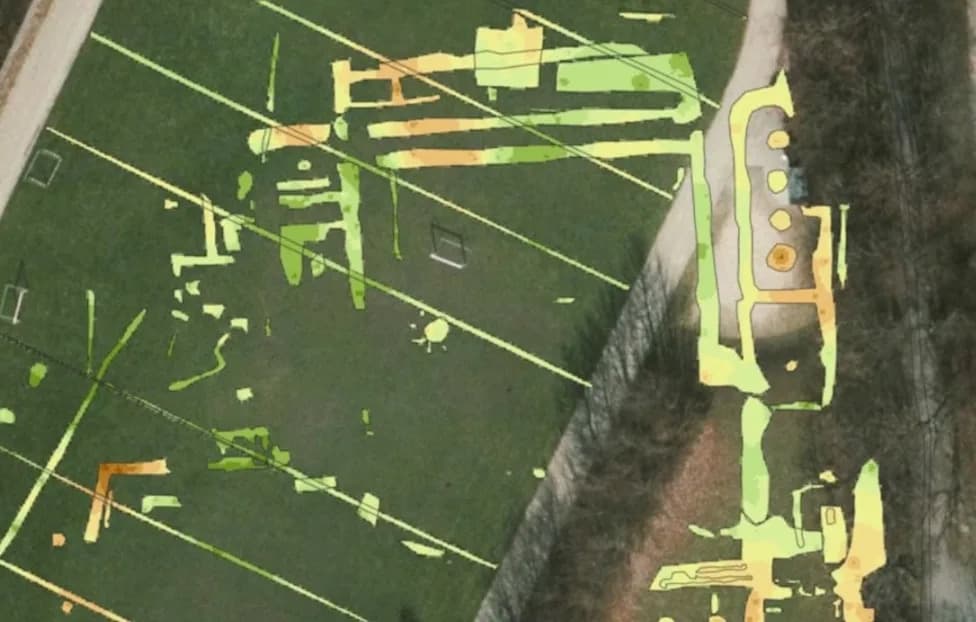
Photo Credit: National Museum of Denmark, NIKU
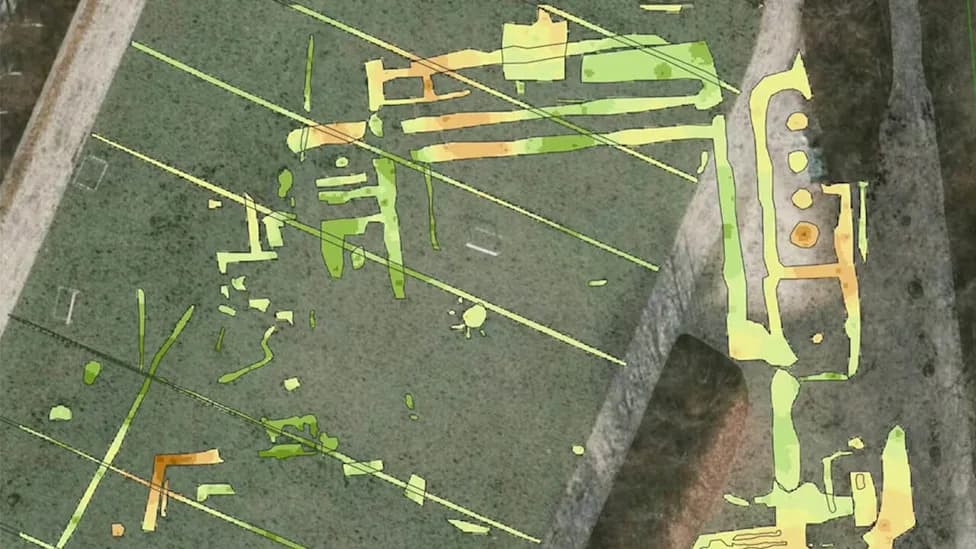
A sports pitch in Roskilde, Denmark, has revealed a far older occupant than goalposts and painted lines. Ground-penetrating radar (GPR) has mapped the buried remains of St. Clare's Convent roughly six feet beneath the playing surface, producing an unusually clear plan of a mid-13th-century monastic complex.
Discovery Through Non-Destructive Imaging
Using electromagnetic pulses, the GPR survey recorded reflections from subsurface features and produced detailed images that show internal divisions, cloistered spaces and a church located along the southern edge of the compound. Arne Abel Stamnes of the Norwegian Institute for Cultural Heritage Research called the clarity of the results exceptional.
"The results are simply impressive. GPR data do not always provide such clear images and often the interpretation requires extensive analytical work," Stamnes said.
Historical Context
St. Clare's Convent was founded in 1256 and was one of five medieval monasteries in Roskilde. The convent was closed and largely dismantled after the Protestant Reformation in the 16th century, and historians had long assumed it was mostly gone. The new radar data confirm well-preserved foundations survive beneath the field.
What the Images Reveal — and What They Don’t
The radar plan suggests the site contained a church, cloisters and a series of internal rooms. Combined with expectations from historical records, archaeologists infer spaces that likely included a refectory, a chapter house, a parlor for visitors, a kitchen, storage areas and specialized rooms such as a library or scriptorium. However, researchers cannot yet determine the exact number of rooms because parts of the complex may have risen to a second storey.
Planned Excavation And Conservation
A limited, carefully controlled excavation will take place in connection with construction of a nearby parking facility. Digging will be restricted to the area directly affected by development, with initial trenching focused on the eastern half of the complex. That opening phase is expected to take about six to 12 months.
Because GPR mapping is non-destructive, archaeologists were able to document the buried remains in detail before any soil was removed. This helps planners avoid unnecessary disturbance and protect historically important areas while development proceeds.
Why This Matters
Jesper Langkilde, a specialist in medieval archaeology, said the team hopes the excavation will recover well-preserved artifacts and organic remains that can illuminate daily life at the convent. He also expects burials that could reveal who the nuns were and who else was interred at the monastery.
"We hope to find lots of well-preserved artifacts and organic remains which can tell us about the daily life at the convent. Also, we expect to find a lot of burials which can tell us about whom the nuns were and who else was buried at the monastery," Langkilde said.
Similar surprising discoveries have emerged beneath modern surfaces elsewhere: reconstructed Iron Age defensive features in Denmark, two-thousand-year-old layers of ancient Paris beneath the plaza outside Notre-Dame, and the recovery in Barcelona of women and children from monastic tombs once attributed to a nobleman.
As imaging and targeted excavation proceed, the Roskilde site could offer a rare, well-preserved window into monastic architecture, daily routines and the people who lived, worked and were buried at the convent over centuries.
Help us improve.