Researchers produced a focused muonium beam by stopping antimuons in superfluid helium at ~0.2 K, creating a narrow, superthermal stream that exits at ≈2.2 km/s with ≈8% conversion efficiency. Detectors confirmed the beam's small velocity spread and directionality. The team aims to redirect the beam horizontally and use a three-grating interferometer to measure muonium's gravitational acceleration with about 1% precision within a few years.
Muonium Beam Aims at Einstein: New Antimatter Test of the Equivalence Principle
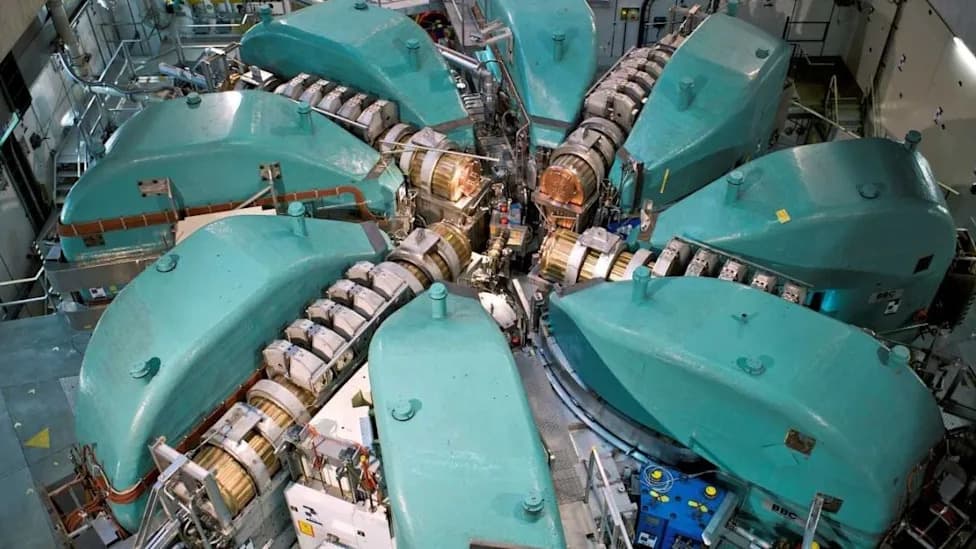
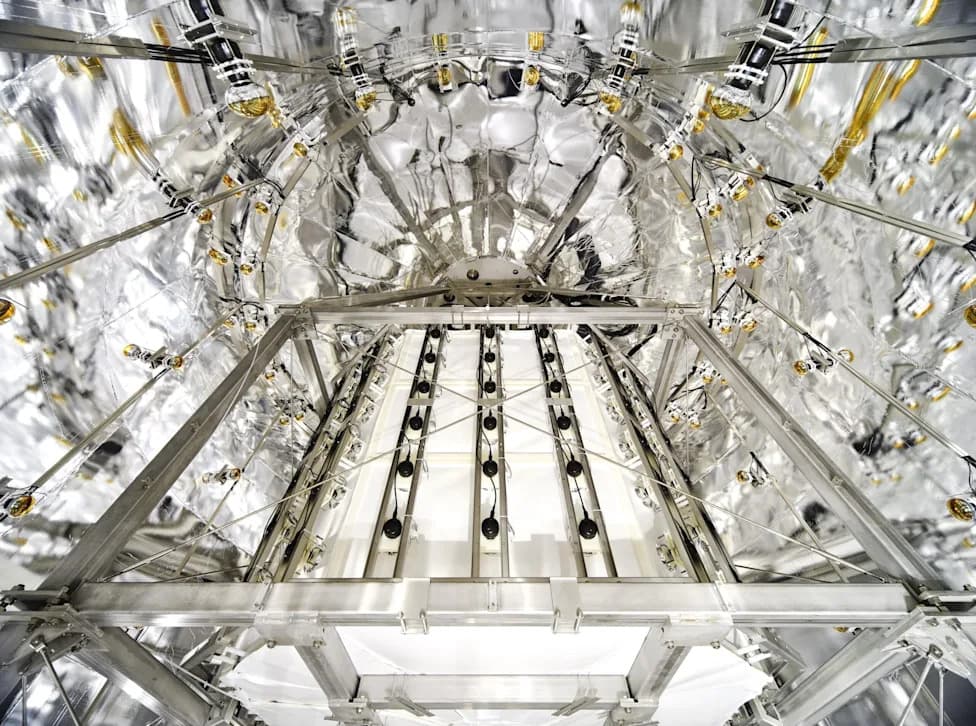
The particle accelerator at the Paul Scherrer Institute in Villigen, Switzerland, used to carry out the experiments. (Markus Fischer/Paul Scherrer Institute)
Researchers have created a directed beam of muonium — an exotic, electrically neutral atom-like system made of a positively charged antimuon bound to an electron — and demonstrated its promise for a direct test of Einstein's weak equivalence principle.

YouTube Thumbnail
What They Built
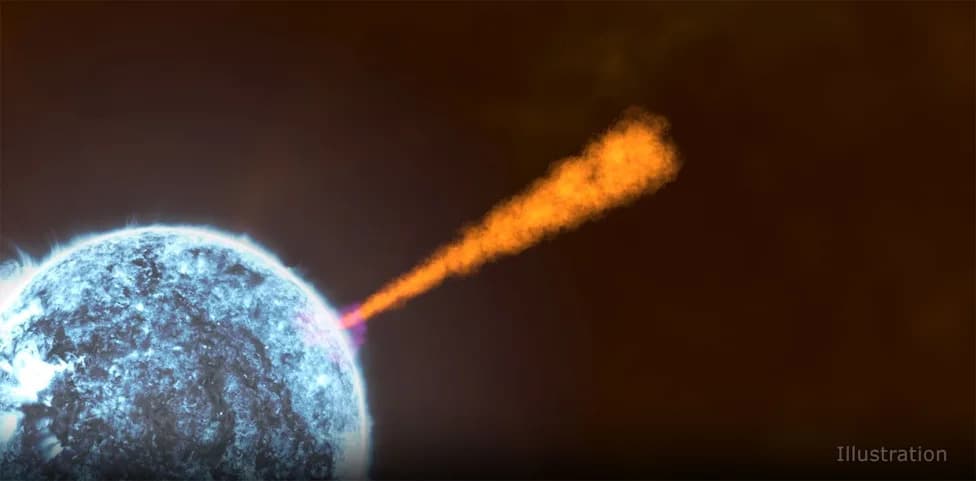
The team injected positive muons (antimuons) into a bath of superfluid helium cooled to roughly 0.2 K. There the antimuons slow and capture electrons to form muonium just beneath the liquid surface. Interaction with the superfluid gives the newly formed atoms an energetic nudge that expels them into the vacuum as a narrow, fast beam instead of the diffuse thermal spray typical of conventional sources.
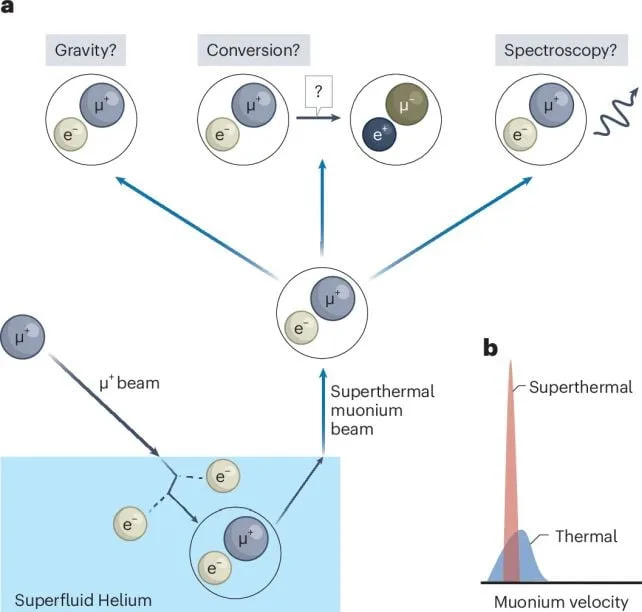
Positive muons enter superfluid helium, where they form muonium that emerges into vacuum as a narrow, superthermal beam. (Tang & Zhao,Nat. Phys., 2026)
Key Performance Metrics
The resulting superthermal muonium beam exits the helium at about 2.2 kilometers per second with a much narrower velocity spread than thermal sources. Conversion efficiency from incoming antimuons to muonium emerging into vacuum is roughly 8 percent. Detectors above the helium tracked muonium decay products and confirmed the beam's directionality and speed.
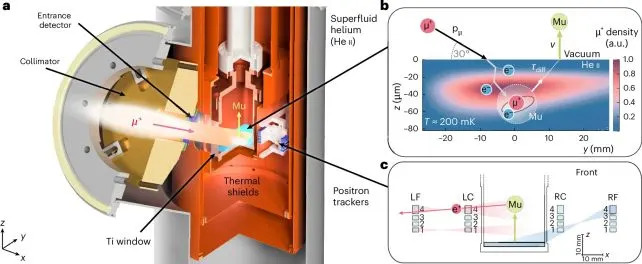
The experimental setup used to generate and detect the new superthermal muonium beam. (Zhang et al.,Nat. Phys., 2026)
Why This Matters
Muonium is unusual because most of its mass comes from an antimuon, the antimatter counterpart of the muon, which is an elementary second-generation particle roughly 200 times heavier than the electron. Prior gravity tests on antimatter, such as CERN's ALPHA experiment with antihydrogen, probed composite antiparticles. A gravity measurement with muonium would therefore test free-fall for a largely antimatter system built from an elementary, second-generation particle.

Subscribe to ScienceAlert's free fact-checked newsletter
Experimental Challenges and Next Steps
The major difficulty is lifetime: muonium exists for only about 2.2 microseconds before the muon decays. To make a gravity measurement within that tiny window, the researchers aim to reorient the beam from its current near-vertical launch into a horizontal trajectory and feed it into a precision interferometer.
The proposed interferometer would send the muonium through three extremely fine gratings spaced millimeters apart. Quantum interference will produce a pattern whose tiny vertical shift under Earth's gravity reveals the particle's gravitational acceleration. With the new beam as a source, the team estimates they could reach about 1 percent precision on muonium's gravitational acceleration.
Outlook
The researchers plan beam trials by the end of the year and expect the full gravity measurement within two to three years. If muonium falls differently from ordinary matter, the result could point to new physics such as a previously unknown force. If it conforms to general relativity, the measurement will still be a landmark test extending equivalence-principle checks to second-generation elementary particles.
Anna Soter, ETH Zurich: I want to measure, for the first time, whether the equivalence between gravitational and inertial mass also applies to the second generation of particles.
The research has been published in Nature Physics.
Help us improve.