Researchers are investigating why a 300-TeV photon from the October 9, 2022 gamma-ray burst nicknamed BOAT survived a two-billion-light-year journey when theory predicts it should have been annihilated by the cosmic microwave background. A Physical Review Letters paper suggests conversion to hypothetical axionlike particles could have let the photon avoid destructive interactions and then reconvert to a photon near Earth. The theory predicts a roughly one-hour delay for such an ultraenergetic photon compared with lower-energy burst photons — a timing pattern that matches observations from a Chinese observatory and Russia’s Carpet detector. Confirmation would provide a new way to probe quantum gravity and particle physics at unprecedented energies.
Why a 'Shouldn't-Exist' 300-TeV Photon From the BOAT Gamma-Ray Burst Reached Earth
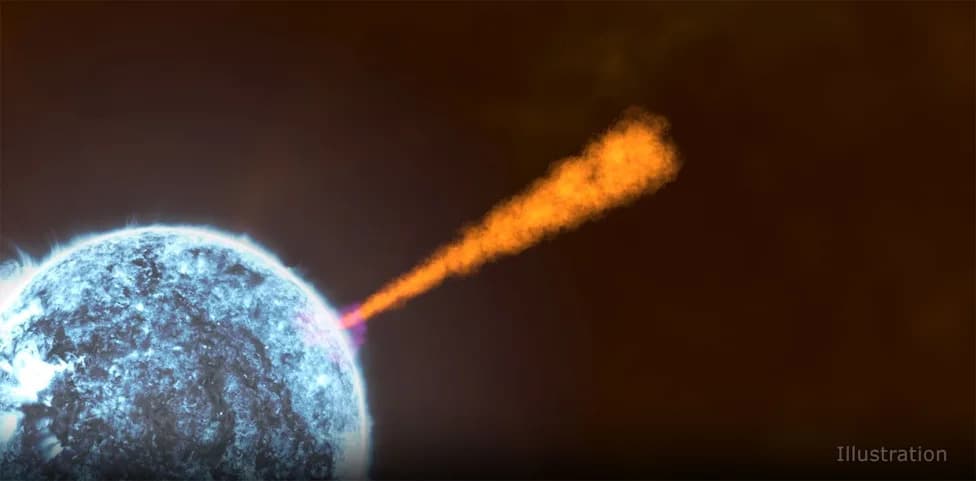
Pineapple on pizza and weekend rain are oddities we shrug off — but a tiny cosmic particle detected in 2022 posed a far stranger puzzle: by standard physics it should never have survived the long journey to Earth, yet it did.
The photon originated in an enormous gamma-ray burst roughly two billion light-years away that researchers nicknamed BOAT (the "brightest of all time"). When photons from BOAT arrived on October 9, 2022, one stood out. Russia’s Carpet detector recorded a photon with an energy of about 300 tera-electron-volts (300 TeV) — the most energetic photon yet observed from a gamma-ray burst and far beyond energies produced by human accelerators such as the Large Hadron Collider.
Why This Photon Shouldn't Have Survived
According to standard theory, a photon at this energy should have interacted with low-energy photons from the cosmic microwave background (CMB) via pair production, creating an electron–positron pair and being effectively annihilated long before reaching Earth. That makes the photon’s arrival surprising and challenges our expectations of high-energy photon propagation across cosmological distances.
A Possible Explanation: Axionlike Particles
In a new paper published in Physical Review Letters, two physicists propose a possible resolution involving hypothetical ultralight particles called axionlike particles (ALPs). The idea is that under certain conditions a high-energy photon can convert into an ALP, travel through space while largely immune to interactions that would destroy photons, and then convert back into a photon before detection. This mechanism could allow a 300-TeV photon to survive the trip.
The authors also note a timing signature: if this conversion-and-reconversion process occurred, the ultraenergetic photon would be expected to arrive at Earth roughly an hour later than lower-energy photons from the same burst. Intriguingly, a Chinese observatory recorded lower-energy photons about an hour earlier than the Carpet detection, consistent with the proposed sequence.
“The most interesting aspect of our work is that, for the first time, it brings together two ideas that until now had been developed separately,” said Marco Roncadelli, an astronomer at Italy’s National Institute for Nuclear Physics. “If future observations confirmed this scenario, the Universe would become a natural laboratory for studying quantum gravity at energies enormously higher than those achievable by any accelerator built on Earth.”
What This Would Mean and What’s Next
If validated, the ALP explanation would open a new observational window on fundamental physics, potentially probing quantum-gravity effects and new particle physics at energies unattainable in terrestrial experiments. However, the hypothesis remains tentative: confirming it will require more coincident observations of gamma-ray bursts, independent detections of similar ultraenergetic photons, and careful cross-checks of detector systematics.
For now, the BOAT photon remains a provocative clue that the Universe may hide surprises at the highest energies — and a prompt for astronomers and particle physicists to look closer.
Help us improve.