Researchers led by Ron Folman used a Quantum Galileo Interferometer and ultracold rubidium atoms in superposition to split atomic matter waves so one branch fell freely while the other was held in place. When recombined, interference measurements revealed a gravity-induced phase shift — the first such measurement showing the equivalence principle at the quantum scale. Published Sept. 2 in Science Advances, the result supports the applicability of quantum mechanics under free fall but does not yet constitute a quantum theory of gravity.
Einstein’s Equivalence Principle Observed at the Quantum Scale — First Measurement of Gravity-Induced Phase Shifts in Falling Atoms
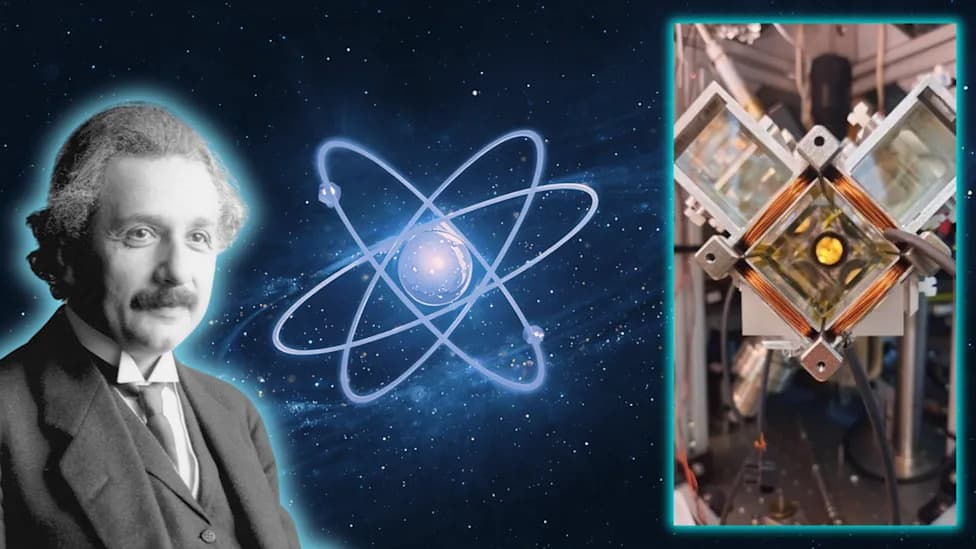
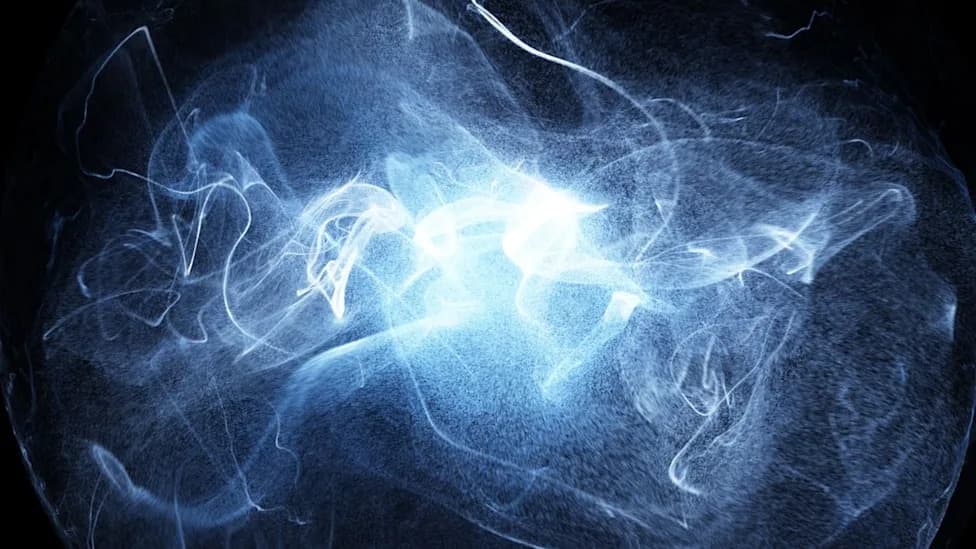
Einstein's equalance principle manifests in the quantum realm.
Researchers have produced the first experimental evidence that Albert Einstein’s equivalence principle applies to quantum objects. Using a specially built Quantum Galileo Interferometer, a team led by Ron Folman split and recombined atomic matter waves and measured gravity-induced phase shifts in falling ultracold rubidium atoms. The result demonstrates that free-fall affects the phase of a quantum wave — an important empirical step where quantum mechanics and general relativity meet, though it does not yet constitute a theory of quantum gravity.
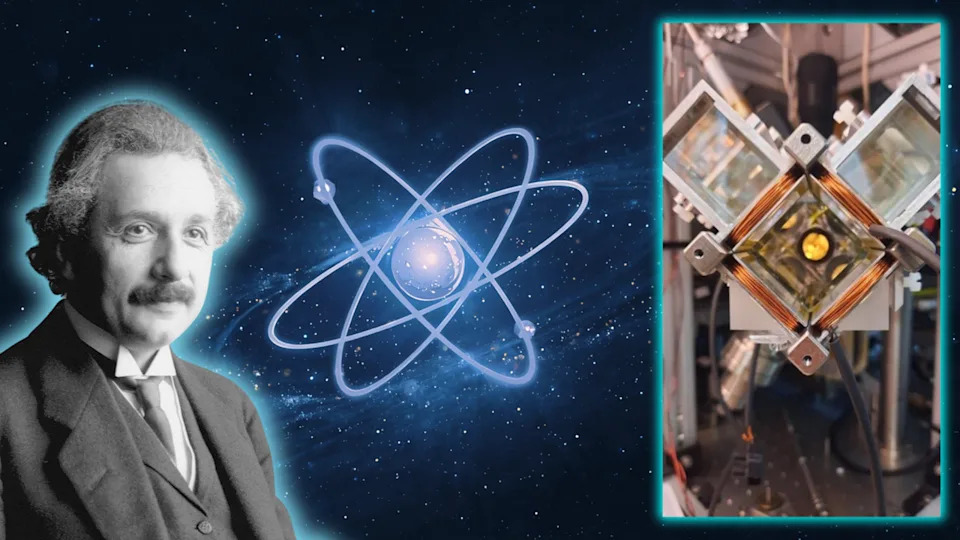
Einstein's equalance principle manifests in the quantum realm. | Credit: Or Dobkowski/Robert Lea (created with Canva)
Why This Matters
General relativity and quantum mechanics are the two pillars of modern physics, yet they remain formally incompatible. The equivalence principle — the idea that local experiments cannot distinguish between uniform acceleration and a gravitational field — is central to general relativity. Showing that this principle holds for quantum systems narrows the range of possible ways gravity and quantum theory can be unified and provides new experimental constraints for future theories.
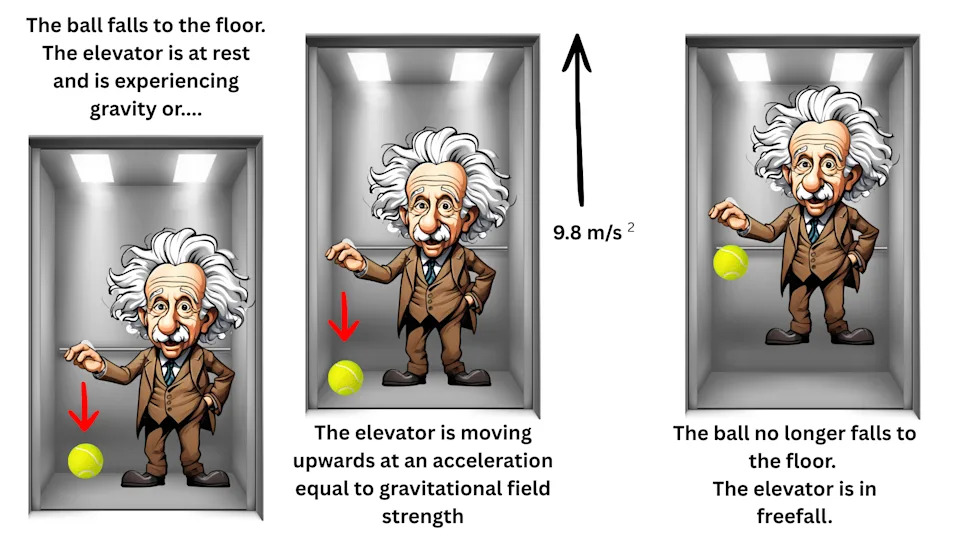
A demonstration of the equivalence principle. | Credit: Robert Lea (created with Canva)
How The Experiment Worked
The experiment used a Quantum Galileo Interferometer to split the matter wave associated with each atom into two distinct paths. The team cooled a cloud of rubidium atoms to near absolute zero and placed them close to the surface of a custom atom chip. Microwave pulses placed each atom into a quantum superposition so it could follow two paths simultaneously.
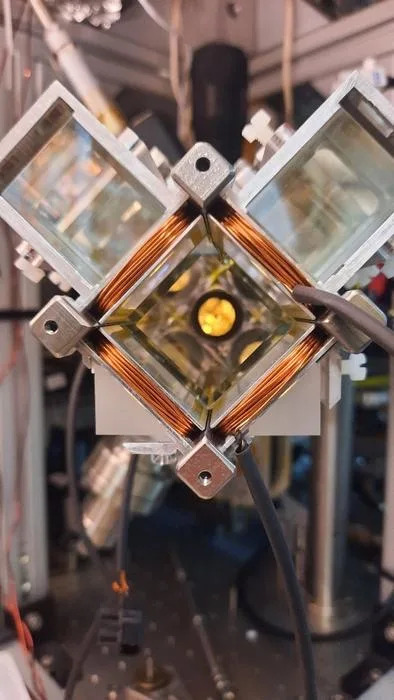
The 2D MOT apparatus which feeds the science chamber with cold atoms. At the center is a glass cell held under vacuum between coils producing magnetic fields. The atoms go into the science chamber through the tiny hole that may be seen in the center of the yellow (reflecting) surface. | Credit: Or Dobkowski.
Magnetic fields generated by the atom chip applied forces that held one branch effectively stationary while the other branch was allowed to fall freely under Earth’s gravity. After a controlled free-fall interval the two branches were recombined, and interference of the matter waves was measured to extract phase differences introduced by the gravitational free fall.
Key Findings
The researchers report the first experimental measurement of how free fall and gravity affect the phase of a quantum wave. Interference fringes revealed a gravity-induced phase shift consistent with the equivalence principle acting on a quantum system. Team members emphasize that the experiment confirms the applicability of quantum mechanics under gravitational free fall, but it does not detect quantum gravity itself.
Ron Folman (Ben-Gurion University of the Negev): “This work combines a demanding experiment with a far-reaching theoretical interpretation about how relativity and quantum theory might be unified.”
Vlatko Vedral: “We have no consistent theory telling us why quantum physics should fail. This experiment pushes quantum mechanics into one of its most intriguing frontiers, gravity, and shows that its predictions hold.”
Publication And Next Steps
The study, led by Ron Folman and collaborators, was published on Sept. 2 in Science Advances. While the result does not provide a quantum theory of gravity, it opens a new experimental window on the interplay between quantum phase and gravitational free fall. Future experiments will aim to increase sensitivity, explore different atomic species and configurations, and test whether any deviations from the equivalence principle appear at higher precision.
Bottom Line
This experiment marks an important empirical milestone: the equivalence principle has been observed affecting the phase of a quantum wave for the first time. It strengthens confidence that quantum mechanics remains valid in a gravitational context and gives theorists and experimentalists a clearer empirical target as they pursue a unified description of nature.
Help us improve.