Italy plans to convert its biggest steelworks in Taranto to electric furnaces after courts ordered the blast furnaces closed, but critics say the government's plan lacks essential details on funding, capacity and jobs. The plant faces an October 28 shutdown while an appeal is set for October 20. Interested buyers include Jindal Steel and the Flacks Group, yet unions and experts insist the state must define investment requirements and employment guarantees before a sale.
Taranto's Turning Point: Italy's Plan To Convert Its Largest Steelworks To Electric Faces Scrutiny
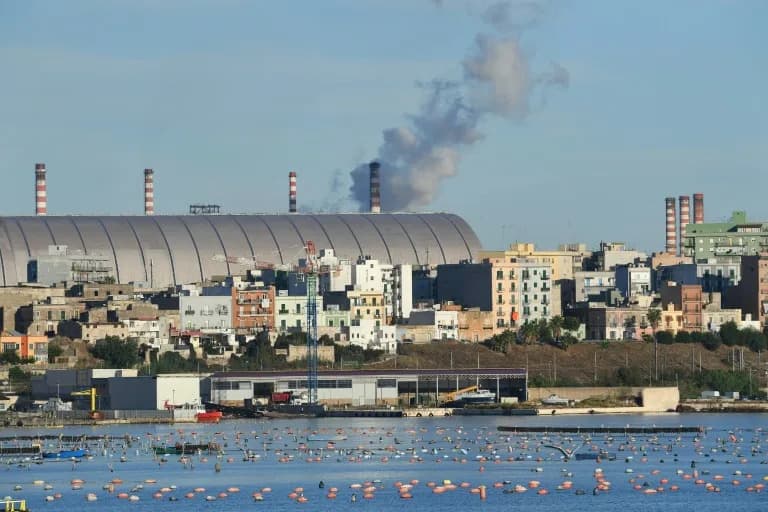
Rome says Italy's largest steel works must be converted to electric (Andreas SOLARO)
Italy's government has announced plans to convert the country's largest steel complex in Taranto to electric operation after a court-ordered shutdown of polluting blast furnaces, but experts, unions and potential buyers say Rome's proposal lacks key details on costs, capacity and jobs.
Background
The plant, formerly known as Ilva and now operated by Acciaierie d'Italia, was placed under state administration in February 2024 to protect employment in a region with very high joblessness. The site has been ordered to shut its blast furnaces by October 28 because of asbestos contamination and illegal concentrations of fine airborne particles. The dispute has reached Italy's highest appeals court, which is due to rule on October 20.
Government Plan: Electric Furnaces And DRI
Rome says any revival must be "green," with steelmaking converted to electric furnaces fed by DRI (direct reduced iron) instead of traditional coal-fired blast furnaces. Alfredo Mantovano, a senior aide to Prime Minister Giorgia Meloni, said the government "intends to enable steel production to continue" and that "resources for DRI... are already available and the government intends to use them."
Unanswered Questions
“It is difficult to understand what the future prospects are because it is not clear what the industrial plan is,” said Carlo Mapelli, a materials engineering professor at Milan's Politecnico. He added that it is unclear who would cover the large investments needed to install electric furnaces.
Experts say other crucial details are missing: how many electric furnaces will be needed, the plant's optimal production level after conversion, where DRI feedstock and other raw materials will come from, and what public funding or guarantees will be provided to bridge the investment gap.
Buyers, Jobs And Local Stakes
So far, offers or expressions of interest have been lodged by India's Jindal Steel, the US-based Flacks Group, and a consortium of Italian firms. Acciaierie d'Italia warns that the complex cooling procedures needed to shut the blast furnaces safely — currently operating at reduced capacity — could jeopardize production across the site. The facility directly employs about 8,000 people and supports a broad network of contractors, making any transition politically and socially sensitive.
What Comes Next
Unions such as USB are calling on the government to spell out a clear industrial plan before the sale: the number of electric furnaces required, the scale of public investment, and the employment guarantees that will follow a transfer to private ownership. Many analysts argue that no private buyer alone can afford the overhaul and that a central, active state role will be required to secure both the green transition and local jobs.
Why it matters: The Taranto case sits at the intersection of environmental law, industrial policy and regional employment. How Rome balances decarbonization goals with social and economic realities will be a test both for the government and for Italy's broader industrial strategy.
Help us improve.