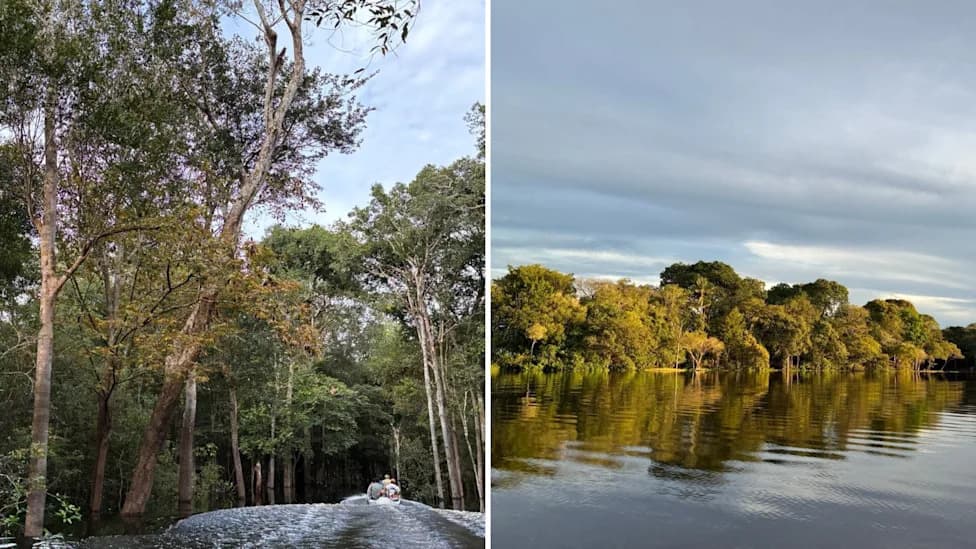
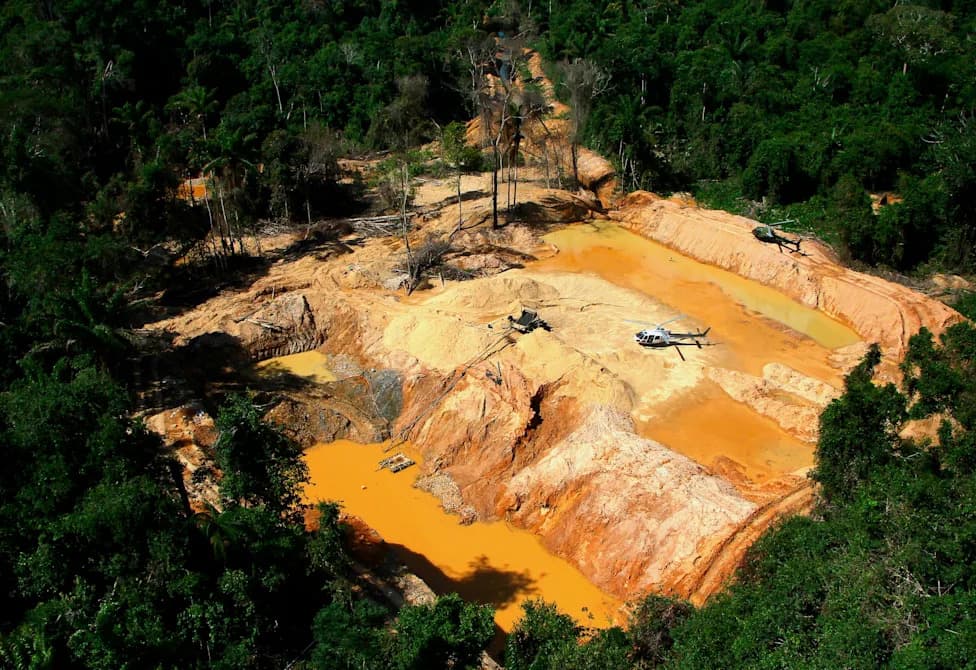
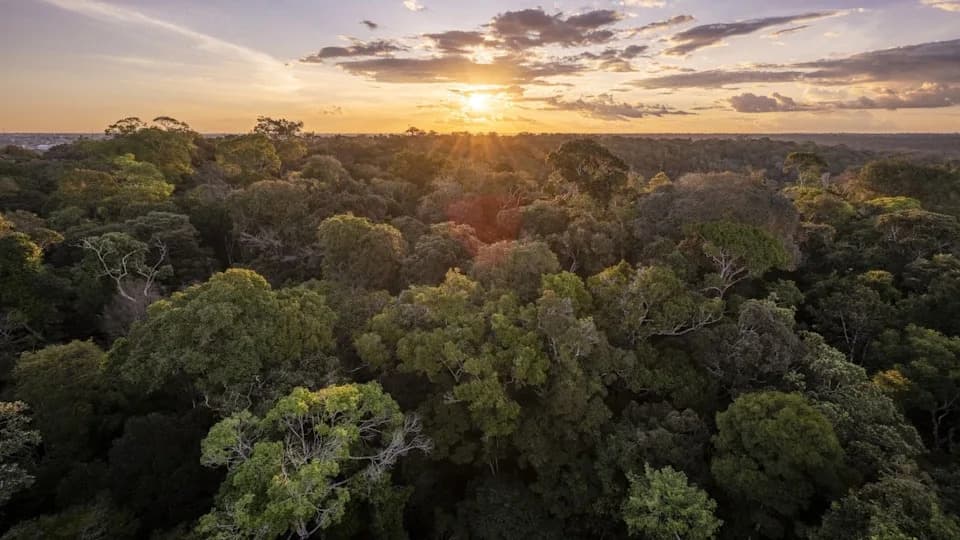
Brazil reported the lowest Amazon deforestation in a decade, a trend credited in part to President Lula’s stepped-up enforcement and supply-chain transparency efforts. But experts warn the gains are fragile: the Amazon Soy Moratorium collapsed this year and major firms like JBS have backtracked on pledges. A Science study estimates up to 1.4 million hectares could be lost over the next decade unless stronger government action and corporate accountability follow.
Amazon’s Decade-Low Deforestation Could Be Temporary — Scientists Warn of 1.4M-Hectare Risk
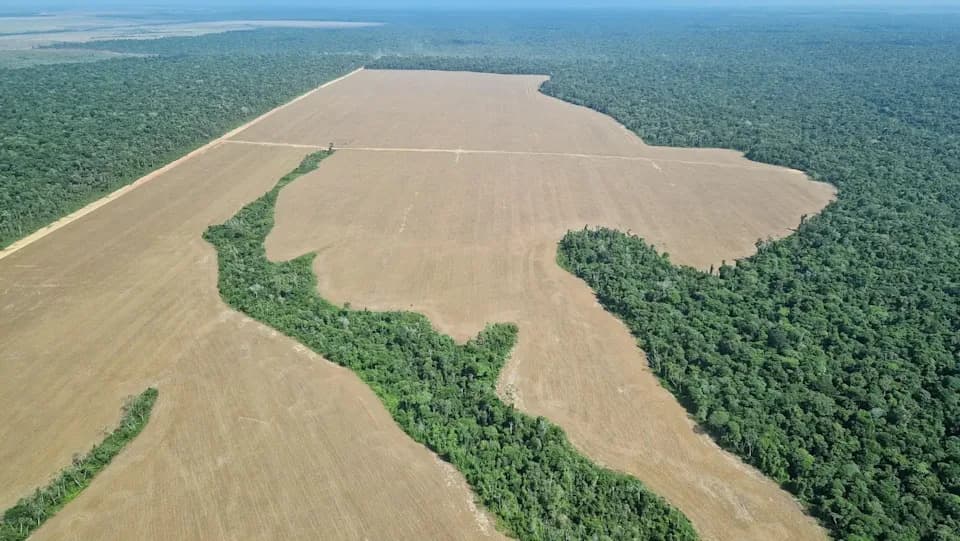
Area that has been cleared for soy cultivation in the Amazon rainforest near the Brazilian city of Belém.
Brazil’s national space agency reported this month that deforestation in the Brazilian Amazon has fallen to its lowest level in a decade. The drop has been widely cited as proof of progress under President Luiz Inácio Lula da Silva, who pledged to eliminate illegal deforestation by 2030 and has tightened enforcement and monitoring since returning to office in 2023.
But environmental experts and recent research caution that these gains are fragile and could be reversed without stronger, sustained action from government and industry.
New Study Projects Significant Future Losses
A team of scientists working in the U.S. and Brazil published a paper in Science estimating the Amazon could lose about 1.4 million hectares to deforestation over the next decade—roughly equivalent to two million soccer fields. That projection reflects risks tied to commodity-driven expansion, especially soy cultivation, and gaps in both private-sector commitments and enforcement of existing laws.
Why Soy Matters Again
Before the soy moratorium was adopted, soy cultivation was a major driver of forest clearing. In Mato Grosso, Brazil’s largest soy-producing state, about 25% of soy output from 2001 to 2005 came from newly cleared forest. A public campaign led by Greenpeace helped spur the creation of the Amazon Soy Moratorium, a voluntary pact that forbade members from buying soy grown on lands deforested after July 2008. "People generally followed it," said Lisa Rausch, co-author of the Science paper. "There weren’t many violations, especially in the early years. This made post-2008 deforested land less valuable to soy traders."
In January, however, a group of agrifood companies left the moratorium. Researchers and advocates warned that the pact’s collapse could reopen pressures for soy-driven clearing. Ane Alencar, director of science at the Amazon Environmental Research Institute (IPAM), said lands cleared after 2008 and currently used for cattle could be converted to soy, pushing ranchers into new frontiers and driving fresh deforestation elsewhere in the Amazon.
Private Promises, Public Pressure
Private-sector commitments are also weakening. This month JBS, the world’s largest meatpacker, publicly retreated from its pledge to reach net-zero deforestation by 2040; company officials had previously acknowledged the target was largely aspirational. Alencar nonetheless argued that companies remain sensitive to public opinion and consumer campaigns: targeted pressure can still shape corporate behaviour in sourcing and supply-chain traceability.
Laws, Enforcement, And Limits
Brazil maintains legal tools intended to limit agricultural clearing, including the Forest Code, which restricts how much land can be deforested for farming. When land is cleared illegally, owners can be fined and the property placed under embargo, preventing commercial agricultural use. Yet Rausch’s analysis found that roughly 20% of soy farms in the Amazon carry embargoes for illegal clearing, underscoring persistent economic incentives for deforestation.
Elsewhere in the region, Colombia recently passed a first-of-its-kind law to improve traceability in its beef industry: over two years authorities must work across the supply chain—ranchers, slaughterhouses, processors, auctioneers and exporters—to ensure animals and meat do not come from illegally deforested lands. Rausch called the move a strong signal, but said its impact will depend on implementation.
Political Risks Ahead
Experts warned that political shifts could also endanger recent gains. With President Lula seeking reelection against Flávio Bolsonaro, son of former president Jair Bolsonaro, Ane Alencar said progress could be rolled back under a more anti-environment administration: "I’m afraid that all of these results that we have achieved—they’ll really be in danger if the government becomes more anti-environmental."
Bottom line: The latest low in Amazon deforestation is welcome, but scientists and campaigners say it is likely to be temporary unless governments and companies strengthen policies, enforcement and supply-chain accountability.
Originally published by Grist on Jul 23, 2026.
Help us improve.