New analysis by IPAM shows gold mining in the Amazon has expanded dramatically, with Indigenous lands experiencing the largest increase — about 24 times more area affected since 1985 and nearly a sevenfold rise from 2016 to 2024. The mining boom, driven by soaring gold prices, is worsening deforestation and mercury pollution, and contributing to spikes in malaria, infant mortality and developmental delays among children. Authorities have increased enforcement and forensic tracing under President Lula, but illegal operations persist and are tied to transnational criminal networks.
Gold Rush in Brazil’s Amazon Hits Indigenous Lands Hardest, New Analysis Finds
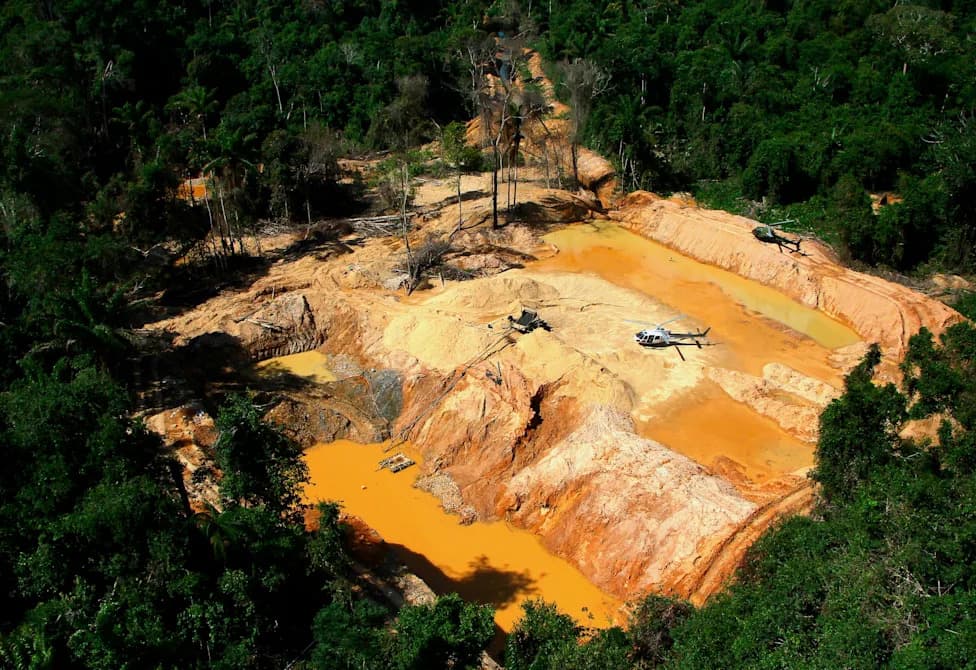
FILE - An illegal mining camp is visible from a Brazil Environmental Agency helicopter during an operation to try to contain illegal mining in Yanomami Indigenous territory, Roraima state, Brazil, Feb. 11, 2023. (AP Photo/Edmar Barros, File)
Indigenous territories in Brazil’s Amazon are bearing the brunt of a renewed gold-mining boom, according to a new analysis released by the nonprofit Amazon Environmental Research Institute (IPAM).
IPAM found that the total area affected by gold mining across the Amazon in 2024 was roughly 20 times larger than in 1985. The increase on Indigenous lands was even steeper: mining now covers about 24 times more area than in 1985 and expanded nearly sevenfold between 2016 and 2024.
Economic Drivers and Environmental Costs
Record-high gold prices — driven largely by investor demand for safe assets amid rising global risks — have fueled a new wave of mining. The surge is accelerating deforestation and releasing mercury into rivers, with serious consequences for riverine and Indigenous communities that depend on aquatic resources.
Health, Climate and Social Impacts
IPAM warned that mining is compounding climate-related threats to Indigenous peoples. Climate change has intensified droughts and extreme heat in the Amazon, undermining traditional food and water sources. At the same time, illegal mining contaminates waterways, accelerates environmental degradation, and increases health problems and violence, weakening communities’ capacity to adapt.
“Extreme weather events threaten access to water, food, transportation and healthcare,” IPAM said. “Expanding illegal mining contaminates rivers, accelerates environmental degradation and fuels health problems and violence, further weakening Indigenous communities' ability to adapt.”
Health impacts documented by Indigenous leaders in the Munduruku territory include a surge in malaria cases, higher infant mortality rates and mercury exposure linked to developmental delays in children’s language and motor skills.
Where the Damage Is Concentrated
Almost 90% of the land affected by mining is concentrated in three territories, including the Munduruku Indigenous Territory in the northern state of Pará. Munduruku leaders presented satellite images and field-monitoring reports showing illegal miners returned after federal operations in 2024 and 2025 temporarily displaced them. Indigenous monitors had identified 10 new illegal mining sites in the territory by August.
Enforcement and Organized Crime
Under President Luiz Inácio Lula da Silva, federal police and environmental agencies have stepped up major operations against illegal mining and used forensic methods to trace gold and identify illicitly mined metal. Nonetheless, enforcement has not eliminated illegal activity: when equipment is destroyed in one area, miners often move or return once officials leave.
The Articulation of Indigenous Peoples of Brazil (Apib) warns the problem is linked to a transnational criminal economy in which armed groups control extraction and transport, and illegal gold and drug trafficking often move along the same river routes. Apib says mining permits are sometimes used to give an appearance of legality to illicitly extracted gold.
Legal and Government Response
Brazilian law prohibits mining on Indigenous lands. In a Sept. 10 statement, Brazil’s Ministry of Human Rights said government officials attended hearings with the Inter-American Court of Human Rights and discussed stepped-up territorial enforcement, improvements to water supply and food security, and the need for a more detailed technical response to mercury contamination.
The Associated Press’ climate and environmental coverage receives financial support from private foundations; AP is solely responsible for the content and its editorial standards. For more information on AP’s funding and standards, see AP.org.
Help us improve.