The New England Aquarium’s aerial team recorded two rare blue whale encounters on consecutive days off Massachusetts: one on February 27 inside the Northeast Canyons and Seamounts Marine National Monument and two more about 15 miles south of Martha’s Vineyard the next day. Scientists note sightings outside Canadian feeding grounds are uncommon and estimate only 400–600 blue whales may inhabit the Western North Atlantic. Aerial surveys provide crucial population and health data, and conservationists are concerned after the recent lifting of commercial fishing protections in the monument.
Rare Blue Whales Spotted Off Massachusetts Coast on Back-to-Back Days
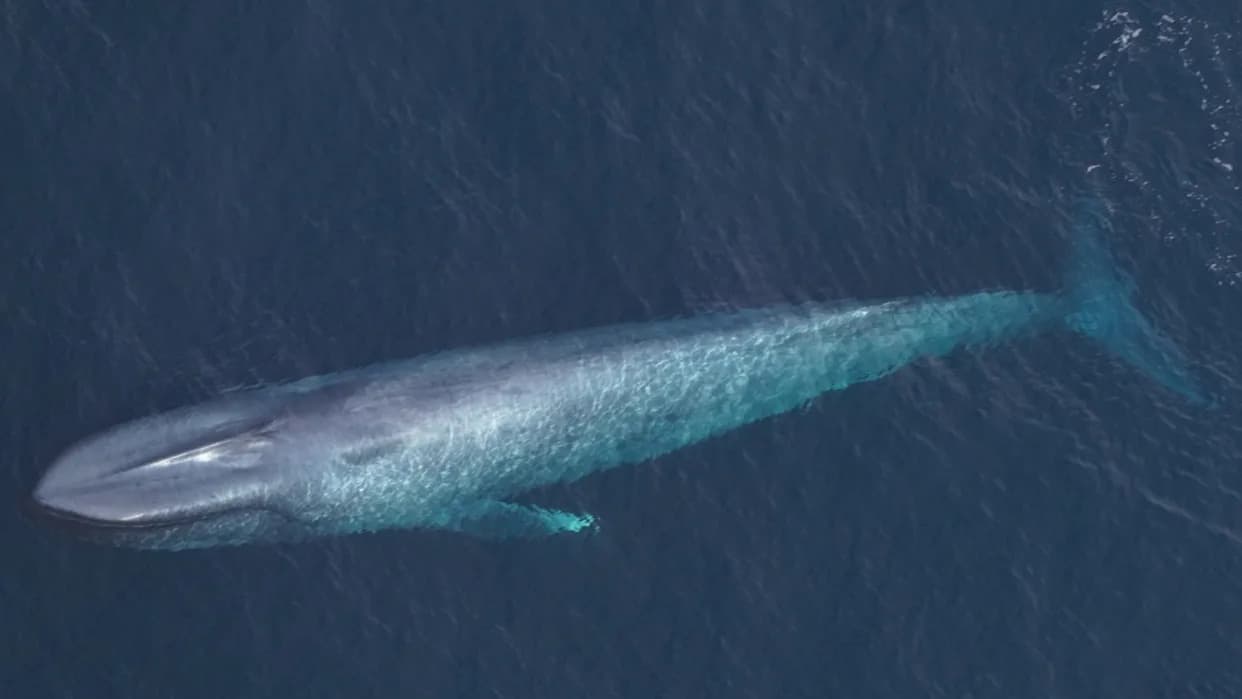
Blue whales can be found in every ocean except the Arctic.
The New England Aquarium’s aerial survey team recorded two rare blue whale sightings on consecutive days off the coast of Massachusetts, an unusual and encouraging event for the species in the Atlantic.
The first sighting, on February 27, took place within the Northeast Canyons and Seamounts Marine National Monument, a protected offshore area south of Nantucket. Approximately 24 hours later, the same team observed two additional blue whales about 15 miles south of Martha’s Vineyard while flying over southern New England waters.
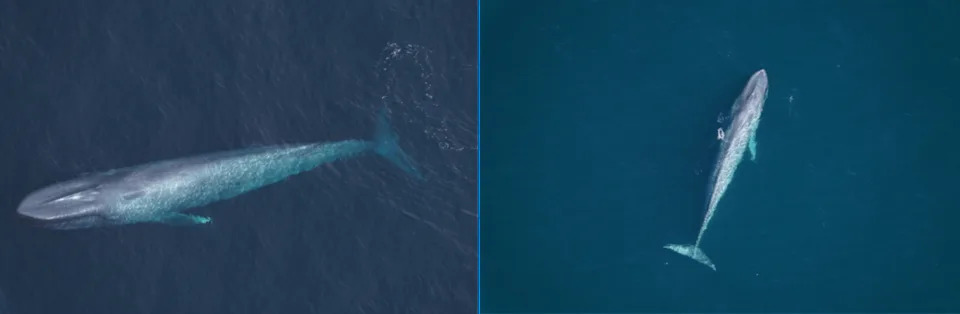
A blue whale seen by the New England Aquarium’s aerial survey team over Northeast Canyons and Seamounts Marine National Monument on Feb. 27, 2026 (left). One of two blue whales sighted over southern New England waters on Feb. 28, 2026 (right).Image: New England Aquarium.
“Seeing blue whales outside of their Canadian feeding grounds is rare in the Atlantic,” said Katherine McKenna, Associate Research Scientist at the Anderson Cabot Center for Ocean Life. “Finding them in two different areas of the ocean just 24 hours apart was a first for us.”
Blue whales (Balaenoptera musculus) are the largest animals known to have lived on Earth and occur in every major ocean except the Arctic. Their numbers were severely reduced by commercial whaling, and they remain listed as endangered under the U.S. Endangered Species Act, although global populations have shown signs of recovery in recent decades.
Researchers have limited data on the Western North Atlantic population and estimate there may be just 400–600 individuals in that region. Aerial surveys like these are essential for estimating population size, tracking seasonal and geographic distribution, and monitoring the health of individual animals.
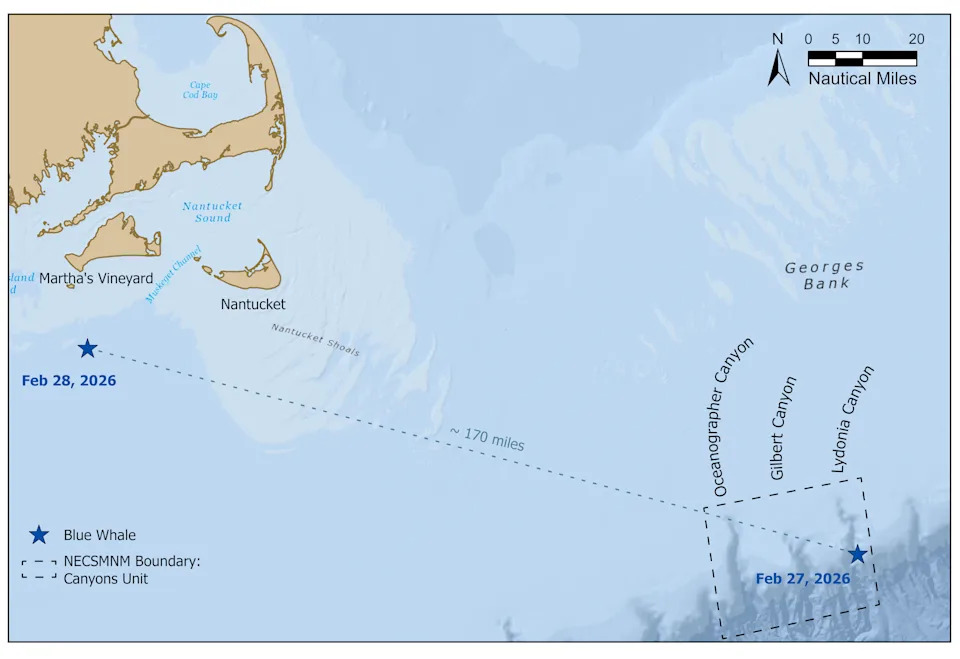
The whales were spotted off the coast of Nantucket and Martha’s Vineyard.Image: New England Aquarium.
“Aerial surveys are critically important for studying highly migratory species such as whales, sea turtles, and sharks, which can range across vast areas of the ocean,” McKenna, who participated in both flights, told Popular Science. “These surveys help scientists estimate population sizes, determine where and when species occur, and monitor individual health.”
The sightings occurred amid renewed debate over protections for the Northeast Canyons and Seamounts Marine National Monument. Last month, the Trump Administration lifted the prohibition on commercial fishing in the monument — a policy change that conservationists warn could increase risks to the animals and their habitat.
“This Monument supports amazing species from the seafloor to the sea surface, and we see evidence of that during every aerial survey,” said Jessica Redfern, Associate Vice President of Ocean Conservation Science at the Anderson Cabot Center for Ocean Life. “Removing protections for Northeast Canyons and Seamounts Marine National Monument puts these species at risk.”
Researchers emphasize that continued monitoring and protective measures are vital to safeguard these rare visitors and the broader marine ecosystem they inhabit.
Help us improve.