Scientists, officials and conservationists convened in Newport, Oregon to confront a steep decline in eastern gray whales along the U.S. West Coast, a drop of roughly 50% in the last decade. Researchers blame Arctic warming for the collapse of the whales' prey and record-low births, while malnourished animals face increased risk from ship strikes and entanglement. NOAA has missed a deadline to respond to a petition to relist the species under the Endangered Species Act, prompting legal action by conservation groups. Meanwhile, advocates push immediate measures — notably voluntary 10-knot speed limits and targeted monitoring — to reduce collisions and buy time for longer-term climate solutions.
Gray Whales Are Starving as the Arctic Warms — Will the U.S. Protect Them?
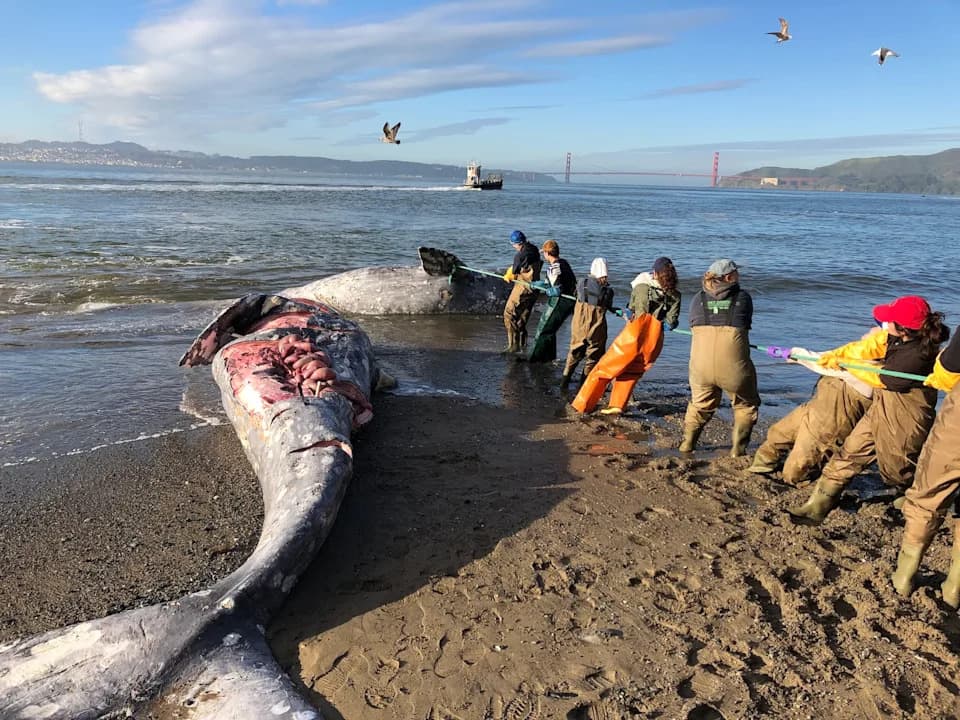
Experts from the Marine Mammal Center and the California Academy of Sciences pull in a gray whale carcass found in the San Francisco bay for examination.
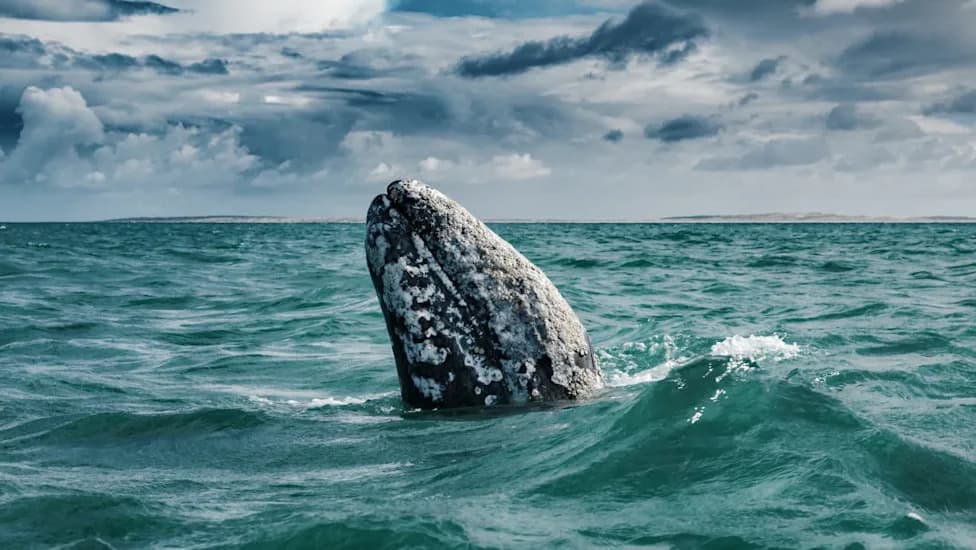
Several hundred scientists, government officials and conservationists gathered in Newport, Oregon for an urgent two-day meeting focused on one species: the eastern gray whale. The gathering reflected alarm over a dramatic population decline along the U.S. West Coast — roughly a 50% drop over the past decade — and an unusually high number of strandings and deaths this summer.
Key figures: this summer 187 gray whales washed ashore across the region, and researchers estimated only 85 calves were born last year compared with a typical ~1,000. U.S. government scientists estimate eastern gray whales peaked at about 25,000–30,000 animals in 2016, with current estimates ranging from roughly 11,700 to 17,000.
Why scientists point to the Arctic
Eastern gray whales feed on benthic crustaceans in Arctic waters near Alaska during the summer and then migrate to Mexico to give birth — one of the longest migrations of any mammal. Arctic warming, which is occurring at roughly four times the global average, has reduced sea ice and triggered cascading ecosystem changes that scientists say have sharply reduced the whales' prey. The leading hypothesis is that many whales are beginning their migration undernourished, with insufficient energy reserves to reproduce or survive the journey.
“As goes Arctic sea ice, so goes the gray whale population,” said Richard Steiner, a marine conservation biologist who submitted the petition to relist gray whales. “If we don't reduce greenhouse gas emissions, the consequences could be apocalyptic for gray whales and many other species.”
Policy, legal fights, and federal response
Although NOAA scientists participated in the Newport meeting, presenters avoided politics out of concern about federal funding and employment ties. NOAA missed a legal deadline to respond to a petition to relist eastern gray whales under the Endangered Species Act, and at the end of August three conservation groups filed a notice of intent to sue if the administration does not act. Conservation attorneys say a formal listing would trigger recovery planning and open federal funding avenues for monitoring, research and habitat protections.
Attendees also voiced concern about staffing and budget cuts at NOAA, proposals to eliminate the Marine Mammal Commission and rollbacks of habitat protections — factors that could hamper research and conservation efforts.
Other threats and regional context
Malnutrition likely worsens whales' vulnerability to other threats along migration routes, including ship strikes and entanglement in fishing gear. Scientists have recorded an uptick in strandings around the San Francisco Bay Area; researchers estimate that at least one-fifth and possibly up to half of gray whales entering the bay are killed by ship collisions. In some cases, carcasses sink before they can be documented, so official counts may underestimate total mortality.
Western Pacific gray whales are faring even worse, with only a few hundred remaining, and the Atlantic gray whale went extinct centuries ago — the only recorded whale extinction in human history — highlighting how vulnerable whale populations are to human impacts.
Immediate actions and mitigation
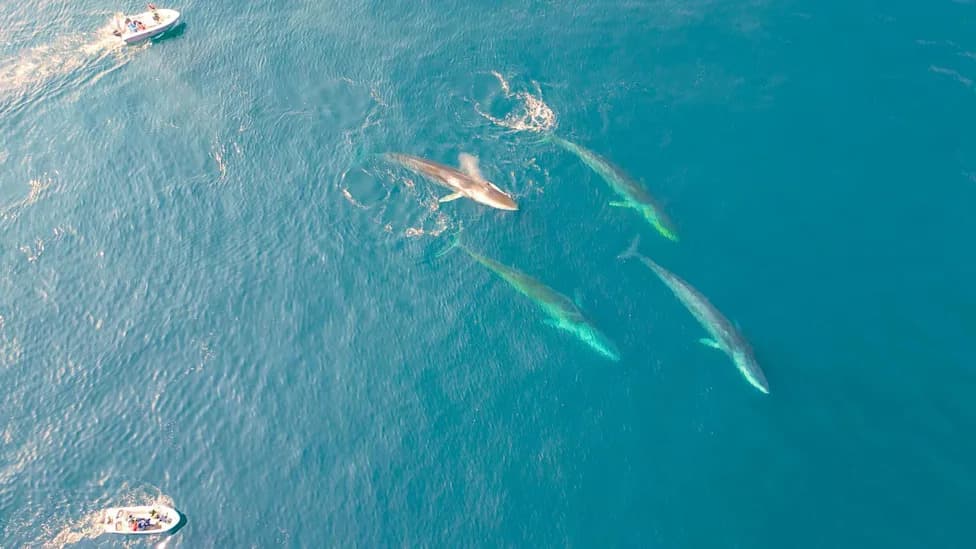
Even without an endangered listing, conservation groups and researchers are promoting near-term protections. One proven measure is slowing large vessels near whale hotspots: reducing speed to 10 knots or less markedly increases a whale's chance of surviving a collision. Projects such as Whale Safe (using sonar, thermal cameras and satellite tags) and voluntary slowdown programs (including Blue Whales Blue Skies) map whale locations and incentivize shipping companies to reduce speed. On parts of the U.S. East Coast, mandatory speed limits exist; on the West Coast, limits remain mostly voluntary.
Scientists emphasize that these interventions buy time for longer-term climate solutions that address the root cause: warming-driven Arctic ecosystem change.
What comes next
Researchers and advocates say the science is clear: eastern gray whales face a severe, climate-driven crisis that requires both immediate mitigation (slower ships, improved monitoring, response efforts) and policy action (listing decisions, recovery planning and broader climate policies). If federal agencies fail to act on the petition, conservation groups are likely to pursue litigation to compel a science-based decision.
Bottom line: The fate of the eastern gray whale hinges on rapid, coordinated responses — from science, policy and industry — to reduce immediate threats and address the underlying impacts of Arctic warming.
Help us improve.