A study in Geophysical Research Letters reports a statistically significant acceleration in global warming after researchers filtered short-term variability from five major temperature datasets. The estimated warming rate rose from ~0.2°C per decade (1970–2015) to ~0.35°C per decade (2015–2025), a roughly 75% increase. If this faster rate persists, the 1.5°C threshold could be reached before 2030; experts applaud the careful methodology but caution that natural variability remains a complicating factor.
Study: Global Warming Accelerated 75% Over Past Decade — 1.5°C Could Arrive Before 2030
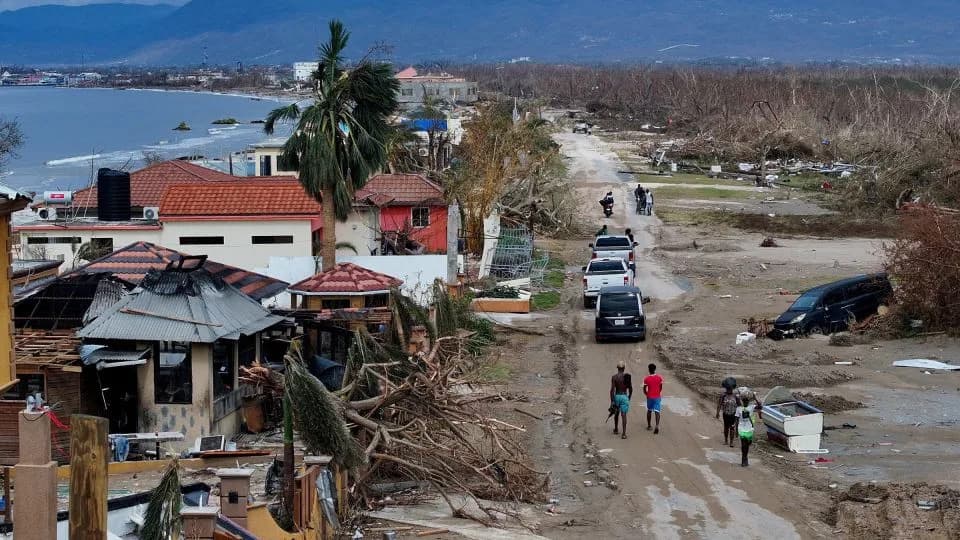
The aftermath of Hurricane Melissa in Black River, Jamaica, on October 30, 2025. A new study finds the rate of global warming is accelerating — and every fraction of a degree of warming brings more catastrophic impacts. - Maria Alejandra Cardona/Reuters
A new study published in Geophysical Research Letters finds that global warming has accelerated over the past decade, raising the possibility that the internationally agreed 1.5°C threshold could be reached sooner than previously projected. The paper analyzed five major global temperature datasets and removed short-term natural variability to isolate the longer-term trend.
Key Findings
The authors filtered out short-term "noise"—including El Niño events, volcanic eruptions and the solar cycle—and report that the global temperature increase accelerated from roughly 0.2°C per decade (1970–2015) to about 0.35°C per decade (2015–2025), an increase of about 75%. According to the paper, this is a statistically significant acceleration and larger than any decade since records began in 1880. The study also notes that 2024 was the warmest year on record and capped the hottest decade in the instrumental record.
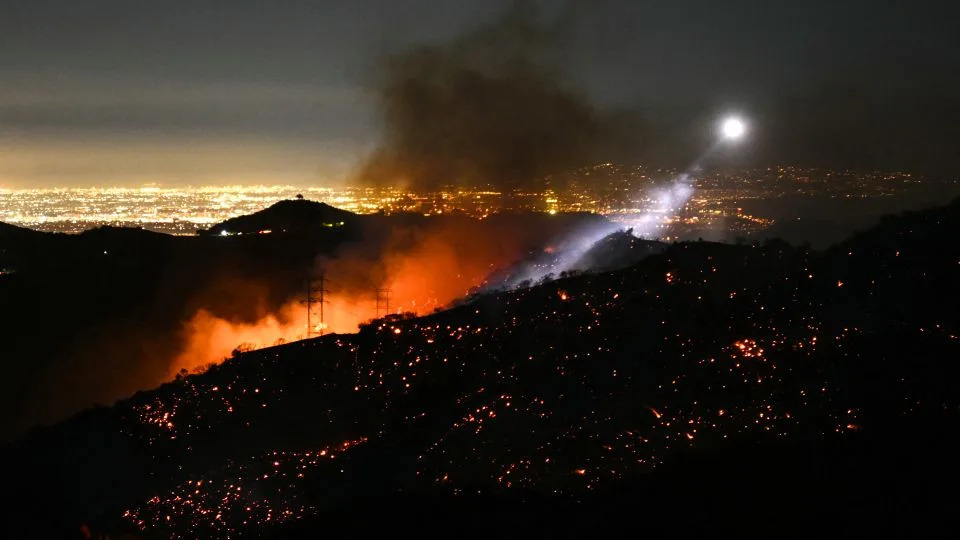
The light of a fire fighting helicopter illuminates a smouldering hillside as the Palisades fire grows near the Mandeville Canyon neighborhood and Encino, California, on January 11, 2025. - Patrick T. Fallon/AFP/Getty Images
Expert Reaction
Some climate scientists praised the study for its careful methodology. Katharine Hayhoe called the approach "careful and meticulous" and offered an analogy: imagine the atmosphere as a swimming pool and rising CO₂ as a hose being turned up, causing the water level to rise faster over time.
Claudie Beaulieu said the consistency across all five datasets strengthens the result but added a note of caution about how completely short-term influences can be removed and emphasized that continued monitoring is essential to determine whether this is a lasting shift or a transient phase of natural variability.

People wade through a flooded alley caused by Typhoon Kajiki in Hanoi, Vietnam, Tuesday, August 26, 2025. - Huy Han/AP
"We think we are the first to show a statistically significant acceleration," said Stefan Rahmstorf, a co-author and head of Earth System Analysis at the Potsdam Institute for Climate Impact Research.
Not all experts agree. Michael Mann argued there is no clear evidence of a recent acceleration and attributed recent heat spikes largely to El Niño. He stressed that warming has increased steadily since the 1970s—partly due to a decline in cooling aerosols—and that a roughly constant, long-term warming rate is already dangerous until emissions reach net zero.
Implications
If the higher warming rate identified in the study continues, the study warns the world could reach the 1.5°C global-warming threshold before 2030—earlier than many current projections that placed the milestone in the 2030s. Crossing this threshold would increase the likelihood that climate impacts exceed the adaptive capacity of many societies and ecosystems.
What Comes Next
The paper's authors and external commentators agree on two points: the result deserves careful attention, and further observation is needed to confirm whether this acceleration is persistent. Regardless of the debate over short-term variability, scientists emphasize the same policy conclusion—reducing greenhouse gas emissions rapidly is essential to limit further dangerous warming.
Bottom line: The new analysis suggests a sharper recent rise in warming rates than previously observed, but experts continue to debate how much short-term natural variability versus a sustained shift explains the trend. Continued monitoring and emissions reductions remain critical.
Help us improve.