Texas A&M researchers tested controlled fire whirls — rotating, upward-spinning flames — as a method to burn oil spills. In a triangular enclosure the vortex reached about 17 feet, consumed up to 95% of the fuel, and produced roughly 40% less soot than standard in-situ pool burns. The team reports nearly double the burn speed, but cautions the approach is early-stage and requires more study of emissions, ecological effects and real-world feasibility.
Controlled 'Fire Tornadoes' Could Accelerate Oil-Spill Cleanup — Texas A&M Tests Show Faster Burns and Less Soot
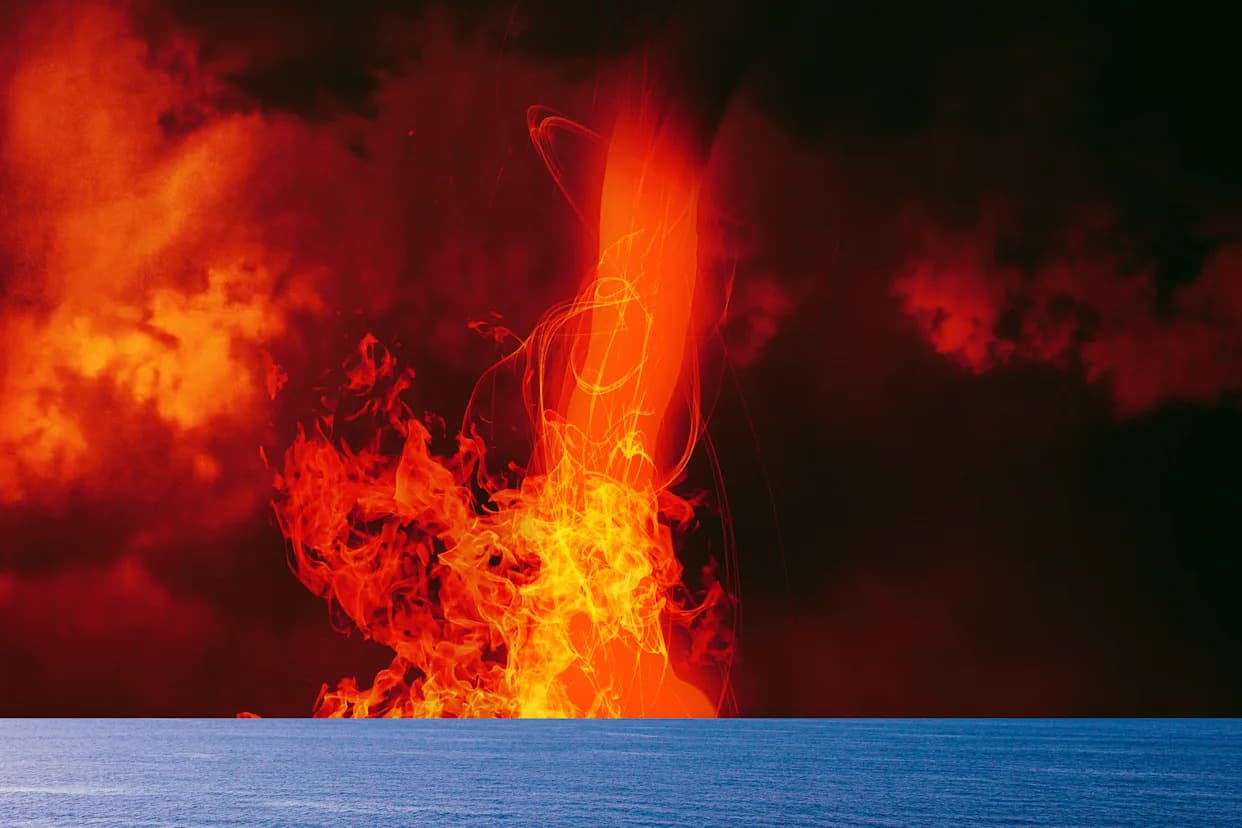
Illustration by Tag Hartman-Simkins / Futurism. Source: Getty Images
When people picture ocean conservation, images of coral restoration or beach cleanups usually come to mind. Researchers at Texas A&M University are exploring a radically different approach: deliberately creating controlled fire vortices — commonly called "fire whirls" or more sensationally, "fire tornadoes" — to consume oil on the water's surface.
A brief on the university website summarized a recent peer-reviewed study published in the journal Fuel testing whether these upward-spinning flames can improve oil-spill remediation compared with conventional in-situ burning (the standard technique of corralling and igniting surface oil pools).
How the experiment worked
In the controlled tests the team built three 16-foot walls arranged roughly in a triangle to generate a predictable vortex. That setup produced a stable fire whirl that reached about 17 feet at its peak. Researchers measured fuel consumption and soot production to evaluate performance and environmental impact.
Key results
Compared with typical in-situ pool burns, the controlled fire whirl consumed up to 95% of the fuel and produced roughly 40% less soot. The study also found that the vortex burned crude nearly twice as fast as conventional pool fires, potentially giving response teams faster options to limit oil spread.
"This is the first time anyone has conceived using fire whirls for oil-spill remediation, and it’s really just the beginning," said Elaine Oran, professor of aerospace engineering at Texas A&M. "Our goal is to harness the chaotic nature of fire whirls as a powerful, precise restoration tool to protect coastlines and marine ecosystems."
Caveats and next steps
These results come from controlled experiments, not open-ocean deployments. While lower soot and faster fuel consumption are promising, the technique needs more study to understand other emissions (gaseous byproducts), effects on marine life and air quality, operational safety, and feasibility in real spill scenarios and varying weather and sea conditions.
Conclusion
Controlled fire whirls show potential as a faster, cleaner variant of in-situ burning in controlled settings, but they remain an early-stage idea. Further research and field trials are required before they could be considered a practical tool for environmental response teams.
Help us improve.