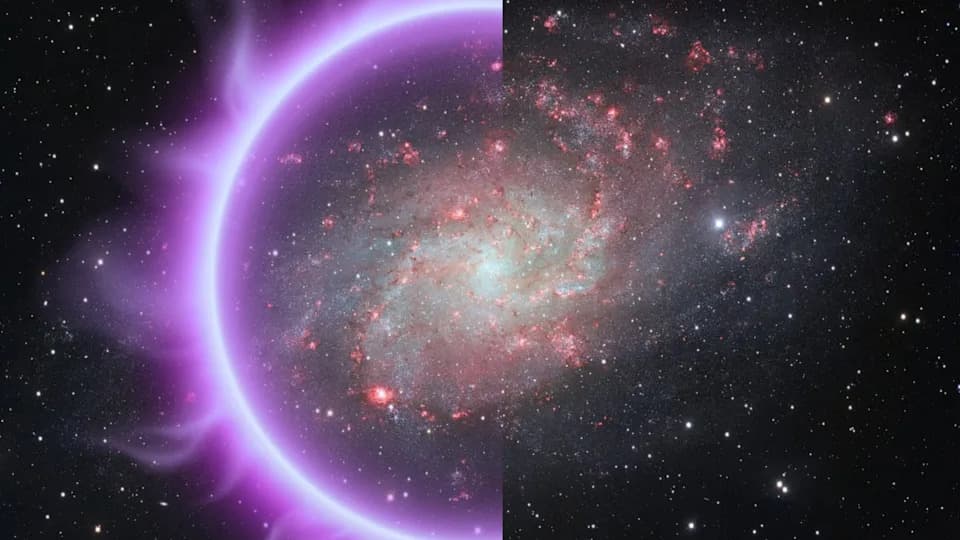
The Milky Way’s central mass — roughly 4 million Suns — is usually identified as the supermassive black hole Sagittarius A*. A new study shows a compact, horizonless blob of fermionic dark matter can reproduce the observed stellar orbits (including S2) with nearly the same accuracy. The fermionic model may also explain the Keplerian decline in Gaia’s rotation data, linking the central object and the halo as one continuous dark-matter structure. Future high-precision stellar monitoring and refined EHT imaging should be able to distinguish between a true event horizon and a dark matter core.
Could A Dense Blob Of Fermionic Dark Matter Be Masquerading As The Milky Way’s Black Hole?
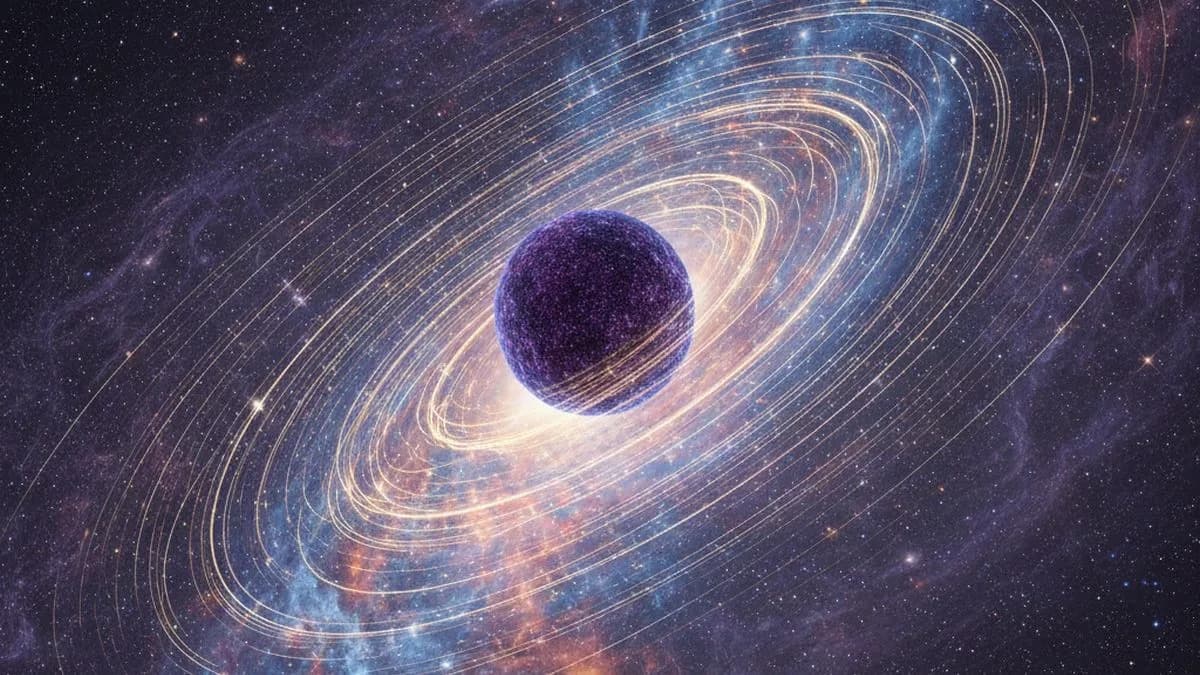
Something Far Darker Than a Black Hole Could Hide in The Heart of The Milky Way
Scientists agree there is an extremely massive, compact object at the center of the Milky Way, traditionally identified as the supermassive black hole Sagittarius A* (Sgr A*). A new study asks whether the same observations might also be explained by a horizonless, ultradense concentration of fermionic dark matter. The authors show that current data cannot yet rule out this intriguing alternative.
The basic puzzle
All measurements of the Galactic Center are consistent with about 4 million solar masses packed into a very small volume. That inference comes from precise tracking of stars — especially the 16-year orbit of the star S2 — whose paths map the region's gravitational potential. The simplest interpretation so far has been a supermassive black hole, and in 2022 the Event Horizon Telescope (EHT) produced an image interpreted as showing the black hole's shadow.
An alternative: fermionic dark matter core
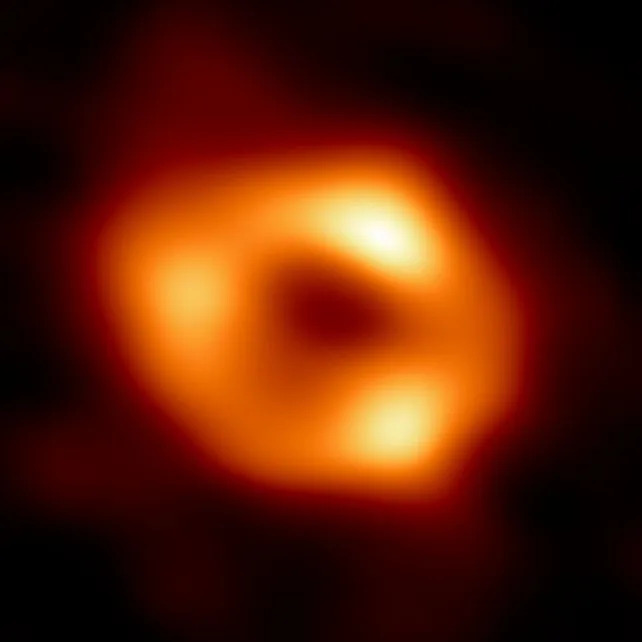
The Event Horizon Telescope image of Sagittarius A*. (EHT Collaboration)
Not all dark matter models predict only diffuse halos. If dark matter consists of fermions (particles that obey the Pauli exclusion principle), they can form extremely compact, quantum-supported objects analogous to white dwarfs or neutron stars. The new paper explores whether such a fermionic dark matter core — a massive, horizonless blob — could reproduce the observed stellar orbits around Sgr A* and also match larger-scale rotation data for the Galaxy.
What the models show
The team modeled the motion of S2 and other central stars for both the conventional black hole scenario and for a fermionic dark matter core. Both frameworks reproduced the observed stellar trajectories with nearly identical accuracy. In other words, present orbital data do not decisively distinguish a black hole with an event horizon from a sufficiently compact dark matter object.
How this links to the rest of the Galaxy

Subscribe to ScienceAlert's free fact-checked newsletter
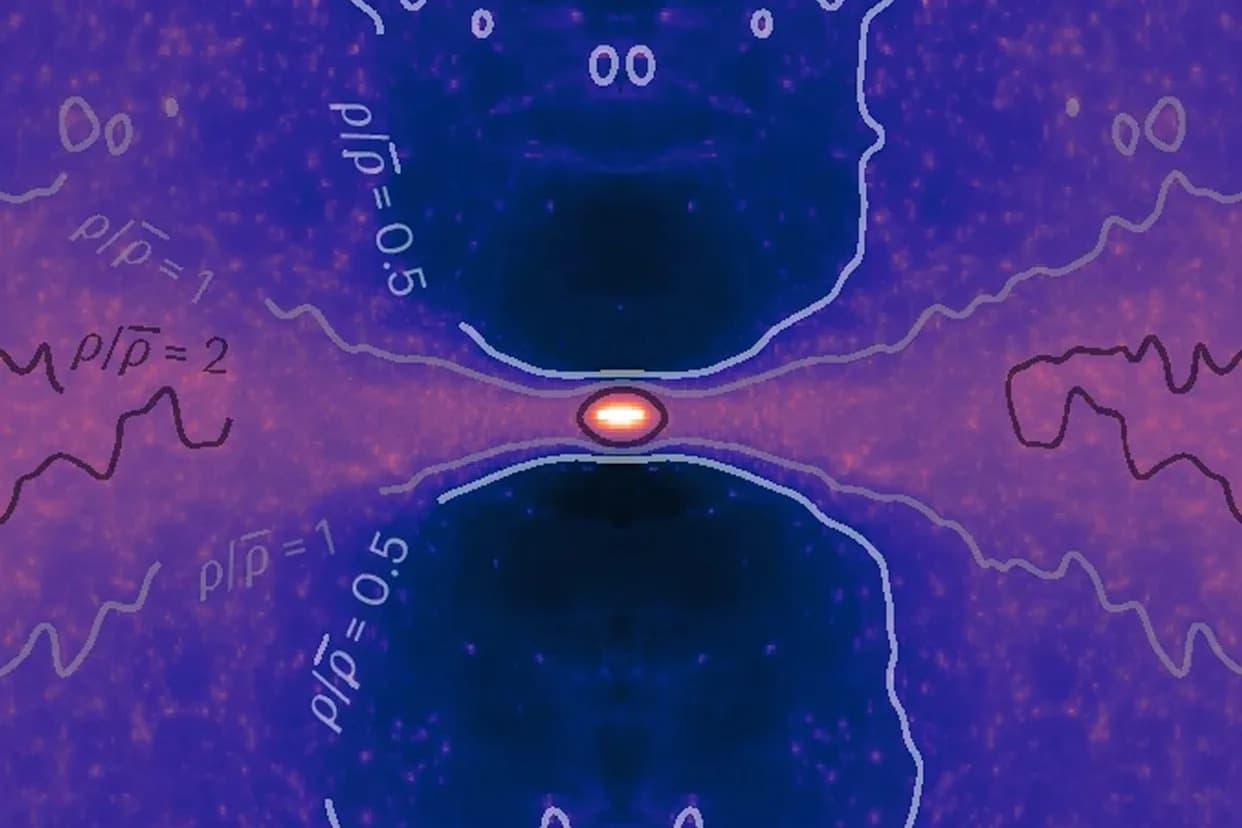
Beyond the immediate center, the Gaia spacecraft's map of the Milky Way shows a decline in rotational speed at large radii (a Keplerian decline). The authors argue that an extended fermionic dark matter halo can naturally produce both the central compact object and the outer rotation curve as a single, self-consistent dark-matter structure — bridging scales that are usually modeled separately.
How to decide between the models
Future observations could break the tie. Longer-term and higher-precision monitoring of S-star orbits, especially for stars that come closer to the center than S2, may reveal subtle dynamical signatures that favor one model. Upgraded EHT imaging could also test for features unique to an event horizon: a sharply defined photon ring or other strong-gravity signatures might be absent or altered if the central mass is a horizonless dark matter core rather than a black hole.
“We are not just replacing the black hole with a dark object; we are proposing that the supermassive central object and the galaxy's dark matter halo are two manifestations of the same, continuous substance,” says Carlos Argüelles of the Institute of Astrophysics La Plata.
Conclusion
The study, published in Monthly Notices of the Royal Astronomical Society, does not overturn the black hole interpretation but highlights a plausible and testable alternative. Distinguishing between a bona fide event horizon and a horizonless dark matter core is now a concrete observational goal: improved stellar astrometry and sharper EHT images over the coming years should be able to tell us which picture is correct.
Help us improve.