Keck Medicine at USC used full-body CT imaging to study two mummified priests, Nes-Min (c. 330 BCE) and Nes-Hor (c. 190 BCE), while each remained in the lower half of its sarcophagus. The scans indicate Nes-Min likely suffered from lower back problems, while Nes-Hor had multiple dental issues and a severely deteriorated hip and was older at death. Researchers produced high-resolution 3D models and life-size prints of spines, skulls, hips and artifacts. The originals and reconstructions will be displayed at the California Science Center when the "Mummies of the World" exhibition opens on February 7.
CT Scans of Two Ancient Egyptian Priests Reveal Back Pain, Dental Decay — 3D Prints to Debut at LA Exhibit
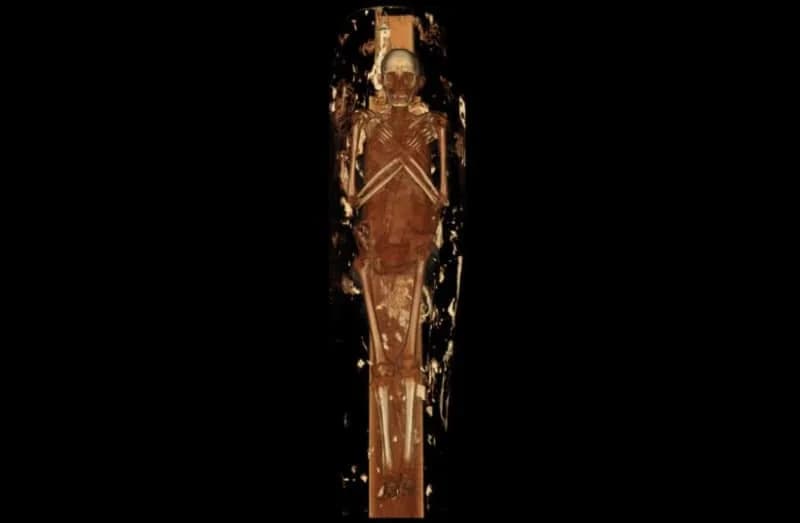
A Keck Medicine of USC 3D digital model of Nes-Hor’s full body provides a clear view of his skeleton, February 6, 2026. (credit: Courtesy of Keck Medicine of USC)
The California Science Center will display high-resolution CT scans, 3D models, and life-size prints from new imaging of two mummified ancient Egyptian priests as part of the returning exhibition, "Mummies of the World: The Exhibition," opening February 7.
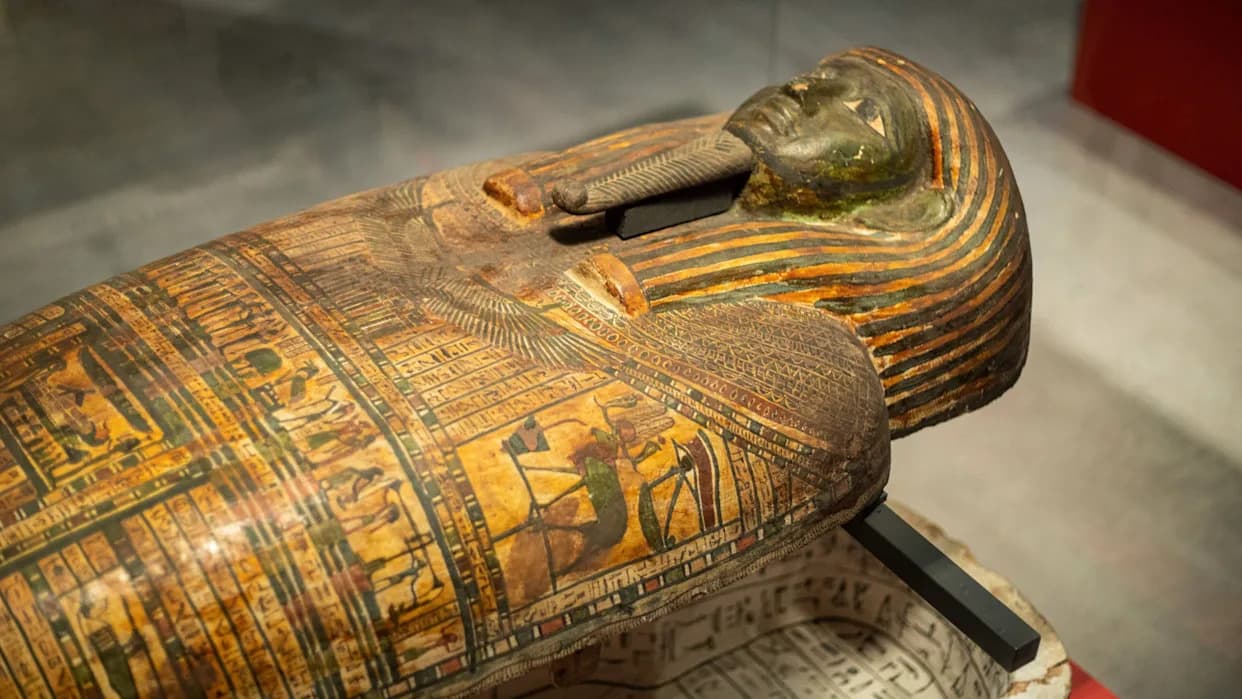
Radiologists from Keck Medicine of the University of Southern California performed full-body CT scans on the roughly 2,000-year-old remains of two priests identified as Nes-Min (circa 330 BCE) and Nes-Hor (circa 190 BCE). Each mummy was scanned while lying inside the lower half of its sarcophagus to preserve the original context.
The scans reveal intimate details about the men’s health and lifestyles. Nes-Min’s images suggest chronic lower back problems likely consistent with long-term strain or degenerative changes. Nes-Hor’s scans show multiple dental issues and a severely deteriorated hip joint; researchers also determined he was older at the time of death than Nes-Min.
After imaging, the Keck research team converted CT data into detailed 3D models and printed life-size replicas of the priests’ spines, skulls, hips, and — in Nes-Min’s case — associated artifacts. These tangible reconstructions help scientists and visitors visualize injuries and daily stressors that affected these individuals.
"These mummies were scanned previously, but due to advancements in scanning technology, the results are much more detailed and extensive than ever before," said Summer Decker, Director of the Center for Innovation in Medical Visualization at the Keck School of Medicine of USC. "The higher-resolution images have revealed things that were previously unknown and helped create a clearer picture of what their lives were like."
Anthropologist Diane Perlov, Senior Vice President of Special Projects at the California Science Center, added: "Mummies have long been a mystery. Seeing beneath the surface to reveal the specific lived experience of individuals is incredibly exciting. Modern imaging gives us a powerful window into past civilizations and personal histories that might otherwise be lost."
The traveling exhibition first appeared at the California Science Center in 2010 and returns with a selection of mummies the museum says have not previously been shown in Los Angeles. Alongside the original remains, the new scans and 3D prints aim to bridge modern medical imaging and ancient history for museum visitors.
Help us improve.