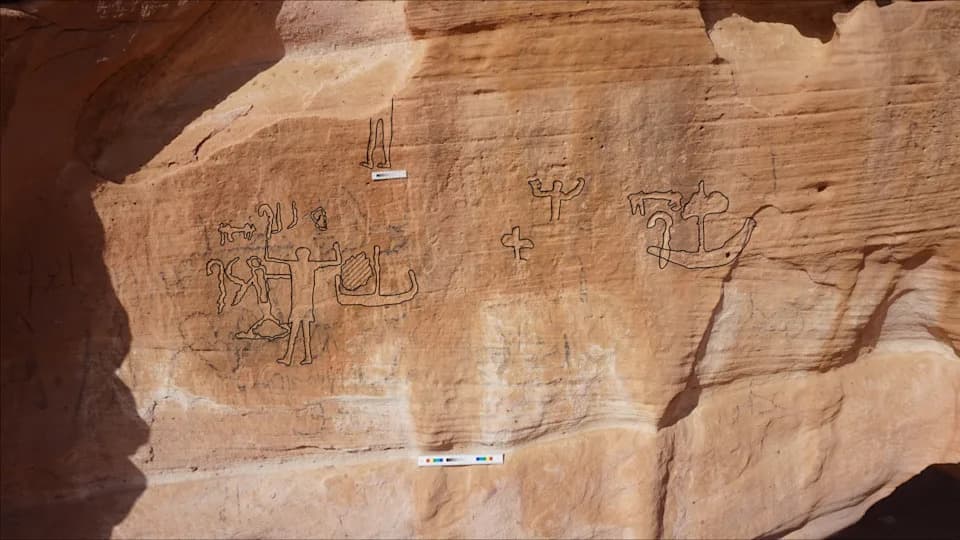
Archaeologists recorded 5,000-year-old rock carvings in Wadi Khamila, southwestern Sinai, that appear to depict an Egyptian victor standing over a kneeling, arrow-pierced Sinaite. A nearby boat carving once bore a name—possibly a pharaoh’s—that has been deliberately erased. Inscriptions invoking the deity Min as protector of Egyptians beyond the Nile were also found, and researchers plan a larger field campaign to document more rock art.
5,000-Year-Old Sinai Carvings Suggest Early Egyptian Conquest — A Pharaoh's Name Was Erased
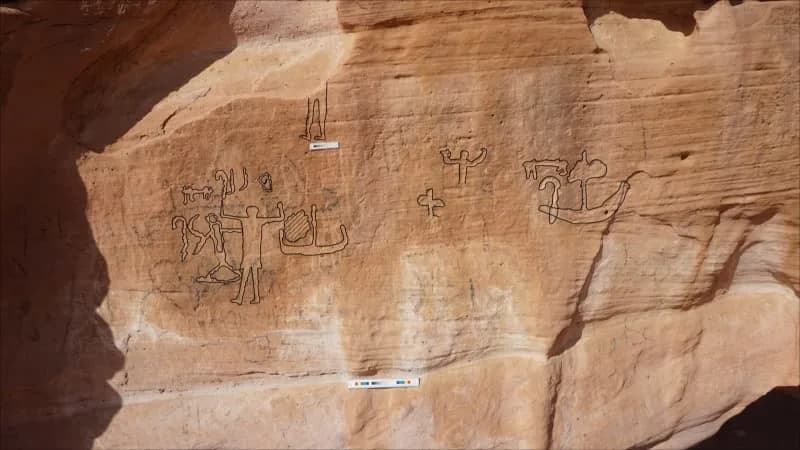
With redrawing for visibility: Rock carvings discovered in Wadi Khamila, Sinai Desert, believed to depict ancient Egypt’s conquest of the region, January 31, 2026. (photo credit: Photo: M. Nour El-Din/redrawing: E. Kiesel)
Archaeologists have identified rock carvings in Wadi Khamila, a dry valley in southwestern Sinai, that date to roughly 5,000 years ago and appear to show an early episode of Egyptian military domination in the region, the University of Bronn said in a statement. The panel of images was first recorded by Egyptian archaeologist Mustafa Nour El-Din and later analyzed by Egyptologist Prof. Dr. Ludwig Morenz.
Key Findings
The main scene depicts a large standing figure with raised arms facing a kneeling figure pierced by an arrow — an image Morenz interprets as an Egyptian victor over a wounded Sinaite. Adjacent to this violent scene is a carved boat; researchers say there was once a name near the boat, possibly that of a pharaoh, which has been deliberately erased. Who removed the name, when, and why remain unknown.
Nearby inscriptions invoke the Egyptian deity Min as a “divine protector of the Egyptians in areas beyond the Nile Valley.” El-Din later identified a second depiction of Min elsewhere in Wadi Khamila.
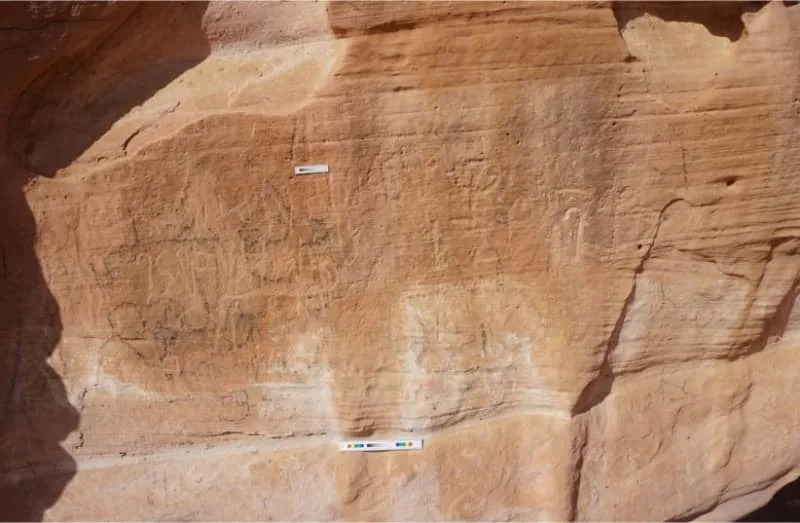
Rock carvings discovered in Wadi Khamila, Sinai Desert, believed to depict ancient Egypt’s conquest of the region, January 31, 2026. (credit: M. Nour El-Din)
Context and Interpretation
While Egyptian rock art has been found in other Sinai wadis, Morenz argues that the Wadi Khamila images — among them one of the oldest known scenes showing killing together with an inscription — strengthen the case for an early Egyptian presence that may have functioned like a colonial or economic network in the southwestern Sinai.
“The southwest of the Sinai is the region in which we can find economically motivated colonization using images and inscriptions, some of which are over 5,000 years old,” Morenz said, calling the Wadi Khamila panel an important early example.
The finds and interpretations are described by El-Din and Morenz in a study published in the 2025 edition of the journal Blätter Abraham. Both researchers say systematic fieldwork has just begun and they are planning a larger campaign to map and document additional rock drawings in the area.
Why It Matters
The carvings offer rare visual evidence for early Egyptian activity beyond the Nile Valley and raise new questions about political reach, resource interests, and cultural interactions in the prehistoric Sinai. The erased name near the boat adds an intriguing mystery about later interventions in the rock art record.
Help us improve.