ALMA polarization observations produced the most detailed magnetic-field map yet of merging galaxy Arp 220, revealing a vertical "magnetic superhighway" that helps launch molecular outflows at about 1.1 million mph (≈500 km/s). The western nucleus shows a field-aligned bipolar outflow, the eastern nucleus hosts a spiral field in a rotating disk, and a polarized dust bridge funnels material between the cores. Measured fields are hundreds to thousands of times stronger than in the Milky Way, suggesting magnetism played a major role in early dusty starbursts.
ALMA Maps a 'Magnetic Superhighway' Powering 1.1 Million mph Winds in Merging Galaxy Arp 220
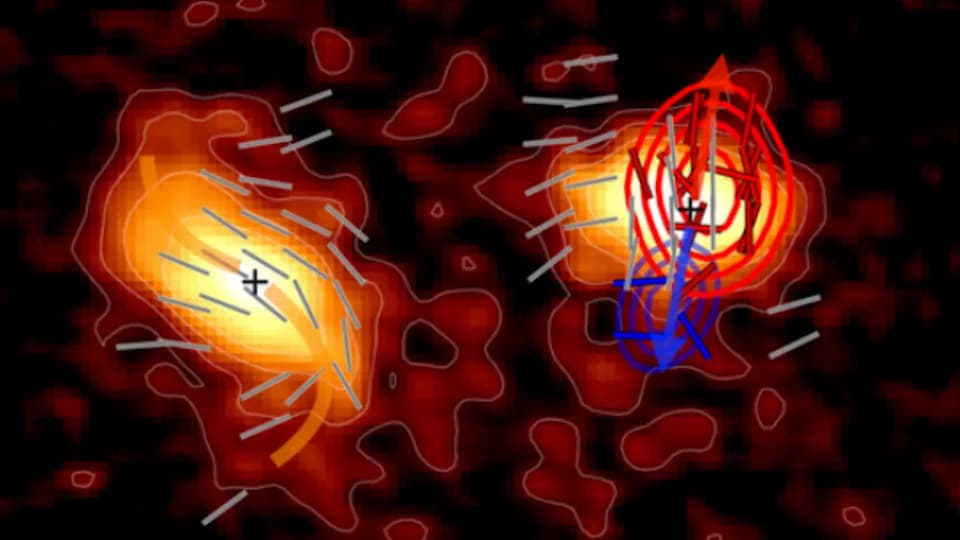
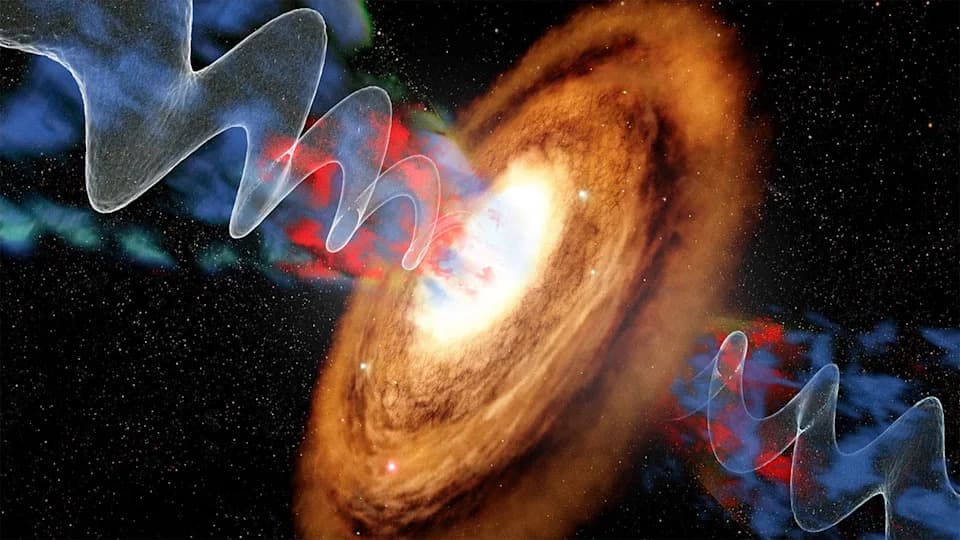
The magnetic fields of the galactic disk and dusty and molecular outflow of the merging galaxy Arp220 observed by ALMA. | Credit: Lopez-Rodriguez, E. (USC; polarization data), Girart, J.M. (ICE-CSIC and IEEC; polarization data); (Barcos-Muñoz, L. (NRAO; 3GHz data)
A team of astronomers has used the Atacama Large Millimeter/submillimeter Array (ALMA) to produce the most detailed magnetic-field map yet of the merging galaxy system Arp 220, revealing a nearly vertical "magnetic superhighway" that appears to launch molecular winds reaching about 1.1 million miles per hour (≈500 km/s).
Located roughly 250 million light-years away, Arp 220 is an ultraluminous infrared galaxy formed by the collision of two spiral galaxies. Its dense dust shrouds hide intense star formation and make it a nearby analog for the dusty, rapidly star-forming galaxies that were common in the early universe. Studying Arp 220 helps astronomers understand how massive galaxies evolved more than 10 billion years ago.
How the Map Was Made: Using ALMA's high-resolution polarization capabilities, the researchers traced the alignment of tiny dust grains and carbon monoxide molecules with the local magnetic field. From these polarization signals they reconstructed the three-dimensional geometry and strength of the magnetic fields within the two galactic nuclei and along their outflows.
Key Findings
Magnetic Superhighway: One nucleus shows an almost vertical, well-ordered channel of magnetized gas streaming outward. The team describes this structure as a "magnetic superhighway" that appears to guide and accelerate the molecular outflow.
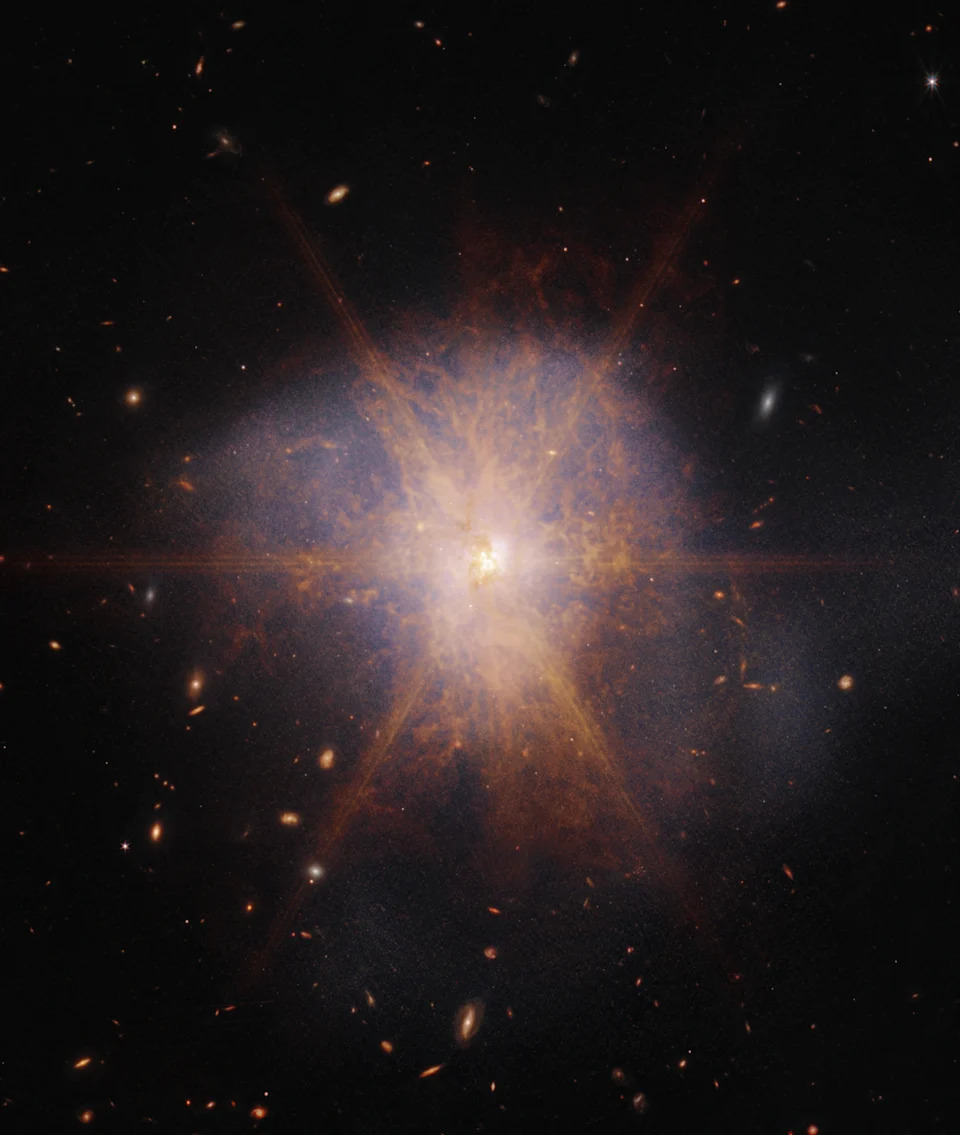
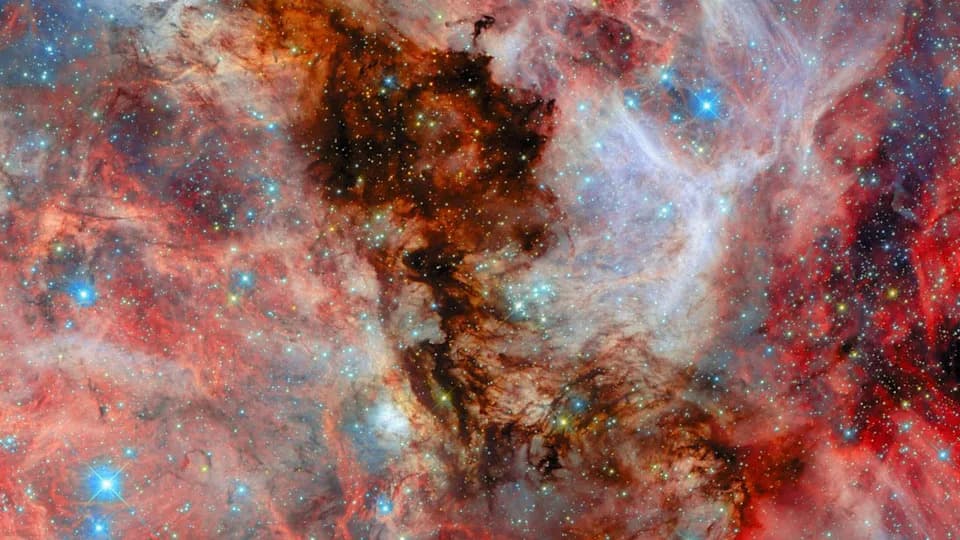
Credit: NASA, ESA, CSA, STScI; Image Processing: Alyssa Pagan (STScI)
Different Magnetic Architectures in Each Core: The western nucleus features a magnetic field closely aligned with a bipolar outflow, suggesting the field actively shapes and helps drive the escaping material. The eastern nucleus displays a spiral-shaped magnetic pattern embedded in a dense, rotating disk, indicating that large-scale magnetic order can survive even in a chaotic merger environment.
Polarized Dust Bridge: The observations also reveal a highly polarized ridge of dust connecting the two nuclei. This magnetized bridge seems to channel material and magnetic flux between the merging cores, emphasizing magnetic fields' role in directing gas flows during collisions.
Field Strengths and Implications: Measured magnetic intensities in the outflows are hundreds to thousands of times stronger than typical Milky Way values. Fields of this strength can substantially influence gas dynamics, cooling, star-formation efficiency, and how galaxies lose material to their surroundings. The results imply that strong, organized magnetism may have been common in early dusty starbursts and could have played a key role in shaping galactic winds and the evolution of galaxies.
"We used ALMA to map the orientation and strength of magnetic fields in the twin galaxies," said Enrique Lopez-Rodriguez of the University of South Carolina. "When Arp 220 is observed as a whole, it's one of the best places in the universe to study how gravity, star formation, winds, and magnetic fields interact to reshape a galaxy."
The research was published on Jan. 2 in The Astrophysical Journal Letters. As astronomers apply these polarization techniques to more distant systems, they expect to find similar magnetized channels throughout the cosmos.
Help us improve.