What You’ll Learn: Purple is a nonspectral color — it doesn’t correspond to a single wavelength of light. Violet, by contrast, is spectral and maps to short wavelengths. Human color vision relies on three cone types (S, M, L) sensitive roughly across 380–740 nm; when red and blue wavelengths stimulate different cones simultaneously, the brain combines those signals and produces the sensation we call purple.
Purple Isn't Real — Science Explains How Your Brain Invents It
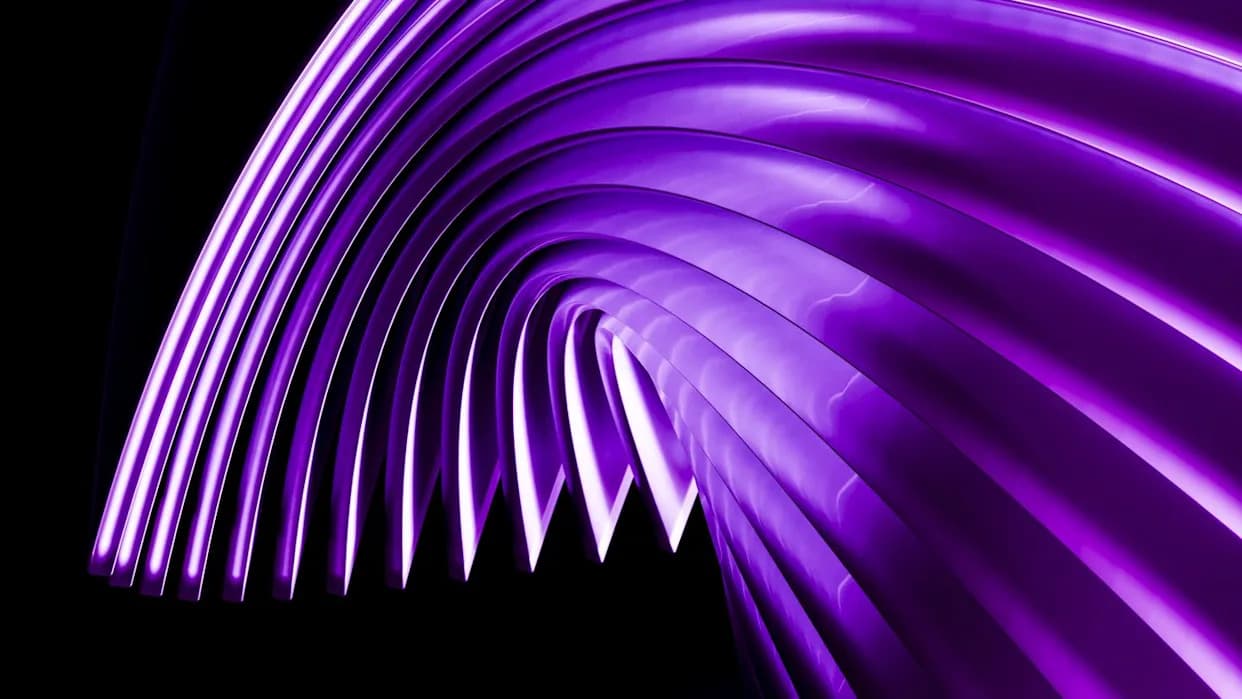
Purple Isn’t Real, Science Saysaire images - Getty Images
Many of us grew up thinking every color we see corresponds to a single wavelength of light. That’s not true for purple. Unlike violet, which is a spectral color with its own wavelength, purple is a nonspectral color — a perceptual construction your brain creates when red and blue wavelengths arrive together.
How Human Color Vision Works
Visible light is only a tiny sliver of the electromagnetic spectrum (roughly 380–740 nanometers, about 0.0035% of the full range). Our retinal cone photoreceptors detect that slice and convert light into electrical signals. Humans typically have three cone types: short-wavelength (S), medium-wavelength (M), and long-wavelength (L) cones.
Approximately 60% of cones are L cones (most sensitive to reddish wavelengths), about 30% are M cones (greenish sensitivity), and roughly 10% are S cones (bluish sensitivity). Each cone type responds across a range of nearby wavelengths, with overlapping sensitivity that allows the brain to compare signals and infer color. The visual cortex reads differences in activation among these cone types to produce the many colors we perceive.
Why Purple Is Not A Spectral Color
Colors like green, yellow, and violet correspond to single spectral wavelengths. Purple does not. The brain perceives purple when light contains strong activation from both L cones (red) and S cones (blue) simultaneously. Because those wavelengths sit at opposite ends of the visible range and have little overlap in cone sensitivity, there is no single wavelength that produces the sensation of purple.
To make sense of such combinations, the visual system effectively "wraps" the linear spectrum into a circular color space so the extremes meet. That junction — where red and blue signals combine — is where we place purple on the color wheel. In technical terms, purple is a nonspectral hue: an emergent percept arising from how our photoreceptors and brain process light, not from a single physical wavelength.
How We Experience Purple In Practice
Purple can be produced by mixing red and blue light (as on screens) or by pigments that absorb and reflect particular wavelengths. Different mixes create the wide range of purples we name — from magenta to mauve — even though none correspond to a single spectral line.
Quick fact: Violet Is A Spectral Color (short wavelength); Purple Is A Perceptual Blend Of Red And Blue Signals.
Purple In Culture
Even if purple is technically a perceptual invention, it has rich cultural significance. Historically expensive to produce, purple is associated with royalty, power, luxury, mystery, and creativity — associations that persist today.
Understanding purple reveals something fascinating: our color world is as much about neural interpretation as it is about physical light. The colors we name are products of both physics and biology.
Help us improve.