Canis Major and Canis Minor are prominent in the winter evening sky. Around 6 p.m. local standard time this week, look roughly 30° south of due east to find Murzam, which heralds the rise of Sirius about 17 minutes later; Procyon in Canis Minor typically rises ~25 minutes before Sirius. The article explains how to locate these stars using Orion’s Belt, summarizes ancient cultural links (including Egypt’s veneration of Sirius), and describes modern discoveries: both Sirius and Procyon have faint white-dwarf companions first inferred by Bessel and later observed by Alvan Clark and Lick Observatory astronomers.
Two Canine Constellations Light Up the Winter Sky — How to Find Sirius, Procyon and Murzam This Week

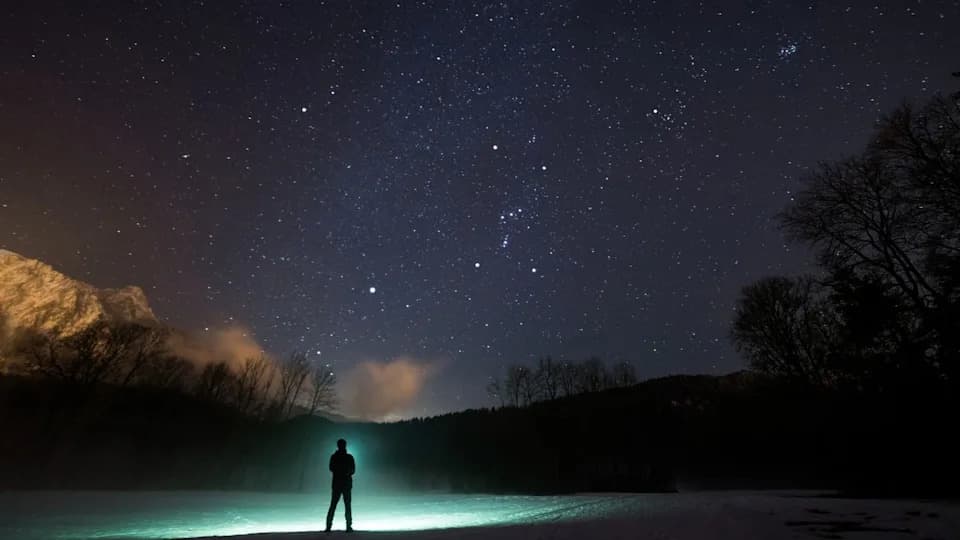
Winter is the perfect time to look for two celestial dogs in the night sky. | Credit: Dneutral Han/Getty Images
On clear winter evenings the twin constellations Canis Major (the Big Dog) and Canis Minor (the Little Dog) dominate the southern sky. If you step outside about 6 p.m. local standard time this week, you can begin locating them as twilight fades.

Milky Way stretching over the Pyramid of Khafre and the Great Sphinx. | Credit: gorinyan/Getty Images
How to Find the Dogs
Face east and find the point on the horizon that marks due east. From that point, scan roughly 30° to the south — about three clenched fists at arm's length (one fist ≈ 10°) — and you should see a 2nd-magnitude star rising: Murzam. Another easy method: draw an imaginary line through Bellatrix in Orion and Alnitak (the lowest star in Orion’s Belt) and extend it about twice the distance between those two stars; that line points to Murzam.
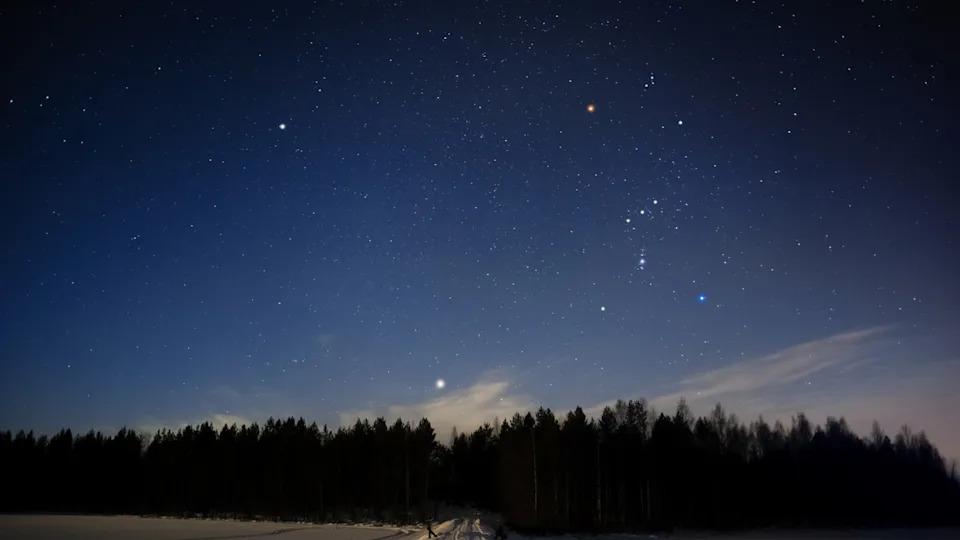
Sirius (lower center) is the brightest star in the night sky. | Credit: Eerik/Getty Images
Murzam (an ancient Arabic name meaning “roarer” or “announcer”) typically appears about 17 minutes before the brightest star in the night sky, Sirius, which is part of Canis Major. Meanwhile, Procyon, the brightest star of Canis Minor, usually rises about 25 minutes before Sirius. Later in the night, when both pairs move toward the south, Procyon will trail behind Sirius.
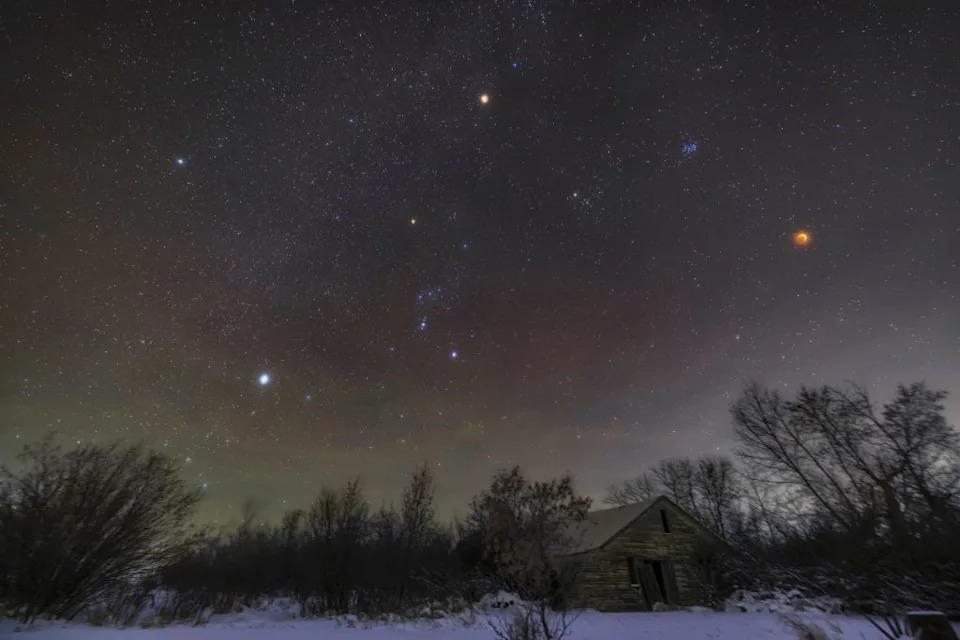
A wide-angle view of the Nov. 8, 2022 total lunar eclipse shows the moon among winter stars, with Orion left of centre and the Dog Stars — Procyon above and Sirius below — at far left. | Credit: VW Pics / Getty Images
What to Look For
By about 9:30 p.m. both dogs are well placed low in the south–southeast. Sirius outshines everything around it, flashing a dazzling white with a hint of blue and serving as the easiest landmark: follow the line of Orion’s Belt southeastward (down and left) to find it. Sirius often appears like a brilliant stud or tag on the Big Dog’s collar. Below and to the side of Sirius, three relatively bright stars form a small triangle that suggests the dog’s hindquarters and tail; the lower-right corner of that triangle is Adhara (magnitude +1.50), one of the sky’s brighter stars.

Canon EOS R7 Mirrorless Camera (Body Only)
Myth, History and the 'Dog Days'
Across cultures the rising of Sirius carried deep meaning. Ancient Greeks linked Sirius and the canine constellations to the oppressive summertime heat called the “dog days.” Because Sirius’s heliacal rising (its first pre-dawn visibility) coincided with the hottest part of the year for some ancient observers, it became associated with heat, drought and pestilence.
The ancient Egyptians revered Sirius (called Sopdet), whose heliacal rising roughly heralded the annual Nile flood that deposited fertile silt across Egypt. That event was so important it marked the start of their year. Temples were often oriented toward the horizon point where Sopdet rose, and the star was represented as a goddess wearing a star on her head.
The Science Behind the Bright Stars
Modern astronomy reveals an intriguing coincidence: both Sirius and Procyon have faint, dense companions — white dwarfs. Sirius B (nicknamed “The Pup”) is roughly the size of Earth (about 7,500 miles / 12,000 km across) but contains nearly as much mass as the Sun, giving it an extremely high density. A single glassful of white-dwarf material would weigh on the order of ten tons if brought to Earth.
The presence of these unseen companions was first inferred from subtle wobbles in the stars’ motions. In 1844 Friedrich Wilhelm Bessel noticed that both Sirius and Procyon followed slightly wavy paths and attributed this to gravitational pull from unseen objects. Sirius B was first observed visually in 1862 by Alvan Clark while testing a new 18½-inch refractor; Procyon’s white-dwarf companion was discovered later, in 1896, at the Lick Observatory in California. Both bright dog stars lie relatively close to us — about 8.6 light-years for Sirius and 11.5 light-years for Procyon — which helped astronomers study them in detail.
Fun Note: The discovery of these compact companions is a delightful astronomical pun — truly deserving of a round of “A‑Paws.”
Joe Rao is an instructor and guest lecturer at New York’s Hayden Planetarium and contributes astronomy writing to Natural History magazine, Sky & Telescope and other publications.
Help us improve.