Congress overwhelmingly approved a bipartisan minibus appropriations bill that restores and increases funding for NOAA, NASA and the NSF, rejecting steep cuts proposed in the Trump administration’s budget. The Senate passed the bill 82-15 after the House approved it 397-28; it now goes to President Trump. The package protects NOAA satellites, boosts National Weather Service staffing, blocks new caps on indirect research costs, and provides roughly $1.67 billion more for NOAA and $5.63 billion more for NASA than requested.
Congress Rejects Deep Science Cuts, Approves Minibus Bill Boosting NOAA, NASA and NSF
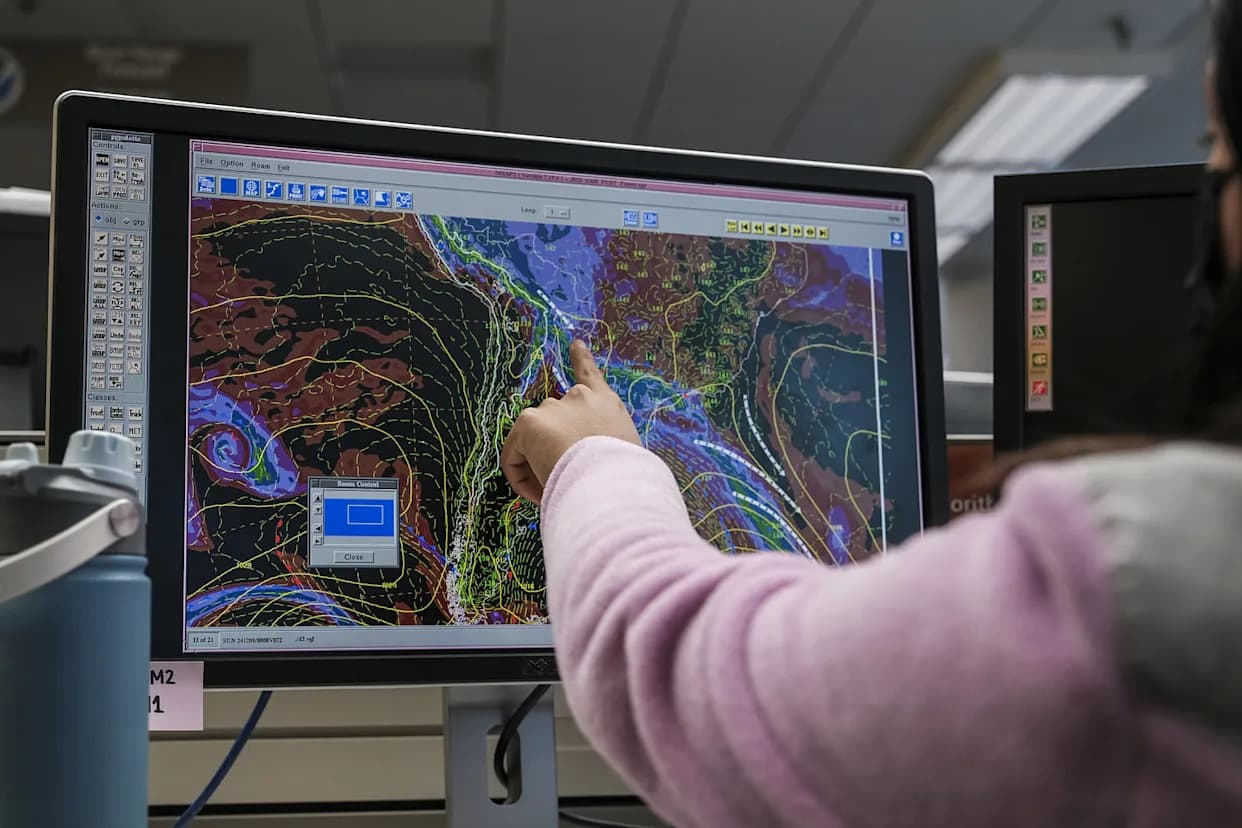
A meteorologist monitors weather activity on a computer screen at the NOAA's Center for Weather and Climate Prediction headquarters in College Park, Md., in 2024. (Michael A. McCoy / Bloomberg / Getty Images file)(Michael A. McCoy)
Congress delivered a bipartisan rebuke to the Trump administration’s proposed science-budget cuts, approving a minibus appropriations bill that restores and increases funding for the National Oceanic and Atmospheric Administration (NOAA), NASA and the National Science Foundation (NSF).
What Passed
The Senate approved the measure by an 82-15 margin after the House passed the same package 397-28. The bill funds a group of agencies that handle science and environmental programs through Sept. 30 and now goes to President Donald Trump for signature.
Funding Restored And Targeted Programs Protected
Lawmakers rejected deep cuts proposed in the administration’s budget request. According to Sen. Patty Murray (D-Wash.), the administration had sought roughly a 57% cut to NSF and about a 47% cut to NASA’s science programs, while NOAA faced an estimated 27% reduction. The enacted package provides about $1.67 billion more for NOAA and $5.63 billion more for NASA than the president requested.
The bill specifically preserves NOAA's satellite programs and provides funding to rebuild National Weather Service staffing after reductions tied to buyout offers and the dismissal of probationary employees. It also bars agencies from imposing a new, lower cap on indirect research costs—overhead funding that covers equipment, facilities, operations, accounting and personnel.
Leadership And Process
The bipartisan measure was led by Sen. Susan Collins (R-Maine) and Sen. Patty Murray (D-Wash.). Collins emphasized her longstanding support for the NSF and highlighted the bipartisan effort to restore funding and clarify treatment of indirect research costs. Murray called the bill a rejection of proposed cuts that would have harmed scientific research, NASA science and NOAA’s climate and forecasting capabilities.
"These bills reassert Congress's power over key spending decisions," Murray said on the Senate floor.
White House Response And Next Steps
The White House Office of Management and Budget indicated earlier that the administration supported the package, saying senior advisors would recommend the president sign the bill in its current form. Congress plans to consider additional minibus appropriations packages covering labor, health, national security and other agencies as lawmakers aim to complete all spending bills by Jan. 30, when a short-term funding measure that ended a 43-day government shutdown expires.
Why it matters: The bill preserves federal support for basic scientific research, weather forecasting and satellite infrastructure that many communities and sectors rely on for safety, innovation and economic planning.
This article was originally published on NBCNews.com.
Help us improve.