The first high-resolution 3D model of Rano Raraku—Easter Island’s main moai quarry—has been released by researchers from Binghamton University and SUNY. The digital reconstruction documents nearly 1,000 moai and opens virtual access to a steep volcanic crater that is closed to visitors for safety. Lead author Carl Lipo says the model provides researchers and the public with previously inaccessible views and a durable, shareable record of the site.
High-Resolution 3D Map Lets You Explore Easter Island’s Restricted Moai Quarry

The new 3D model, made possible by Binghamton researchers, lets visitors explore the main quarry of Easter Island, home to nearly 1,000 moai statues.
A new digital reconstruction now lets anyone explore one of Rapa Nui’s most mysterious archaeological sites from home. Researchers from Binghamton University and the State University of New York have released the first high-resolution 3D model of Rano Raraku, the principal quarry on Easter Island where nearly 1,000 moai statues remain in various stages of carving.
Virtual Access to a Restricted Crater
Rano Raraku sits inside a steep volcanic crater that is partly off-limits to visitors for safety reasons. To reduce pressure from tourism, only a limited number of flights reach the isolated island each week, and the busiest months—December through March—fill quickly. The new model provides virtual access to views that are normally impossible for on-site visitors to reach, including tops, sides and other angles of the statues.
“You can see things that you couldn’t actually see on the ground. You can see tops and sides and all kinds of areas that [you] just would never be able to walk to,”
said Carl Lipo, an anthropologist at Binghamton University and lead author of a paper about the model published in PLOS One in November 2025.
What the Model Shows
The 3D reconstruction captures nearly 1,000 finely rendered moai and documents the quarry’s landscape and carved figures in unprecedented detail. Besides offering a stunning public exhibit, the model creates a durable, shareable record for researchers studying the site’s archaeology, carving techniques and preservation needs.
Why This Matters
Preservation: A comprehensive digital record helps safeguard the quarry’s archaeological information against erosion, damage or loss.
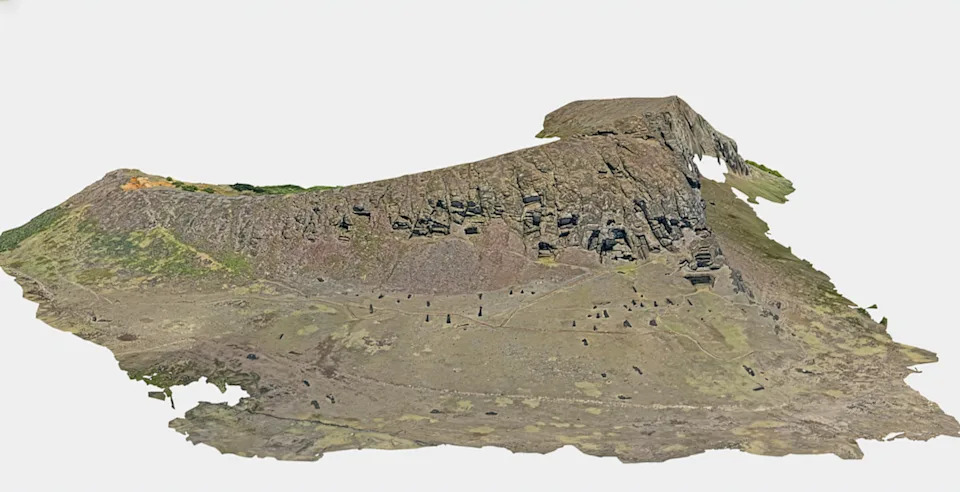
Three-dimensional model of Rano Raraku quarry produced through Structure-from-Motion photogrammetry. This comprehensive digital documentation, derived from 11,686 UAV images, reveals the complex spatial organization of production activities distributed across multiple workshops. areas.Image: Carl Lipo
Access: The model widens public and scholarly access to restricted areas without putting visitors at risk or increasing foot traffic.
Education: Teachers, students and enthusiasts can examine features and perspectives that physical visits rarely allow.
“We’re documenting something that really has needed to be documented, but in a way that’s really comprehensive and shareable,”
Lipo added, calling the concentrated field of carved figures “the archaeological Disneyland” — now visitable virtually from the comfort of home.
Quick facts: Rapa Nui (Easter Island) is home to about 6,000 residents, covers roughly 63.2 square miles (about twice the size of Disney World), and draws about 100,000 visitors annually interested in the iconic 13-foot moai statues.
Explore the model to view Rano Raraku’s moai from angles few have seen and to learn more about how digital tools are changing archaeology and public access to heritage sites.
Help us improve.