Researchers analyzed 20 years of mark–recapture data from Año Nuevo State Park to test natal philopatry in Northern elephant seals. From 124 mother–pup pairs (2000–2023), females pupped a mean distance of 1,296 feet from their natal sites, with 25% of births occurring within 407 feet. Fidelity persisted across breeding seasons, though longer gaps between pupping correlated with greater distances. Strong site fidelity can affect genetic mixing — a key concern for a species that once nearly went extinct — while also offering benefits like easier mate finding and local familiarity.
Elephant Seals Return Home With Remarkable Precision — Most Pup Near Their Natal Beach
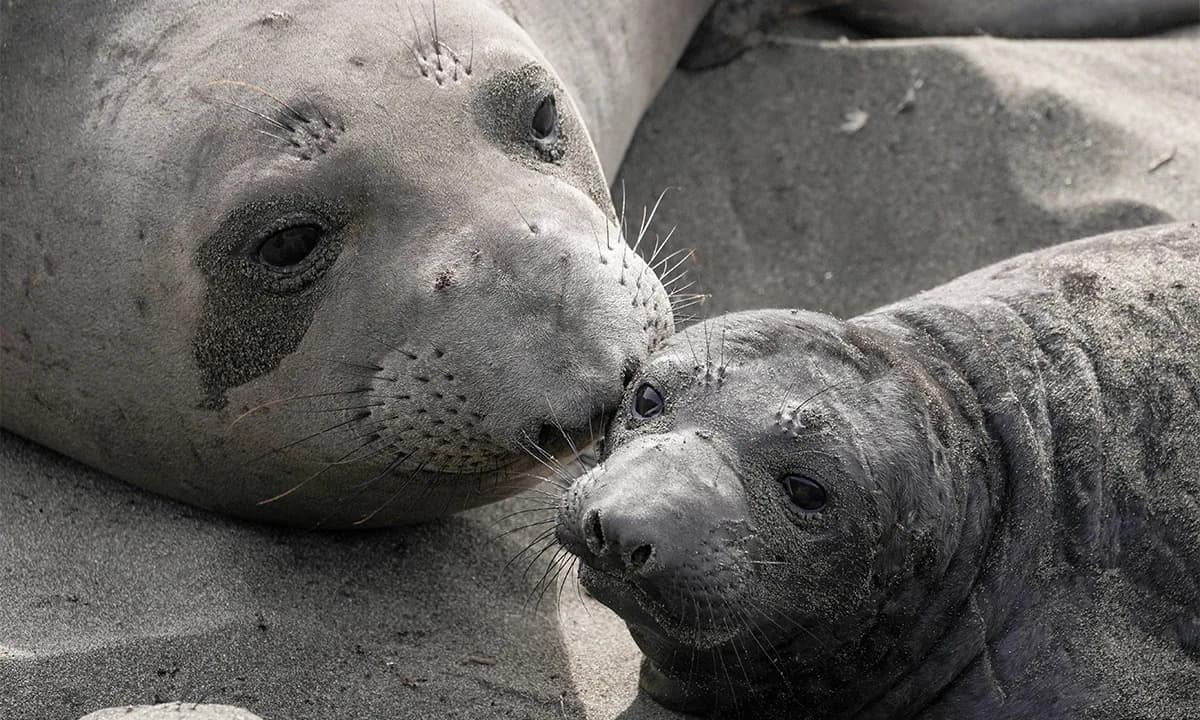
Lead image: Tiny Turkey / Shutterstock
When many young adults leave home to study or work, only a small share remain — a 2023 Pew Research Center survey found about 18 percent of U.S. adults aged 25–34 live with their parents. In the animal world, however, many females consistently return to where they were born to reproduce. A new study in Oecologia shows northern elephant seals exhibit strong natal philopatry, returning to their natal beaches with surprising accuracy.
Study Design And Key Findings
Researchers at the University of California, Santa Cruz analyzed 20 years of mark–recapture data from a breeding colony at Año Nuevo State Park in California to map pupping locations for Northern elephant seals (Mirounga angustirostris). The team measured distances between birth sites and later pupping sites using data from 124 mother–pup pairs recorded between 2000 and 2023.
The results demonstrate clear fine-scale fidelity. On average, females gave birth 1,296 feet from their own natal site, and 25 percent of births occurred within just 407 feet — roughly the length of a football field. That precision is notable given these animals migrate to the breeding beaches from thousands of miles away and can travel more than 12,000 miles in a single year.
Bella Garfield, lead author and now a marine science graduate student at the University of Massachusetts, Dartmouth, notes that this precision continues within the colony and creates a surprisingly organized breeding structure.
Repeat Fidelity And Drivers
The study also found that females tend to pup near the locations where they previously gave birth, so natal philopatry persists across reproductive events. However, longer intervals between pupping events were associated with females nesting farther from their natal sites — indicating flexibility when years separate births.
Ecological And Genetic Implications
Strong site fidelity can shape the colony's spatial organization and the flow of genes across generations. Returning to a small area to breed increases the chance of encountering relatives, which can limit genetic mixing and diversity. This concern is particularly relevant for northern elephant seals, a species that recovered from near extinction in the 19th century — strong philopatry could constrain the outcrossing needed to rebuild variation.
At the same time, consistently using familiar pupping sites likely offers benefits: individuals may locate mates more easily and exploit local knowledge of environmental conditions. The authors emphasize that their results provide a baseline for Año Nuevo, enabling future comparisons to understand how environmental change could reshape colony structure over time.
This work underscores how fine-scale behaviors — returning within a few hundred yards of where one was born — can have outsized consequences for population genetics and conservation planning.
Help us improve.