China's efforts to lift its birth rate are running into cultural and economic headwinds as more young couples choose to remain child-free or delay parenthood. Births fell to 9.54 million in 2024 and the population has shrunk for three consecutive years, while the UN warns of sharp long-term decline. Experts say high costs, long working hours and changed family norms since the one-child era limit the impact of current incentives.
China’s Birth-Rate Push Stumbles as More Young Couples Choose a Child-Free Life
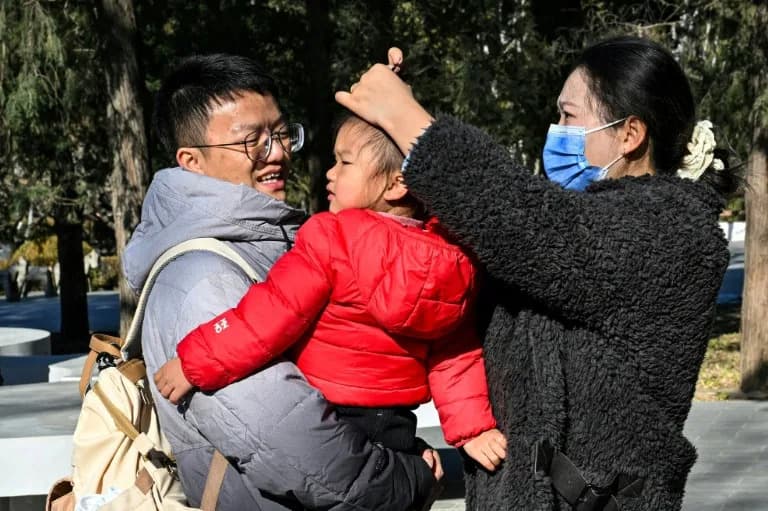
China's birth rate could fall from 1.4 billion today to around 800 million by 2100, the United Nations says (Adek BERRY)(Adek BERRY/AFP/AFP)
Twenty-five-year-old Grace and her husband have decided not to have children, resisting pressure from family and society even as Beijing steps up efforts to reverse a falling birth rate.
A decade after China relaxed its one-child policy and introduced a two-child limit in 2016 — followed by a three-child policy in 2021 — the country faces a growing demographic challenge. The population has fallen for three consecutive years, and the United Nations has warned it could drop from roughly 1.4 billion today to about 633 million by 2100.
Births in China fell to 9.54 million in 2024 — roughly half the number recorded in 2016 — as a rising number of young people either postpone parenthood or opt out entirely.
Why Couples Are Saying No
Increasingly, young couples describe themselves as DINKs — dual income, no kids — a label that has gone viral on Chinese social platforms such as Xiaohongshu. Those choosing this path cite multiple reasons: high child-rearing costs, career pressures, long working hours, and lifestyle preferences.
"Without a decent income and some savings, I wouldn't even consider having kids," Grace, a content creator who asked to be identified by her English name, told AFP. "If I publicly celebrated being a DINK, many people would be upset."
Policy Responses and Limits
Chinese authorities have rolled out a range of pronatalist measures, including reported childcare subsidies of roughly $500 per year for each child under three. Yet some moves have been criticized as inconsistent — for example, a value-added tax introduced in January that applies to condoms and other contraceptives.
Experts say cultural and structural forces limit how effective incentives alone will be. "The one-child policy reshaped family norms and lifestyles; many in the one-child generation now prefer smaller families," said Pan Wang, an associate professor at the University of New South Wales. Independent demographer He Yafu added that younger generations' intentions to marry and have children remain weak.
Economic and Time Pressures
Rising living costs and economic uncertainty also weigh heavily. Beijing resident Wang Zibo, 29, said he and his wife plan to wait until the "economy stabilises" despite relatively good personal finances. Many young professionals face long hours under the pervasive "996" culture — 9 a.m. to 9 p.m., six days a week — leaving little time for family life.
"People are so busy with work that for some it's difficult even to think about starting a family," Wang said. One anecdote recounted by Wang highlights how parenthood can quickly absorb time, money and personal identity soon after marriage.
Demographic Risks
Demographers warn that if China's fertility rate remains around 1.0, the country will face a sustained population decline and rapid ageing. That trend would increase the long-term burden of elderly care, pressure public finances, and could weigh on economic growth.
Policy makers face a complex challenge: reversing demographic trends will likely require deeper structural reforms — more affordable childcare, workplace flexibility, housing and education cost relief — rather than short-term incentives alone.
Help us improve.