Conservative proposals to increase stay‑at‑home parenting will be more effective if they target low‑income families. Pairing a national paid‑leave floor with an unconditional cash allowance—fully refundable and available at birth—can give low‑wage parents the real choice to reduce paid work. Evidence suggests payment scale matters: roughly $300/month produced modest effects, while benefits closer to $800/month appear more likely to reduce paid work and improve family well‑being.
A Conservative Case For Paying Low‑Income Parents To Stay Home
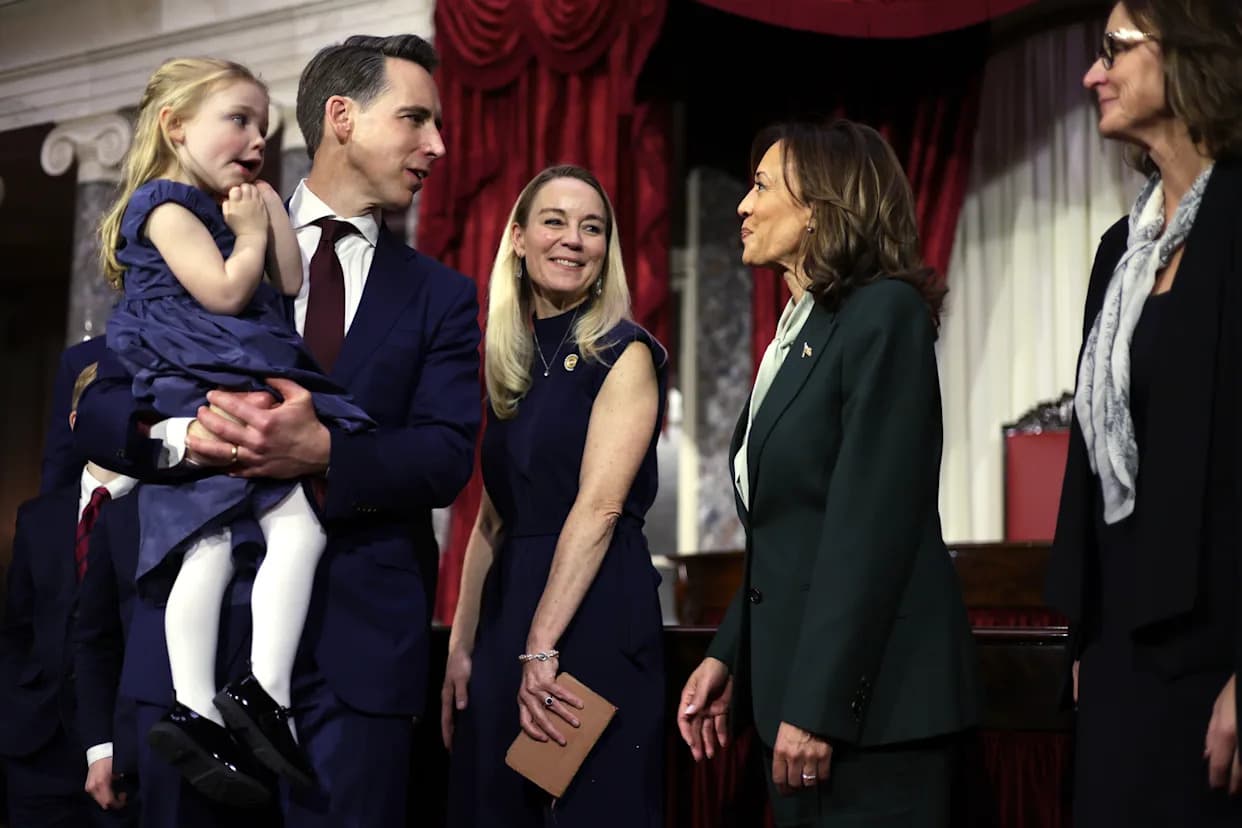
Sen. Josh Hawley (R-MO), his wife Erin Morrow Hawley, and daughter Abigail Hawley, speak with Vice President Kamala Harris on January 3, 2025, in Washington, DC. | Alex Wong/Getty Images
Conservative policymakers frequently say they want more parents—especially mothers—to spend time at home with young children. However, one-off baby bonuses or marginally higher child tax credits are unlikely to trigger a broad shift out of the workforce. A more pragmatic and politically palatable approach is to focus support on low‑income parents by pairing a national paid parental‑leave floor with an unconditional cash allowance for new parents.
Why Target Low‑Income Parents?
Low‑earning parents are the group most likely to reduce paid work in order to care for infants if given financial breathing room. Modest payments can have outsized effects for families with little savings or unstable, low‑paid jobs. Helping these parents choose to spend time at home could also relieve acute shortages in infant care in under‑resourced neighborhoods, improve child development outcomes, and encourage employers to create more family‑friendly workplaces.
Historical Context
U.S. welfare policy has a fraught history of steering poor mothers—especially single mothers of color—into paid work. Early programs and caseworker practices favored white widowed mothers while pressuring Black and nonwhite mothers to take jobs. Later reforms added strict work requirements that pushed many new mothers back into low‑quality, erratic employment, sometimes at the expense of parent–child time and emotional support during early childhood.
What The Evidence Shows
Research does not suggest that mothers' employment inherently harms child development. But studies of welfare‑to‑work mandates found that forced or premature returns to work produced measurable declines in parents' provision of emotional support and in the amount of quality time young children received. The problems identified were not employment per se but (1) being compelled to return before readiness, (2) the incompatibility of low‑wage jobs with infant care (erratic schedules, long commutes), and (3) uneven quality of subsidized child care.
Experimental and quasi‑experimental evidence offers clues about payment levels. The Baby's First Years cash allowance pilot (~$300/month) did not substantially change employment overall, though it reduced paid work during the pandemic peak when families also received enhanced child tax credits. A New Hampshire study that increased monthly benefits to more than $800 for single‑parent families found both better food security and reductions in work—suggesting the scale of support matters and that larger monthly supplements are more likely to let single parents spend more time at home.
Policy Design Recommendations
- Combine Programs: Pair a national paid parental‑leave program with a guaranteed minimum wage replacement and an unconditional cash allowance for new parents.
- Target Generously to Low‑Income Families: Make credits fully refundable so families with little or no taxable income receive payments, and scale amounts higher for single parents and larger families.
- Deliver Early: Ensure payments are available at birth (or shortly thereafter), not only at tax time, so parents without savings can use them immediately.
- Respect Choice: Structure benefits so they neither coerce work nor penalize caregivers—the goal is to expand real options for families.
Feasibility And Political Considerations
Programs targeting low‑income parents have precedent but have struggled with sustainable funding and political classification—neither clearly childcare, traditional paid leave, nor welfare, which can limit champions. Framing payments as compensation for caregiving (not charity) and emphasizing choice and child welfare are strategies that may broaden bipartisan support among those who care about families, neighborhoods, and economic productivity.
“The goal must be to give parents power over critical decisions: whether to work, when to start, whether to choose child care, and what kind of child care,” said economist Chris Herbst.
Conclusion
For conservatives seeking more stay‑at‑home parenting, targeting low‑income families with a paired paid‑leave minimum and unconditional cash allowance is a pragmatic and evidence‑informed route. Carefully designed, refundable, and timely payments—sized to make a real difference for single and low‑income parents—could expand parental choice, improve early childhood experiences, and strengthen communities without rolling back workplace gains for higher‑income women.
Help us improve.