Scientists have reclassified a 1916 New Mexico specimen as a new giant hadrosaur, Ahshislesaurus wimani, estimated at about 40 ft (12 m) long. Cranial features — a relatively flat skull with a low snout crest — distinguish it from related genera and justify the new name. The find suggests duck‑billed dinosaurs were more diverse and temporally overlapping in the last 20 million years of the Cretaceous, helping researchers better understand their evolution and ecosystems.
Nearly 100‑Year‑Old Fossil Reveals New 40‑Foot Duck‑Billed Dinosaur, Ahshislesaurus wimani
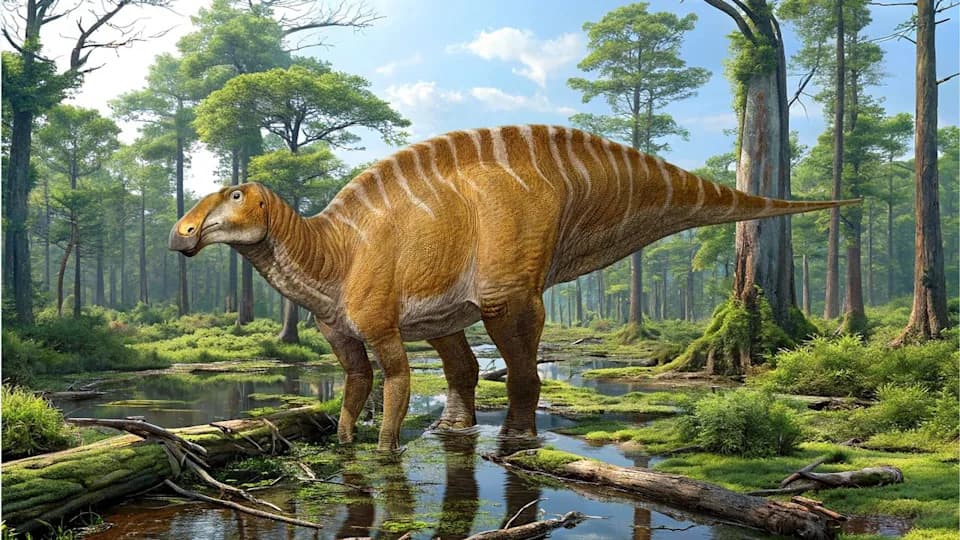
Artist impression ofAhshislesaurus wimani, a giant duck-billed dinosaur that lived approximately 75 million years ago. | Credit: Sergey Krasovskiy/Courtesy of NMMNHS
Researchers have reclassified a nearly century‑old fossil from New Mexico as a previously unrecognized, very large duck‑billed dinosaur: Ahshislesaurus wimani. The specimen — an incomplete skull, lower jaw and several vertebrae collected in 1916 from the Kirtland Formation — is curated at the Smithsonian National Museum of Natural History.
Distinct Skull Features Point to a New Species
The research team, publishing in the Bulletin of the New Mexico Museum of Natural History and Science, concluded that the animal had a relatively flat skull with a low bony crest on the snout. Cranial anatomy was central to the reassessment: skull features differed enough from known hadrosaurid genera to justify naming a new genus and species.
"While this may not be a perfect metaphor, they likely were living in herds and would have been conspicuously present in the environments of northern New Mexico near the end of the Cretaceous," said Steven Jasinski, co‑author and paleontologist at Harrisburg University of Science and Technology.
Size, Age and Taxonomic Context
Ahshislesaurus wimani is estimated to have reached about 40 feet (roughly 12 meters) in length and lived around 75 million years ago during the Late Cretaceous. The fossil had long been assigned to the genus Kritosaurus, but fresh comparisons with other hadrosaurid skulls showed key anatomical differences.
"As a general rule ... skulls are really the basis for identifying differences in animals," said co‑author Anthony Fiorillo, executive director of the New Mexico Museum of Natural History and Science. "When you have a skull and you're noticing differences, that carries more weight than, say, you found a toe bone that looks different from that toe bone."
What This Means for Hadrosaur Diversity
The study suggests hadrosaurids — often nicknamed the "cows of the Cretaceous" because they were common, herd‑living herbivores — were more taxonomically diverse and more temporally overlapping in the final 20 million years of the Cretaceous than previously recognized. Ahshislesaurus appears closely related to Kritosaurus, implying their lineages split not long before this animal lived.
Co‑author Edward Malinzak (Penn State Lehigh Valley) noted that Kritosaurus remains a valid genus, but the reanalyzed specimen shows sufficiently distinct anatomy to merit its own name. Tracking the distribution and duration of such lineages can help paleontologists reconstruct Late Cretaceous ecosystems and the evolutionary history of duck‑billed dinosaurs.
Significance: Reexamining long‑held museum specimens can reveal overlooked diversity and refine our understanding of how related species coexisted and spread across continents during the Late Cretaceous.
Help us improve.